. 2002 Jan;222(1):212-8.
doi: 10.1148/radiol.2221010626.

Correlation of white matter diffusivity and anisotropy with age during childhood and adolescence: a cross-sectional diffusion-tensor MR imaging study

Affiliations

Correlation of white matter diffusivity and anisotropy with age during childhood and adolescence: a cross-sectional diffusion-tensor MR imaging study

Vincent J Schmithorst et al. Radiology. 2002 Jan.

Abstract

Purpose: To evaluate differences in white matter diffusion properties as a function of age in healthy children and adolescents.

Materials and methods: Echo-planar diffusion-tensor magnetic resonance (MR) imaging was performed in 33 healthy subjects aged 5-18 years who were recruited from a functional imaging study of normal language development. Results of neurologic, psychologic, and structural MR imaging examinations were within the normal range for all subjects. The trace of the apparent diffusion coefficient and fractional anisotropy in white matter were correlated as a function of age by using Spearman rank correlation.

Results: Statistically significant negative correlation of the trace of the apparent diffusion coefficient with age was found throughout the white matter. Significant positive correlation of fractional anisotropy with age was found in the internal capsule, corticospinal tract, left arcuate fasciculus, and right inferior longitudinal fasciculus.

Conclusion: Diffusion-tensor MR imaging results indicate that white matter maturation assessed at different ages involves increases in both white matter density and organization during childhood and adolescence. The trace of the apparent diffusion coefficient and fractional anisotropy may reflect different physiologic processes in healthy children and adolescents.


Figures
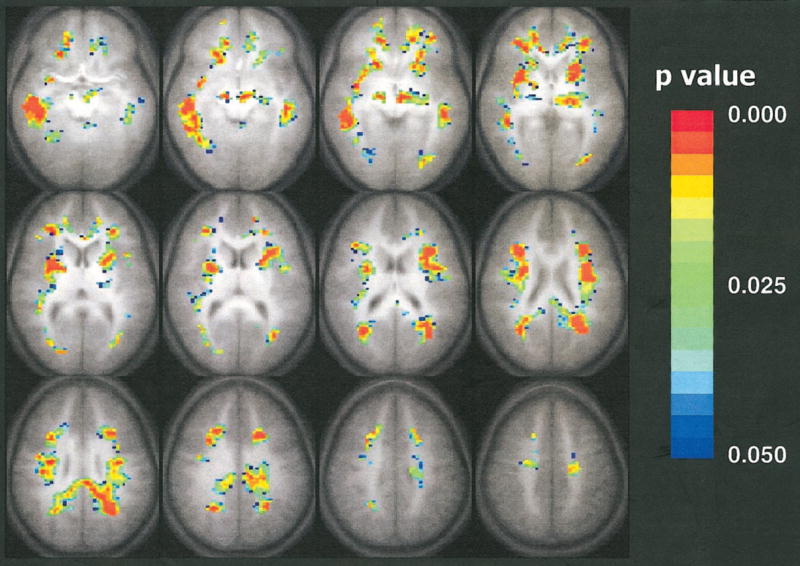
Figure 1
Figure 1
Composite map of the trace of the apparent diffusion coefficient negatively correlated with respect to the age of the subject. Colored pixels have P values less than .05 according to the Spearman rank correlation test, with a cluster size of 15, and are overlaid on the average (n = 33) T1-weighted transverse whole-brain data set. The colors indicate the level of statistical significance from a P value less than .05 (blue) to a P value less than .003 (red). Statistically significant decreases in the trace of the apparent diffusion coefficient with age are shown throughout the white matter. Single-shot spin-echo echo-planar diffusion-tensor MR imaging parameters were as follows: 3,250/80; matrix, 64 × 128; field of view, 19.2 × 25.6 cm; section thickness, 5 mm; Δ, 40 msec; δ, 15 msec. Modified driven-equilibrium Fourier transform whole-brain anatomic imaging parameters were as follows: 18/4.3; matrix, 256 × 128 × 96; field of view, 19.2 × 25.6 × 14.4 cm; τ, 550 msec.
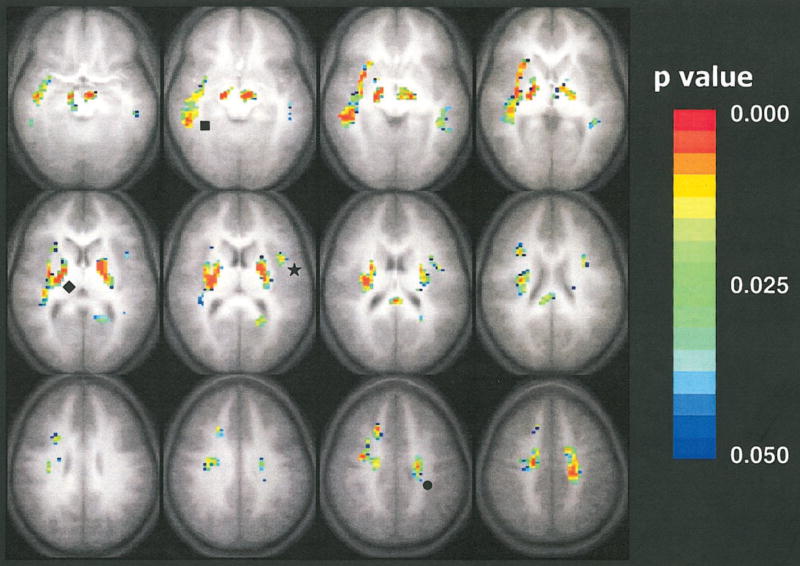
Figure 2
Figure 2
Composite map of fractional anisotropy positively correlated with respect to the age of the subject. Colored pixels have P values less than .05 according to the Spearman rank correlation test, with a cluster size of 15, and are overlaid on the average (n = 33) T1-weighted transverse whole-brain data set. The colors indicate the level of statistical significance from a P value less than .05 (blue) to a P value less than .003 (red). Statistically significant increases in fractional anisotropy with age are shown in the internal capsule (◆), the corticospinal tract (●), the left arcuate fasciculus (★), and the right inferior longitudinal fasciculus (■). Single-shot spin-echo echo-planar diffusion-tensor MR imaging parameters were as follows: 3,250/80; matrix, 64 × 128; field of view, 19.2 × 25.6 cm; section thickness, 5 mm; Δ, 40 msec; δ, 15 msec. Modified driven-equilibrium Fourier transform whole-brain anatomic imaging parameters were as follows: 18/4.3; matrix, 256 × 128 × 96; field of view, 19.2 × 25.6 × 14.4 cm; τ, 550 msec.
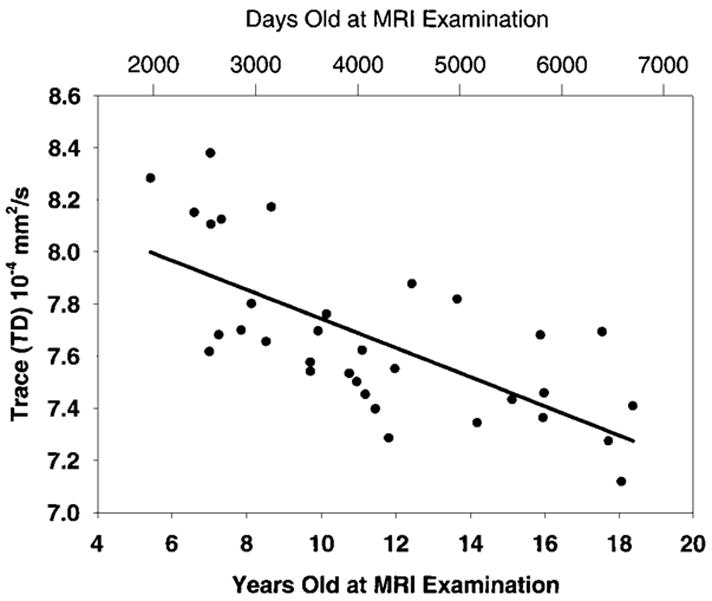
Figure 3
Figure 3
Scatterplot shows correlation of the trace of the apparent diffusion coefficient with age. The Spearman rank correlation coefficient, R, was −0.68, and the P value was less than .001 for all pixels having a significant correlation in the sixth section (middle row, second image from left) of Figure 1.
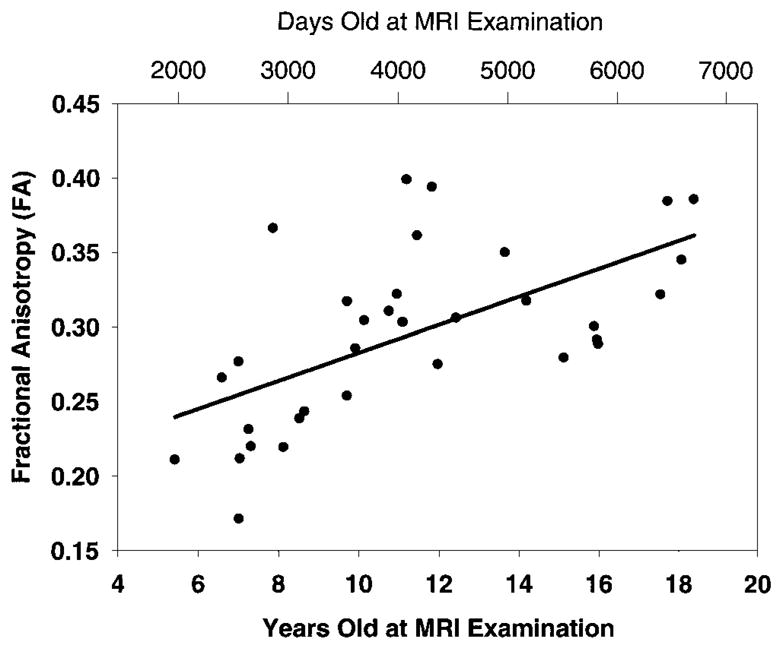
Figure 4
Figure 4
Scatterplot shows correlation of fractional anisotropy with age. The Spearman rank correlation coefficient, R, was 0.65, and the P value was less than .001 for all pixels having significant correlation in the sixth section (middle row, second image from left) of Figure 2.

References

    1. Nakagawa H, Iwasaki S, Kichikawa K, et al. Normal myelination of anatomic nerve fiber bundles: MR analysis. AJNR Am J Neuroradiol. 1998;19:1129 –1136. - PMC - PubMed
    1. Pfefferbaum A, Mathalon DH, Sullivan EV, Rawles JM, Zipursky RB, Lim KO. A quantitative magnetic resonance imaging study of changes in brain morphology from infancy to late adulthood. Arch Neurol. 1994;51:874 –887. - PubMed
    1. Courchesne E, Chisum HJ, Townsend J, et al. Normal brain development and aging: quantitative analysis at in vivo MR imaging in healthy volunteers. Radiology. 2000;216:672–682. - PubMed
    1. Casey BJ, Giedd JN, Thomas KM. Structural and functional brain development and its relation to cognitive development. Biol Psychol. 2000;54:241–257. - PubMed
    1. Huttenlocher PR, Dabholkar AS. Regional differences in synaptogenesis in human cerebral cortex. J Comp Neurol. 1997;387:167–178. - PubMed

Publication types

LinkOut - more resources