. 2002 Mar 15;277(11):9302-6.
doi: 10.1074/jbc.M110516200. Epub 2001 Dec 31.

A human RNA polymerase II-containing complex associated with factors necessary for spliceosome assembly

Affiliations

A human RNA polymerase II-containing complex associated with factors necessary for spliceosome assembly

Francois Robert et al. J Biol Chem. .

Abstract

Transcription and splicing are coordinated processes in mammalian cells. We have used affinity chromatography with immobilized transcription elongation factor SII to purify a protein complex that contains core RNA polymerase II (RNA Pol II), the general transcription initiation factors, and several splicing factors, including the U1, U2, and U4 small nuclear RNPs, the U2AF(65), and serine/arginine-rich proteins. The splicing factors and the transcription machinery co-purify through a gel filtration column and co-immunoprecipitate in experiments using an anti-U2AF(65) antibody, indicating that they are part of a unique complex. Although the RNA Pol II-containing complex does not possess splicing activity, it can complement small nuclear RNP-inactivated extracts and can promote the formation of a pre-spliceosome complex. Because interactions between components of the splicing and transcription machineries occur in the context of a complex containing a hypophosphorylated RNA Pol II capable of initiating transcription, our results suggest that the coupling between transcription and splicing begins before transcription initiation.


Figures
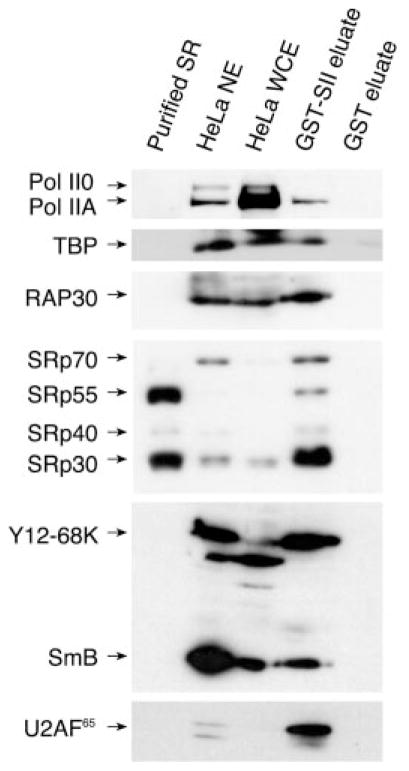
Fig 1
Fig 1. Association of splicing factors with a human RNA Pol II-containing complex
SR proteins, the U2AF65 factor, the Y12-68K polypeptide and Sm proteins co-purify with a RNA Pol II-containing complex on a GST-SII affinity column. Western blot analysis of purified SR proteins (lane 1), HeLa nuclear extract (NE) (lane 2), HeLa whole cell extract (WCE) (lane 3), the GST-SII column eluate (lane 4), and the GST column eluate (lane 5) was performed using antibodies directed against the N terminus of the RPB1 subunit of RNA Pol II (Ab N-20) and detecting both the hypophosphorylated (IIA) and hyperphosphorylated (IIO) forms. Antibodies directed against different general transcription factors were also used (only experiments using anti-TBP and anti-RAP30 are shown). In addition, the monoclonal Ab104 and Y12 antibodies revealed the presence of SR, Sm, and Y12–68K proteins.
Fig. 2
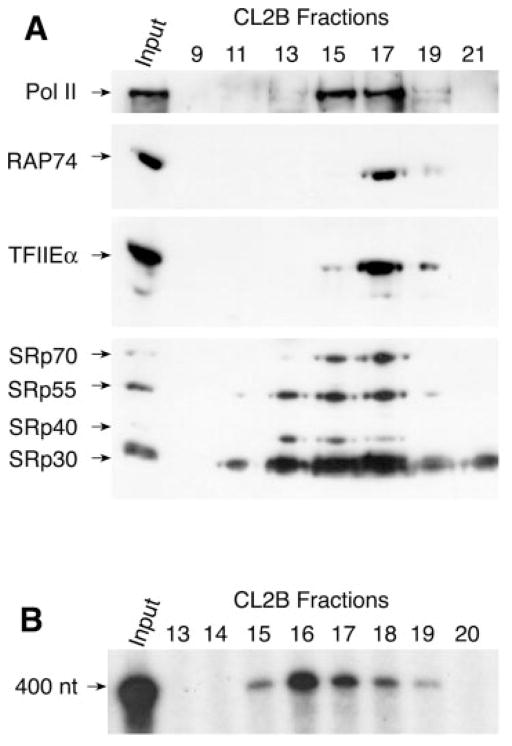
Fig. 2. Co-migration of the SR splicing factors with the RNA Pol II-containing complex and transcriptional activity on a gel filtration column
A, co-purification of SR proteins with the general initiation factors and core RNA Pol II. The GST-SII column eluate was chromatographed through a Sepharose CL2B column, and the resulting concentrated fractions were analyzed by Western blot using antibodies directed against RPB1 (form IIA), RAP74, TFIIEα, and SR proteins. B, the RNA Pol II-containing complex is active in in vitro transcription. The GST-SII column eluate was chromatographed through a Sepharose CL2B gel filtration column, and the resulting fractions were tested in transcription assays in vitro. The position of the run-off transcript (400 nt) is indicated.
Fig. 3
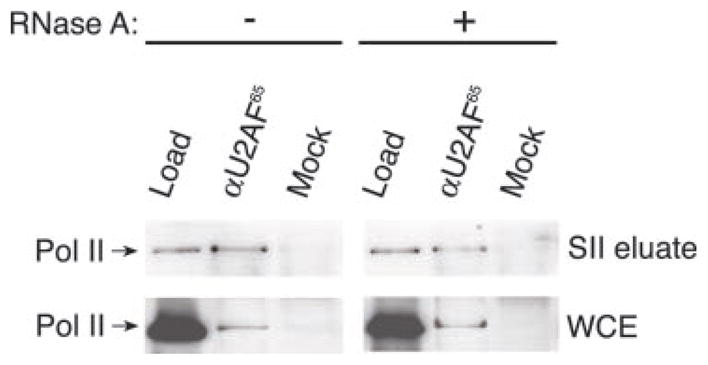
Fig. 3. Immunoprecipitation of the RNA Pol II-containing complex using anti-U2AF65 before, or following, an extensive treatment with RNase A
The SII-column eluate (top panel) and the crude whole cell extract (WCE; bottom panel) were either treated (+) or not treated (−) with RNase A and then immunoprecipitated using either an anti-U2AF65 (αU2AF65) or a pre-immune (Mock) antibody. A proportion (5%) of the loading reactions (Load) and the whole pellets were then analyzed by Western blot using an anti-Pol IIA antibody (Ab 8WG16).
Fig. 4
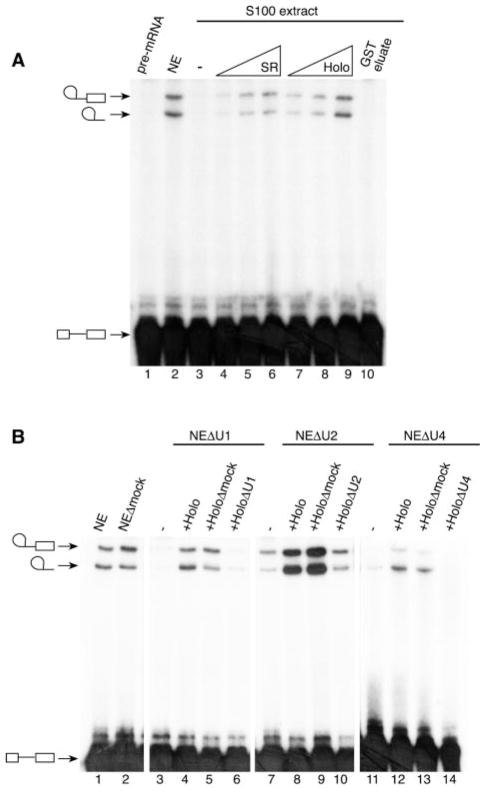
Fig. 4. Functional SR proteins and U1, U2, and U4 snRNPs associated with the RNA Pol II-containing complex
A, the RNA Pol II-containing complex (Holo) can complement the splicing activity of an S100 extract. Splicing reactions were performed using either a HeLa nuclear extract (lane 2) or an S100 extract alone (lane 3), or supplemented with increasing amounts of purified SR proteins (lanes 4–6), the GST-SII column eluate (lanes 7–9), or the GST column eluate (lane 10). Lane 1 contained the pre-mRNA alone. B, the RNA Pol II-containing complex (Holo) can complement the splicing activity of nuclear extracts depleted of U1, U2, and U4 snRNAs. Splicing assays were performed using either an untreated nuclear extract (NE; lane 1) or nuclear extracts depleted using a mock oligonucleotide (NEΔmock; lane 2), the U1-specific oligonucleotide (NEΔU1; lanes 3–6), the U2-specific oligonucleotide (NEΔU2; lanes 7–10), or the U4-specific oligonucleotide (NEΔU4; lanes 11–14). Some reactions were complemented using the RNA Pol II-containing complex (lanes 4, 8, and 12) or the RNA Pol II-containing complex depleted using the mock oligonucleotide (lanes 5, 9, and 13), the U1-specific oligonucleotide (lane 6), the U2-specific oligonucleotide (lane 10), or the U4-specific oligonucleotide (lane 14). The positions of the splicing products are indicated.
Fig. 5
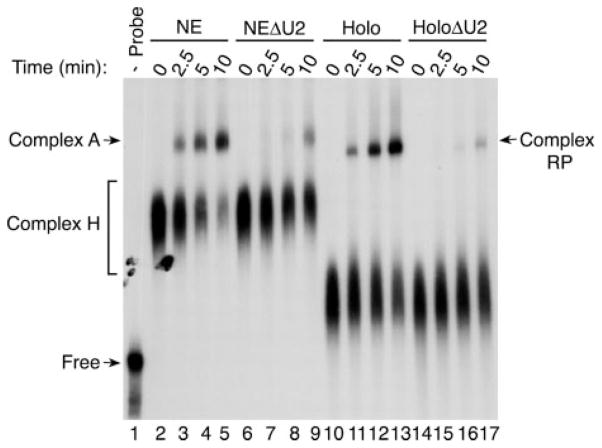
Fig. 5. Efficient formation of a U2-dependent complex by splicing factors associated with the RNA Pol II-containing complex
Nuclear extracts (lanes 2–5) and the RNA Pol II-containing complex (Holo; lanes 10–13) were incubated with an adenovirus pre-mRNA containing a splicing cassette. A nuclear extract (NEΔU2; lanes 6–9) and the RNA Pol II-containing complex (HoloΔU2; lanes 14–17) depleted of snRNA U2 were used as controls. Splicing complex formation was monitored over time as indicated. The positions of the H and A complexes formed in nuclear extracts are indicated. The RNA Pol II-containing complex also leads to the assembly of a U2-dependent complex (RP) that nearly migrates with the A complex.
Fig. 6
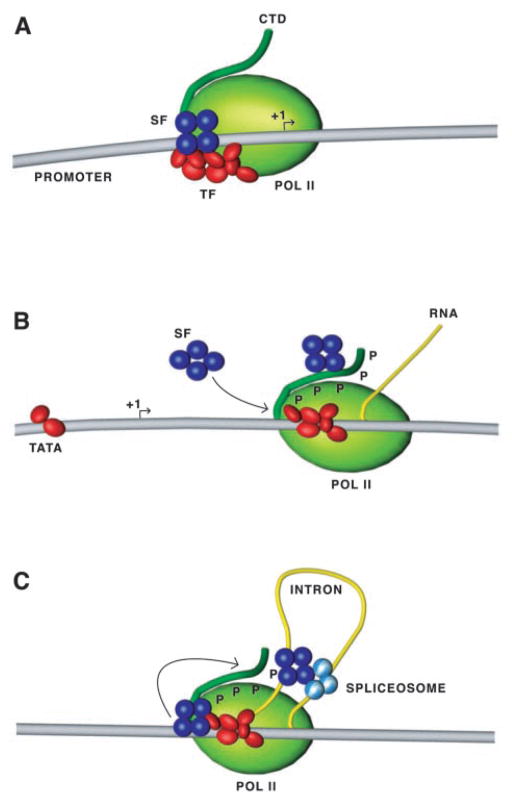
Fig. 6. A model for transcription-coupled splicing
A, splicing factors (SF) involved in pre-spliceosomal complex formation are part of the RNA Pol II-containing complex in association with a non-CTD site located either on a transcription factor (TF) or core RNA Pol II (Pol II). B, after transcription initiation, the CTD of RNA Pol II is phosphorylated, and the splicing factors are transferred to the hyperphosphorylated CTD. The non-CTD site then becomes available for the recruitment of a new set of splicing factors. C, the position of the CTD near the RNA exit channel of RNA Pol II allows binding and unloading of the splicing factors to the nascent transcript and formation of the spliceosome. Splicing factors at the non-CTD site could be transferred to the phosphorylated CTD in preparation for splicing of the next intron.

References

    1. Kramer A. Annu Rev Biochem. 1996;65:367–409. - PubMed
    1. Moore MJ, Query CC, Sharp PA. In: The RNA World: the Nature of Modern RNA Suggests a Prebiotic RNA World. Gesteland RF, Atkins JF, editors. Cold Spring Harbor Laboratory Press; Cold Spring Harbor, NY: 1993. pp. 303–358.
    1. Bauren G, Wieslander L. Cell. 1994;76:183–192. - PubMed
    1. Beyer AL, Yvonne N, Osheim YN. Genes Dev. 1988;2:754–765. - PubMed
    1. Misteli T, Spector DL. Mol Cell. 1999;3:697–705. - PubMed

Publication types

Substances

Grants and funding

LinkOut - more resources