


Precore stop mutant in HBeAg-positive patients with chronic hepatitis B: clinical characteristics and correlation with the course of HBeAg-to-anti-HBe seroconversion
- PMID: 11773086
- PMCID: PMC120083
- DOI: 10.1128/JCM.40.1.16-21.2002
Precore stop mutant in HBeAg-positive patients with chronic hepatitis B: clinical characteristics and correlation with the course of HBeAg-to-anti-HBe seroconversion
Abstract
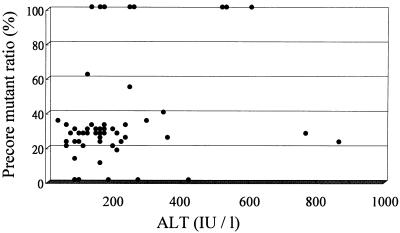
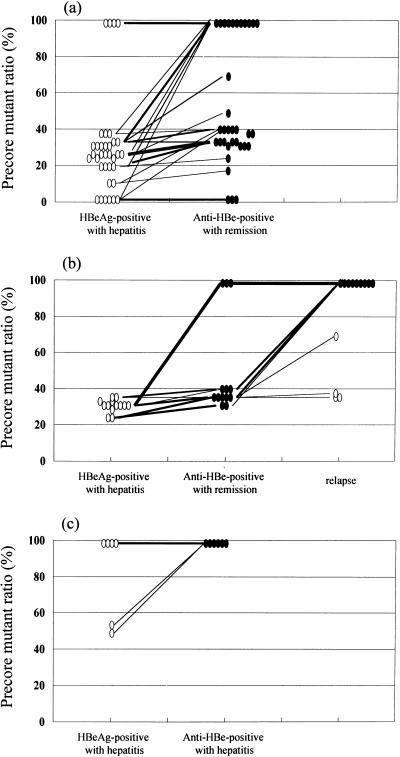
This study aimed to investigate the ratios of precore stop mutant (codon 28; TGG to TAG) to total viremia in 53 HBeAg-positive patients with chronic hepatitis B by amplification-created restriction site assays along the course of HBeAg-to-anti-HBe seroconversion. At baseline, 11% had exclusive wild-type hepatitis B virus (HBV), 15% had exclusively precore mutant, and 74% had mixed viral strains. Precore mutant ratios correlated little with age, sex, or HBV DNA levels (all P > 0.1), but correlated modestly with alanine aminotransferase (ALT) levels (P = 0.05). The intervals from presentation to anti-HBe seroconversion correlated significantly with ALT and precore mutant ratios in univariate analysis but with only precore mutant ratios in multivariate analysis (P = 0.003). Precore mutant ratios at baseline were significantly higher (P < 0.001) in six patients with persistent high viremia and ALT elevation after anti-HBe seroconversion (group 1) than in 47 with remission (group 2). All group 1 patients had exclusive precore mutant after anti-HBe seroconversion, as did only 14 (30%) of the group 2 patients (P = 0.003). Among group 2 patients, precore mutant ratios at baseline or after anti-HBe seroconversion showed no significant difference between 34 patients with sustained remission and 13 with relapse. Cirrhosis developed in 50% (5 of 10) of patients with precore mutant ratios >50% at baseline but only in 12% (5 of 43) of those with precore mutant ratios of <50% at baseline (P < 0.05). In conclusion, precore mutant of variable ratios was frequently detected in HBeAg-positive patients with chronic hepatitis B. Precore mutant ratios tended to correlate with ALT levels and anti-HBe seroconversion, but high precore mutant ratios were associated with persistent hepatitis after anti-HBe seroconversion and increased risk of cirrhosis.
Figures
References
-
- Akahane, Y., T. Yamanaka, H. Suzuki, Y. Sugri, F. Tsuda, S. Yotsumoto, S. Omi, H. Okamoto, Y. Miyakawa, and M. Mayumi. 1990. Chronic active hepatitis with hepatitis B virus DNA and antibody against e antigen in the serum. Gastroenterology 90:1113–1119. - PubMed
-
- Bonino, F., F. Rosina, M. Rizzetto, R. Rizzi, E. Chiaberge, R. Tardanico, F. Callea, and G. Verme. 1986. Chronic hepatitis in HBsAg carriers with serum HBV-DNA and anti-HBe. Gastroenterology 90:1268–1273. - PubMed
-
- Brook, M. G., P. Karayiannis, and H. C. Thomas. 1989. Which patients with chronic hepatitis B virus infection will respond to alpha-interferon therapy? A statistical analysis of predictive factors. Hepatology 10:761–763. - PubMed
-
- Brunetto, M. R., M. Stemler, F. Schodel, H. Will, A. Ottobrelli, M. Rizzetto, G. Verme, and F. Bonino. 1989. Identification of HBV variants which cannot produce precore-derived HBeAg and may be responsible for severe hepatitis. Ital. J. Gastroenterol. 21:151–154.
-
- Brunetto, M. R., M. Giarin, G. Saracco, F. Oliver, P. Calvo, G. Capra, A. Randone, M. L. Abate, P. Manzini, and M. Capalbo. 1993. Hepatitis B virus unable to secrete e antigen and response to interferon in chronic hepatitis B. Gastroenterology 105:846–850. - PubMed
Publication types
MeSH terms
Substances
LinkOut - more resources
Full Text Sources
Medical
