Development and validation of a PCR-based enzyme-linked immunosorbent assay with urine for use in clinical research settings to detect Trichomonas vaginalis in women
- PMID: 11773098
- PMCID: PMC120133
- DOI: 10.1128/JCM.40.1.89-95.2002
Development and validation of a PCR-based enzyme-linked immunosorbent assay with urine for use in clinical research settings to detect Trichomonas vaginalis in women
Abstract
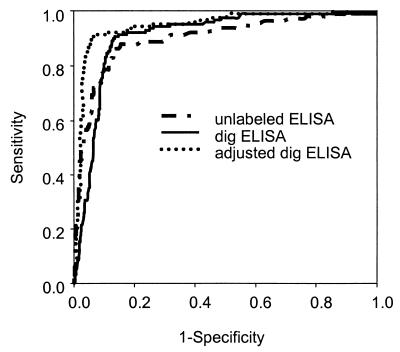
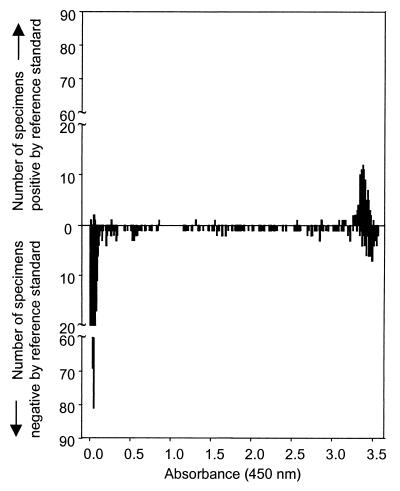
Trichomonas vaginalis infection is highly prevalent worldwide and is associated with poor birth outcomes and enhanced human immunodeficiency virus transmission. Traditional detection methods rely on microscopic examination of vaginal specimens (wet mount) and culture, which can be insensitive and time-consuming. More than 3,000 women attending two sexually transmitted disease clinics were enrolled in this cross-sectional study to evaluate urine-based PCR for detection of T. vaginalis using a combined reference standard of wet mount and culture from vaginal swab. The prevalence of trichomoniasis in the population was 16.7% (502 of 3,009 women) using the reference standard. PCR with urine combined with agarose gel-based detection was 66.9% sensitive and 98.3% specific compared to the reference standard. Detection of PCR products using an unlabeled enzyme-linked immunosorbent assay (ELISA) improved the sensitivity to 86.4%, but specificity fell to 86.1%. Using a digoxigenin-labeled ELISA for detection of amplified T. vaginalis DNA from urine, the sensitivity and specificity of the PCR improved to 90.8 and 93.4%, respectively, compared to wet mount or culture from vaginal swabs. For clinical research settings in which vaginal specimens are not available and culture conditions are not feasible, urine-based PCR-ELISA may be useful for the detection of trichomoniasis in women.
Figures
References
-
- Carroll, K. C., W. E. Aldeen, M. Morrison, R. Anderson, D. Lee, and S. Mottice. 1998. Evaluation of the Abbott LCx ligase chain reaction assay for detection of Chlamydia trachomatis and Neisseria gonorrhoeae in urine and genital swab specimens from a sexually transmitted disease clinic population. J. Clin. Microbiol. 36:1630–1633. - PMC - PubMed
-
- Cohen, M. S., I. F. Hoffman, R. A. Royce, P. Kazembe, J. R. Dyer, C. Costello Daly, D. Zimba, P. L. Vernazza, M. Maida, S. A. Fiscus, and J. J. Eron. 1997. Reduction of concentration of HIV-1 in semen after treatment of urethritis: implications for prevention of sexual transmission of HIV-1. Lancet 349:1868–1875. - PubMed
-
- Cotch, M. F., J. G. Pastorek II, R. P. Nugent, S. L. Hillier, R. S. Gibbs, D. H. Martin, D. A. Eschenbach, R. Edelman, J. C. Carey, J. A. Regan, M. A. Krohn, M. A. Klebanoff, A. V. Rao, and G. G. Rhoads. 1997. Trichomonas vaginalis associated with low birth weight and preterm delivery. The Vaginal Infections and Prematurity Study Group. Sex. Transm. Dis. 24:353–360. - PubMed
-
- Fouts, A. C., and S. J. Kraus. 1980. Trichomonas vaginalis: reevaluation of its clinical presentation and laboratory diagnosis. J. Infect. Dis. 141:137–143. - PubMed
-
- Hadgu, A. 1996. The discrepancy in discrepant analysis. Lancet 348:592–593. - PubMed
Publication types
MeSH terms
Substances
Grants and funding
LinkOut - more resources
Full Text Sources
Other Literature Sources
Medical