


Retroviral vectors produced in the cytoplasmic vaccinia virus system transduce intron-containing genes
- PMID: 11773399
- PMCID: PMC135843
- DOI: 10.1128/jvi.76.3.1236-1243.2002
Retroviral vectors produced in the cytoplasmic vaccinia virus system transduce intron-containing genes
Abstract
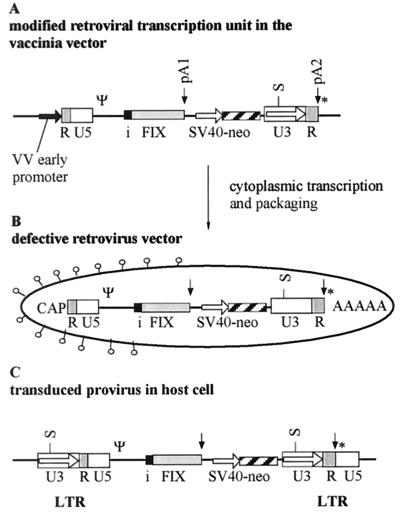
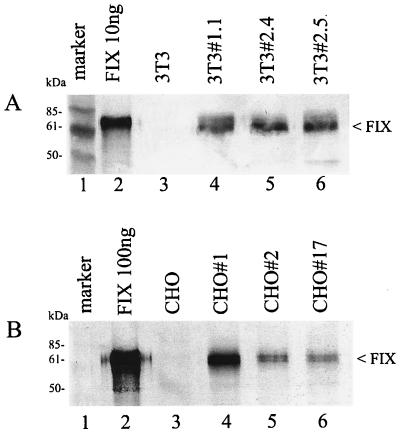
Introns and polyadenylation (pA) sites are known to improve transcript stability and nuclear-cytoplasmic transport and are normally present in efficient gene expression vectors. Standard retroviral vectors, however, do not allow the inclusion of such sequence elements, as mRNA processing at internal splice and pA sites interferes with the production of functional full-length vector genomes. In this report we examined the capability of hybrid vaccinia/retroviral vectors to transduce complex gene cassettes with nuclear RNA processing signals within the retroviral genome. A retroviral vector was constructed that contains a gene of interest (the human coagulation factor IX [FIX] cDNA), including an intron and an internal pA site. The modified proviral vector genome was cloned downstream of a vaccinia virus promoter and was inserted into the vaccinia virus genome. Infection of a packaging cell line with the recombinant vaccinia virus vector resulted in secretion of retroviral particles at average titers of 10(5) CFU per ml of cell culture supernatant. Due to the cytoplasmic transcription and the nonrecognition of nuclear transcription signals in the vaccinia virus system, full-length transcripts were obtained that still contained the intron. In the retrovirally transduced cell lines the FIX transcripts were terminated at the internal pA site. The transcripts were quantitatively spliced, and FIX was secreted. Recombinant cell lines with stable single-copy inserts containing sequence elements necessary for efficient gene function could be generated. Thus, a relatively simple cytoplasmic system for the generation of complex retroviral vectors is described. Retroviral vectors transducing intron-containing gene cassettes may play a further role in gene therapy applications.
Figures
References
-
- Abonour, R., D. A. Williams, L. Einhorn, K. M. Hall, J. Chen, J. Coffman, C. M. Traycoff, A. Bank, I. Kato, M. Ward, S. D. Williams, R. Hromas, M. J. Robertson, F. O. Smith, D. Woo, B. Mills, E. F. Srour, and K. Cornetta. 2000. Efficient retrovirus-mediated transfer of the multidrug resistance 1 gene into autologous human long-term repopulating hematopoietic stem cells. Nat. Med. 6:652–658. - PubMed
-
- Andreadis, S. T., C. M. Roth, J. M. Le Doux, J. R. Morgan, and M. L. Yarmush. 1999. Large-scale processing of recombinant retroviruses for gene therapy. Biotechnol. Prog. 15:1–11. - PubMed
-
- Barrett, P. N., A. Mitterer, W. Mundt, J. Eibl, M. Eibl, R. C. Gallo, B. Moss, and F. Dorner. 1989. Large-scale production and purification of a vaccinia recombinant-derived HIV-1 gp160 and analysis of its immunogenicity. AIDS Res. Hum. Retrovir. 5:159–171. - PubMed
MeSH terms
Substances
LinkOut - more resources
Full Text Sources
Other Literature Sources
