


Comment
doi: 10.1073/pnas.022641699.
Bacterial chemotaxis and the question of gain
Affiliations
- PMID: 11782543
- PMCID: PMC117503
- DOI: 10.1073/pnas.022641699
Item in Clipboard
Comment
Bacterial chemotaxis and the question of gain
Proc Natl Acad Sci U S A.
.
No abstract available
Figures
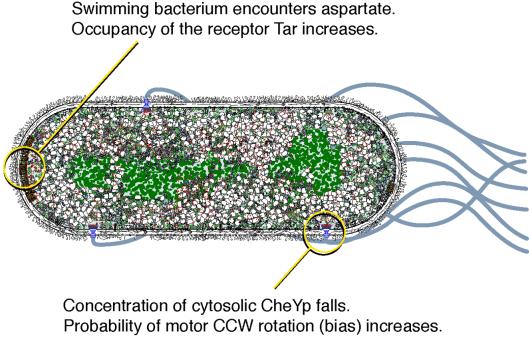
Chemotactic gain. If an E. coli cell swims into the
attractant molecule aspartate, this will lead to an increase in the
occupancy of aspartate receptors, typically clustered at
one end of the cell, as shown here. A cascade of signal transduction
events then leads to a fall in the cytosolic concentration of the
protein CheYp, which diffuses to one of the flagellar motors. A fall in
CheYp concentration at the motor increases the probability that it will
turn in a counterclockwise direction, causing the bacterium to persist
in this favorable direction. The probability that a motor turns
counterclockwise is expressed as the rotational bias.
The chemotactic gain, which is the subject of this
commentary, is simply the change in bias divided by the change in
occupancy.
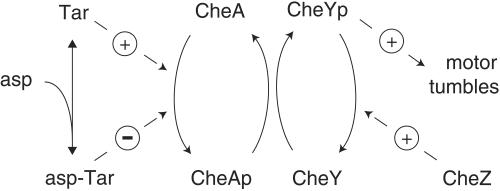
Excitatory signal cascade. That portion of the signal cascade that
relays a change in aspartate binding to a change in swimming behavior
is shown in simplified form. Reactions responsible for adaptation are
omitted for clarity. Tar is the receptor that binds aspartate (asp);
CheA is the autophosphorylating kinase; CheY is the response regulator.
After phosphorylation by CheA, CheYp diffuses to the six or so
flagellar motors, increasing the likelihood that they turn clockwise
and thereby initiate a tumble. CheZ is a protein that interacts with
CheYp and stimulates its dephosphorylation. For further details see
ref. .
Comment on
-
Receptor sensitivity in bacterial chemotaxis.Proc Natl Acad Sci U S A. 2002 Jan 8;99(1):123-7. doi: 10.1073/pnas.011589998. Epub 2001 Dec 11. Proc Natl Acad Sci U S A. 2002. PMID: 11742065 Free PMC article.
References
-
- Berg H C, Brown D A. Nature (London) 1972;239:500–504. - PubMed
Publication types
MeSH terms
Substances
LinkOut - more resources
Full Text Sources
