. 2002 Feb;22(3):750-61.
doi: 10.1128/MCB.22.3.750-761.2002.

A novel RNA polymerase I transcription initiation factor, TIF-IE, commits rRNA genes by interaction with TIF-IB, not by DNA binding

Affiliations

A novel RNA polymerase I transcription initiation factor, TIF-IE, commits rRNA genes by interaction with TIF-IB, not by DNA binding

Anna Maria Al-Khouri et al. Mol Cell Biol. 2002 Feb.

Abstract

In the small, free-living amoeba Acanthamoeba castellanii, rRNA transcription requires, in addition to RNA polymerase I, a single DNA-binding factor, transcription initiation factor IB (TIF-IB). TIF-IB is a multimeric protein that contains TATA-binding protein (TBP) and four TBP-associated factors that are specific for polymerase I transcription. TIF-IB is required for accurate and promoter-specific initiation of rRNA transcription, recruiting and positioning the polymerase on the start site by protein-protein interaction. In A. castellanii, partially purified TIF-IB can form a persistent complex with the ribosomal DNA (rDNA) promoter while homogeneous TIF-IB cannot. An additional factor, TIF-IE, is required along with homogeneous TIF-IB for the formation of a stable complex on the rDNA core promoter. We show that TIF-IE by itself, however, does not bind to the rDNA promoter and thus differs in its mechanism from the upstream binding factor and upstream activating factor, which carry out similar complex-stabilizing functions in vertebrates and yeast, respectively. In addition to its presence in impure TIF-IB, TIF-IE is found in highly purified fractions of polymerase I, with which it associates. Renaturation of polypeptides excised from sodium dodecyl sulfate-polyacrylamide gels showed that a 141-kDa polypeptide possesses all the known activities of TIF-IE.


Figures
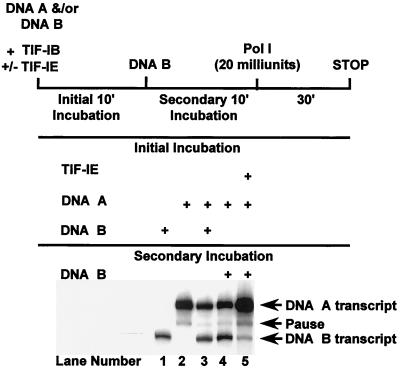
FIG. 1.
FIG. 1.
TIF-IE is required along with glycerol gradient-purified TIF-IB to form a committed complex on the rDNA promoter. Template commitment assays of glycerol gradient-purified TIF-IB alone (lane 4) or with the addition of TIF-IE (lane 5) were performed as described in Materials and Methods. DNA A (pEBH10/NdeI) and DNA B (pAr6/HindIII) produced 309- and 240-nucleotide runoff RNAs, respectively (lanes 1, 2, and 3). The RNA transcripts synthesized from DNA A and DNA B in lanes 3, 4, and 5 were quantified, and their ratios (A/B) in each of these lanes are 1.1, 1.4, and 20.4, respectively. Components used for the initial or secondary incubation are indicated.
FIG. 2.
FIG. 2.
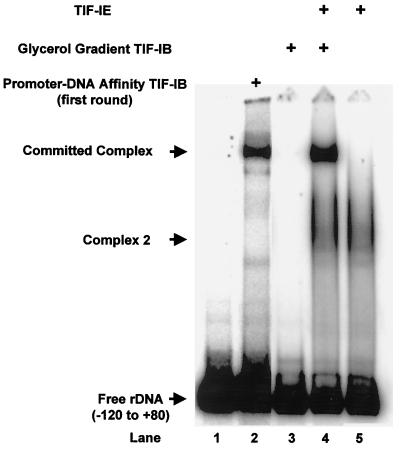
TIF-IE is required along with glycerol gradient-purified TIF-IB for the formation of a stable complex on the rDNA promoter. EMSAs on the rRNA promoter of TIF-IB purified through one round of promoter-DNA affinity chromatography (lane 2), of glycerol gradient-purified TIF-IB alone (lane 3), of TIF-IB in the presence of TIF-IE (lane 4), and of TIF-IE alone (lane 5) were performed as described in Materials and Methods. Lane 1, probe DNA alone.
FIG. 3.
FIG. 3.
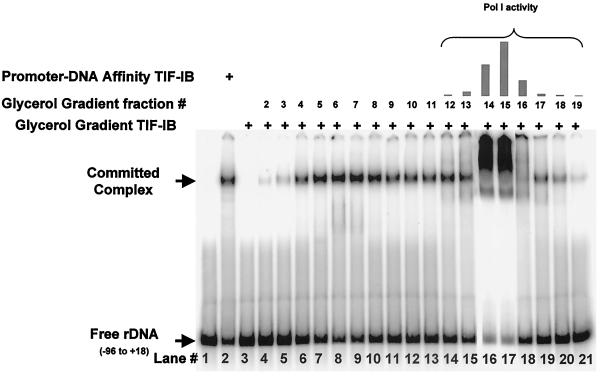
Rate zonal sedimentation of TIF-IE in a glycerol gradient. Shown are results of EMSAs on the rRNA promoter of promoter-DNA affinity-purified TIF-IB (lane 2) and of glycerol gradient-purified TIF-IB alone (lane 3) or with 0.5 μl of fractions 2 to 19 from a glycerol gradient sedimentation of Pol I (lanes 4 to 21). The bar graph above lanes 14 to 21 shows nonspecific Pol I activity in the fractions.
FIG. 4.
FIG. 4.
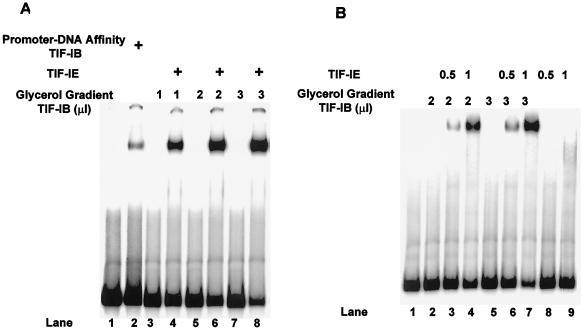
Stimulation of TIF-IB binding in an EMSA by TIF-IE is dose dependent. (A) Lane 1 is the probe DNA alone; lane 2 has added promoter-DNA affinity column-purified TIF-IB. Lanes 3, 5, and 7 have increasing amounts of glycerol gradient-purified TIF-IB alone; lanes 4, 6, and 8 are the same with 0.5 μl of TIF-IE added. (B) EMSAs of glycerol gradient-purified TIF-IB alone (lanes 2 and 5) or with increasing amounts of TIF-IE, as indicated (lanes 3, 4, 6, and 7). Lanes 8 and 9 contain the indicated amounts of TIF-IE alone.
FIG. 5.
FIG. 5.
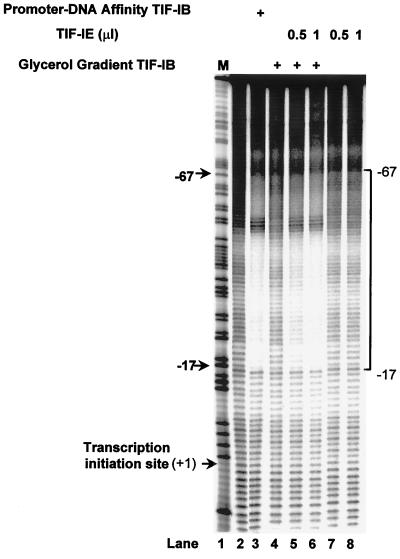
TIF-IE is required along with glycerol gradient-purified TIF-IB for the formation of a footprint on the rDNA, and its effect is dose dependent. Shown are MPE · Fe(II) footprints of the template strand of the rRNA promoter. DNA was preincubated either with promoter-DNA affinity-purified TIF-IB (lane 3), with glycerol gradient-purified TIF-IB alone (lane 4), with glycerol gradient-purified TIF-IB and increasing amounts of TIF-IE (lanes 5 and 6), or with TIF-IE alone (lanes 7 and 8) before MPE · Fe(II) treatment. The previously determined footprint (−17 to −67) of the committed complex is indicated. M, marker lane; lane 2, probe DNA alone, treated with MPE · Fe(II) as described in Materials and Methods.
FIG. 6.
FIG. 6.
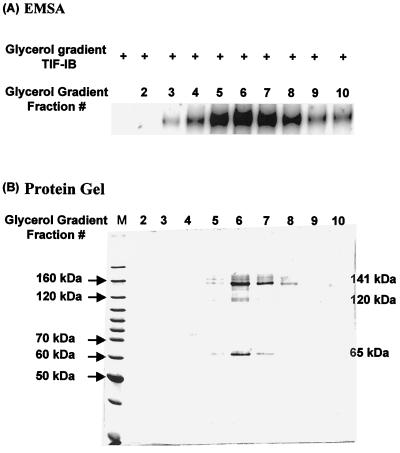
Three major polypeptides with relative molecular sizes of 65, 120, and 141 kDa consistently sedimented with TIF-IE activity. (A) EMSA showing complexes formed between glycerol gradient-purified TIF-IB and 0.5 μl of glycerol gradient fractions of Pol I (fractions 2 to 10) on an rDNA promoter fragment (−120 to +80). (B) SDS-10% polyacrylamide gel of 40 μl of the glycerol gradient fractions assayed in panel A, stained with Coomassie blue. Molecular masses of markers are shown on the left, and estimated molecular masses of the three prominent polypeptides are shown on the right.
FIG. 7.
FIG. 7.
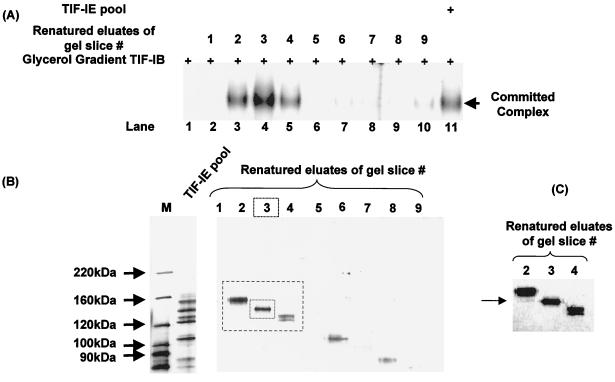
TIF-IE has an apparent molecular mass of 141 kDa. (A) EMSAs showing complexes formed between the rRNA promoter and glycerol gradient-purified TIF-IB either alone (lane 1), with the renatured eluates of gel slices 1 to 9 (lanes 2 to 10), or with the TIF-IE applied to the SDS gel (lane 11). (B) SDS-6% polyacrylamide gel of the renatured eluates of gel slices 1 to 9 assayed in panel A, stained with silver. (C) Higher-sensitivity image of the region of the SDS-polyacrylamide gel boxed in panel B, showing polypeptides in eluates of gel slices 2 to 4. Arrow indicates the presence of a small amount of the 141-kDa polypeptide in gel slice 2.
FIG. 8.
FIG. 8.
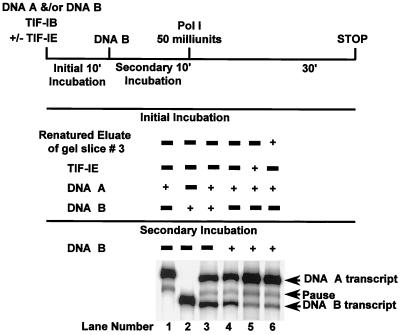
The 141-kDa renatured polypeptide is able to confer commitment on glycerol gradient-purified TIF-IB. A template commitment assay was run as described for Fig. 1. Glycerol gradient-purified TIF-IB either alone (lane 4), with 1 μl of TIF-IE (lane 5), or with 5 μl of the 141-kDa renatured eluate of gel slice 3 (lane 6) was used in the assay. The RNA transcripts synthesized from DNA A and DNA B in lanes 3, 4, 5, and 6 were quantified, and their ratios (A/B) in each of these lanes are 1.7, 2.3, 11.96, and 8.3, respectively.
FIG. 9.
FIG. 9.
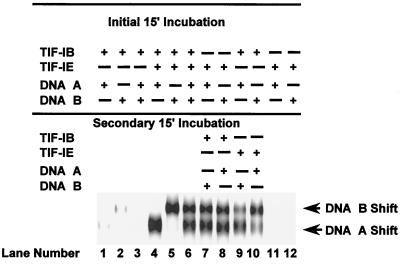
The initial binding of TIF-IE to the rRNA promoter is not required for the recruitment of homogeneous TIF-IB. EMSAs show complexes formed during the initial incubation period between DNA A and TIF-IB either alone (lane 1) or with TIF-IE (lane 4); between DNA B and TIF-IB either alone (lane 2) or with TIF-IE (lane 5); or between both DNA templates and TIF-IB either alone (lane 3) or with TIF-IE (lane 6). EMSAs in lanes 7 to 10 show the effects of order of addition of the different factors and DNA templates on complex formation, as indicated above the lanes. EMSAs of TIF-IE alone with DNA A and DNA B are shown in lanes 11 and 12, respectively. The complexes formed in lanes 6, 7, 8, 9, and 10 on both templates were quantified, and their ratios (B/A) in each of these lanes are 0.89, 0.84, 0.76, 0.5, and 1.9, respectively.
FIG. 10
FIG. 10
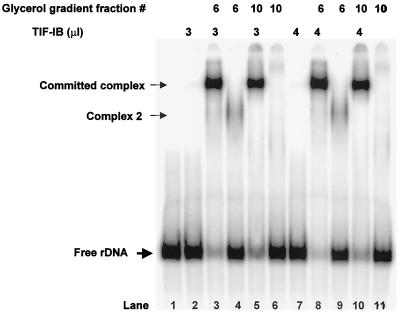
TIF-IE activity does not correlate with the DNA-binding activity (complex 2) found in impure fractions. Shown are EMSAs of glycerol gradient-purified TIF-IB alone (lanes 2 and 7) or with 0.5 or 0.7 μl of glycerol gradient fractions 6 and 10 (Fig. 1), respectively (lanes 3, 5, 8, and 10). EMSAs of 0.5 and 0.7 μl of glycerol gradient fractions 6 and 10 in the absence of TIF-IB are shown in lanes 4, 6, 9, and 11. Complex 2 is a protein-rRNA promoter DNA complex formed by a contaminating protein in fraction 6.
FIG. 11
FIG. 11
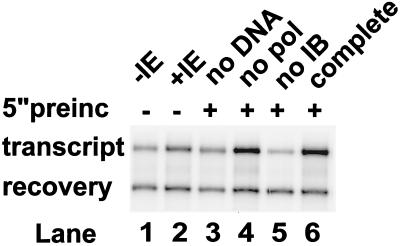
Transcriptional stimulation by TIF-IE requires preincubation with TIF-IB and DNA and does not require nucleoside triphosphates. Various combinations of transcriptional components were preincubated (preinc) (lanes 3 to 6) or not preincubated (lanes 1 and 2) for 5 min prior to initiation of transcription by addition of the missing component(s) plus nucleoside triphosphates. Transcription proceeded for 2 min before the reaction was stopped and the RNA products were processed as described in Materials and Methods.

References

    1. Aprikian, P., B. Moorefield, and R. H. Reeder. 2001. New model for the yeast RNA polymerase I transcription cycle. Mol. Cell. Biol. 21:4847–4855. - PMC - PubMed
    1. Bachvarov, D., and T. Moss. 1991. The RNA polymerase I transcription factor xUBF contains 5 tandemly repeated HMG homology boxes. Nucleic Acids Res. 19:2331–2335. - PMC - PubMed
    1. Bachvarov, D., M. Normandeau, and T. Moss. 1991. Heterogeneity in the Xenopus ribosomal transcription factor xUBF has a molecular basis distinct from that in mammals. FEBS Lett. 288:55–59. - PubMed
    1. Bateman, E., L. Hoffman, C. Iida, W. Kubaska, P. Kownin, P. Risi, M. Zwick, and M. R. Paule. 1989. Eukaryotic RNA polymerase I binds to promoters by protein-protein interactions and melts DNA in a separate step following binding, p.259–269. In T. Cech and J. Gralla (ed.), Molecular biology of RNA- and DNA-protein interactions in transcription. Alan R. Liss, Inc., New York, N.Y.
    1. Bateman, E., C. T. Iida, P. Kownin, and M. R. Paule. 1985. Footprinting of ribosomal RNA genes by transcription initiation factor and RNA polymerase I. Proc. Natl. Acad. Sci. USA 82:8004–8008. - PMC - PubMed

Publication types

MeSH terms

LinkOut - more resources