. 2002 Jan;135(1):37-47.
doi: 10.1038/sj.bjp.0704458.

Magnolol attenuates VCAM-1 expression in vitro in TNF-alpha-treated human aortic endothelial cells and in vivo in the aorta of cholesterol-fed rabbits

Affiliations

Magnolol attenuates VCAM-1 expression in vitro in TNF-alpha-treated human aortic endothelial cells and in vivo in the aorta of cholesterol-fed rabbits

Yung-Hsiang Chen et al. Br J Pharmacol. 2002 Jan.

Abstract

1. In a previous study, we showed that magnolol, a potent antioxidant derived from a Chinese herb, attenuates monocyte chemotactic protein-1 (MCP-1) expression and intimal hyperplasia in the balloon-injured aorta of cholesterol-fed rabbits. Expression of cell adhesion molecules by the arterial endothelium and the attachment of leukocytes to the endothelium may play a major role in atherosclerosis. In the present study, the effects of magnolol on the expression of endothelial-leukocyte adhesion molecules and the activation of nuclear factor kappa B (NF-kappa B) in tumour necrosis factor-alpha (TNF-alpha)-treated human aortic endothelial cells (HAECs) were investigated. 2. Pretreatment of HAECs with magnolol (5 microM) significantly suppressed the TNF-alpha-induced expression of vascular cell adhesion molecule-1 (VCAM-1) (64.8+/-1.9%), but had no effect on the expression of intercellular cell adhesion molecule-1 and endothelial cell selectin. 3. Magnolol (5 and 10 microM) significantly reduced the binding of the human monocytic cell line, U937, to TNF-alpha-stimulated HAECs (58.4 and 56.4% inhibition, respectively). Gel shift assays using the (32)P-labelled NF-kappa B consensus sequence as probe showed that magnolol pretreatment reduced the density of the shifted bands seen after TNF-alpha-induced activation. Immunoblot analysis and immunofluorescence staining of nuclear extracts demonstrated a 58% reduction in the amount of NF-kappa B p65 in the nuclei in magnolol-treated HAECs. Magnolol also attenuated intracellular H(2)O(2) generation in both control and TNF-alpha treated HAECs. 4. Furthermore, in vivo, magnolol attenuates the intimal thickening and TNF-alpha and VCAM-1 protein expression seen in the thoracic aortas of cholesterol-fed rabbits. 5. Taken together, these data demonstrate that magnolol inhibits TNF-alpha-induced nuclear translocation of NF-kappa B p65 and thereby suppresses expression of VCAM-1, resulting in reduced adhesion of leukocytes. These results suggest that magnolol has anti-inflammatory properties and may play important roles in the prevention of atherosclerosis and inflammatory responses in vivo.


Figures
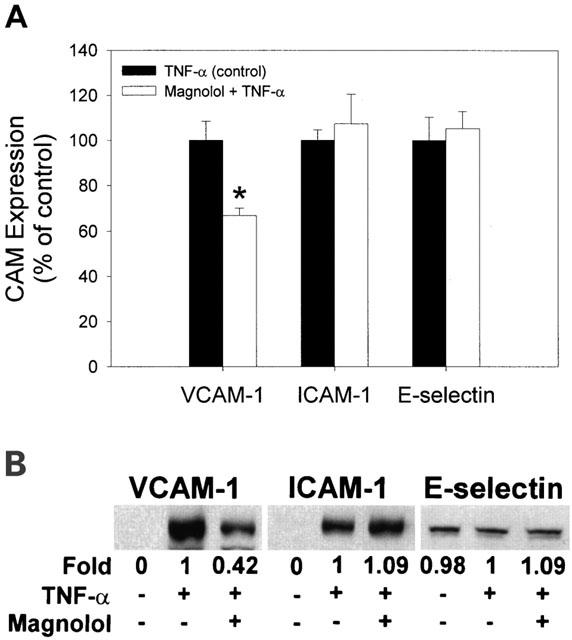
Figure 1
Figure 1
Effect of magnolol on adhesion molecule expression in HAECs. (A) Control cells or cells pretreated for 18 h with magnolol were treated for 6 h with TNF-α (2 ng ml−1), and expression of the adhesion molecules, VCAM-1, ICAM-1, and E-selectin, was measured by cell-ELISA. Data are expressed as the mean±s.e.mean of three experiments performed in triplicate. * P<0.05 compared to TNF-α-treated HAECs (controls). (B) Western blot analysis of VCAM-1, ICAM-1, and E-selectin protein levels in cultured HAECs. Three independent experiments gave similar results.
Figure 2
Figure 2
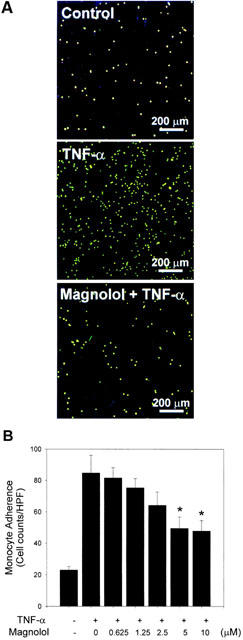
Effects of magnolol on the adhesion of U937 cells to TNF-α-stimulated HAECs. Control or HAEC cells pretreated for 18 h with magnolol were incubated with TNF-α (2 ng ml−1 for 6 h). (A) Representative fluorescent photomicrographs showing the effect of pretreatment with 5 μM magnolol on the TNF-α-induced adhesion of fluorescein-labelled U937 cells to HAECs. (B) Confluent HAECs were preincubated with the indicated concentration of magnolol, then incubated with TNF-α for 6 h. The data are representative of three experiments and the values are reported as the mean number of U937 cells bound per high power field (HPF)±s.e.mean. *P<0.05 compared to TNF-α alone.
Figure 3
Figure 3
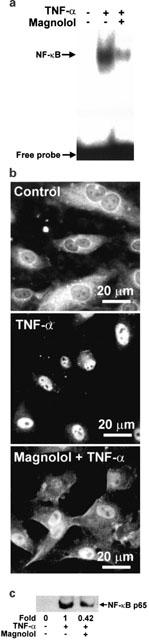
Effect of magnolol on NF-κB activation in TNF-α-stimulated HAECs. Control cells or cells were pretreated for 18 h with 5 μM magnolol, then stimulated with 2 ng ml−1 TNF-α for 30 min at 37°C. (A) EMSA, showing the effect of magnolol on TNF-α-stimulated HAECs. Nuclear extracts were prepared and tested for DNA binding activity of NF-κB. A representative result from three separate experiments is shown. (B) Immunofluorescent staining for NF-κB p65. (C) Western blotting and densitometry of NF-κB in nuclear extracts of HAECs. The results are representative of three separate experiments.
Figure 4
Figure 4
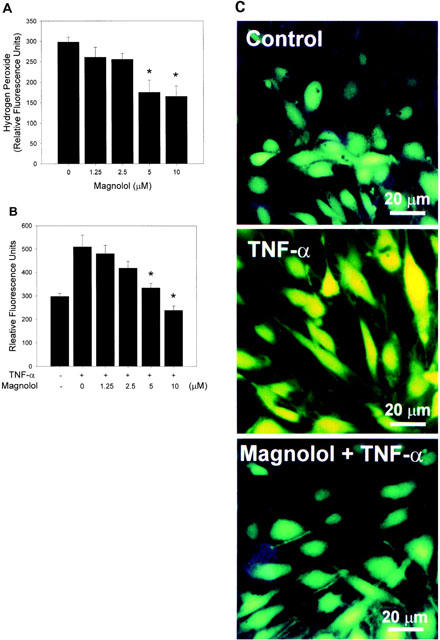
Effect of magnolol on intracellular H2O2 production in HAECs. (A) HAECs in 48-well plates were incubated for 18 h with 0, 1.25, 2.5, 5, or 10 μM magnolol, washed three times with HBSS to remove magnolol, then DCFH-DA was added to the wells. After 45 min incubation at 37°C, DCF fluorescence was measured. The data are the mean±s.e.mean of three independent experiments (with separate endothelial cells isolates) performed in triplicate. * P<0.05 compared to the magnolol-untreated control. (B) Effects of magnolol on H2O2 generation by TNF-α-stimulated HAECs. HAECs in 48-well plates were preincubated for 18 h with 0, 1.25, 2.5, 5, or 10 μM magnolol, then stimulated with 2 ng ml−1 of TNF-α for 1 h. Fluorescence readings were taken at 15 min intervals over a period of 60 min; only the 60 min result is shown. A significant difference (P<0.05) compared to control samples was seen after 60 min. (C). Fluorescent images of representative control, TNF-α-treated, and magnolol+TNF-α-treated HAECs.
Figure 5
Figure 5
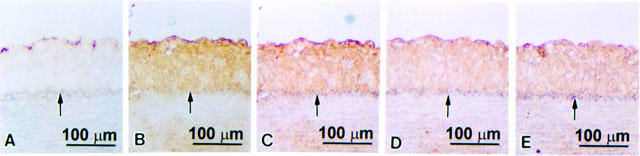
Immunohistochemical staining for vWF, TNF-α, VCAM-1, ICAM-1, or E-selectin protein expression in serial sections of thoracic aortas from cholesterol-fed rabbits. The lumen is uppermost in all sections. The internal elastic membrane is indicated by an arrow. Strongly positive vWF staining was seen on the luminal surface (A), and strong staining for TNF-α (B), VCAM-1 (C), ICAM-1 (D), and E-selectin (E) was seen in the markedly thickened intima.
Figure 6
Figure 6
Immunohistochemical staining for vWF, TNF-α, VCAM-1, ICAM-1, or E-selectin protein expression in serial sections of thoracic aortas from magnolol-treated cholesterol-fed rabbits. The lumen is uppermost in all sections. The internal elastic membrane is indicated by an arrow. Positive vWF staining was seen on the luminal surface (A). Weak staining for TNF-α (B) and VCAM-1(C) was seen in the less thickened intima. The intensity of ICAM-1 (D) and E-selectin (E) staining was similar to that in the control cholesterol-fed rabbits.

References

    1. CHAN P., CHENG J.T., TSAO C.W., NIU C.S., HONG C.Y. The in vitro antioxidant activity of trilinolein and other lipid-related natural substances as measured by enhanced chemiluminescence. Life Sci. 1996;59:2067–2073. - PubMed
    1. CHANG W.S., CHANG Y.H., LU F.J., CHIANG H.C. Inhibitory effects of phenolics on xanthine oxidase. Anticancer Res. 1994;14:501–506. - PubMed
    1. CHEN Y.H., LIN S.J., KU H.H., SHIAO M.S., LIN F.Y., CHEN J.W., CHEN Y.L. Salvianolic acid B attenuates VCAM-1 and ICAM-1 expression in TNF-alpha-treated human aortic endothelial cells. J. Cell. Biochem. 2001a;82:512–521. - PubMed
    1. CHEN Y.L., LIN K.F., SHIAO M.S., CHEN Y.T., HONG C.Y., LIN S.J. Magnolol, a potent antioxidant from Magnolia officinalis, attenuates intimal thickening and MCP-1 expression after balloon injury of the aorta in cholesterol-fed rabbits. Basic Res. Cardiol. 2001b;96:353–363. - PubMed
    1. COLLINS T., READ M.A., NEISH A.S., WHITLEY M.Z., THANOS D., MANIATIS T. Transcriptional regulation of endothelial cell adhesion molecules: NF-kappa B and cytokine-inducible enhancers. FASEB J. 1995;9:899–909. - PubMed

Publication types

MeSH terms