. 2002 Jan 15;30(2):E2.
doi: 10.1093/nar/30.2.e2.

PCR-mediated generation of a gene disruption construct without the use of DNA ligase and plasmid vectors

Affiliations

PCR-mediated generation of a gene disruption construct without the use of DNA ligase and plasmid vectors

Hidekazu Kuwayama et al. Nucleic Acids Res. .

Abstract

We introduce a PCR-based procedure for generating a gene disruption construct. This method depends on DNA fragment fusion by the PCR technique and requires only two steps of PCR to obtain a sufficient amount of the gene disruption construct for one transformation experiment. The first step involves three separate PCR syntheses of a selectable marker cassette and the 5'- and 3'-regions of a target gene. Of the four primers used in amplification of the 5'- and 3'-regions of the target gene, two primers placed proximal to the site of the marker cassette are designed to have sequence tags complementary to the 5'- or 3'-side of the marker cassette. The two primers used in PCR synthesis of the marker cassette are complementary to the tagged primers. By fusion PCR, the 5' and 3' PCR products are linked to the marker cassette via the regions of tagged primers that overlap. A sufficient amount of the disruption construct can be directly amplified with the outermost primers. This method is simple, rapid and relatively inexpensive. In addition, there is the freedom of attaching long flanking regions to any selectable marker cassette.


Figures
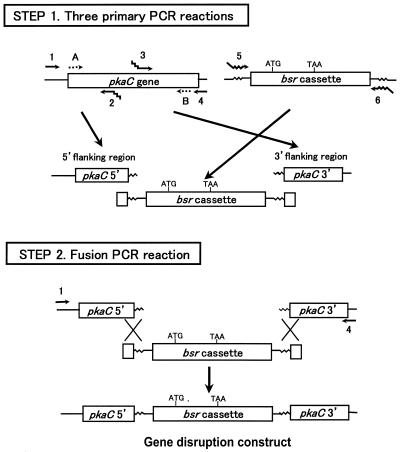
Figure 1
Figure 1
Schematic illustration of PCR-based construction of the pkaC gene disruption construct. Step 1, the three primary PCR reactions. The 5′- and 3′-flanking regions are amplified with primers (primers 1–4) specific for the sequence of the target gene, pkaC of Dictyostelium discoideum. The primers distal to the selectable marker insertion site are simple primers complementary to the target gene (primers 1 and 4). The primers directly adjacent to the marker cassette are chimeric (primers 2 and 3). They contain the M13 reverse (primer 2) and forward (primer 3) sequences at their 5′-ends because bsr is cloned into the pUC118 vector (11). Primers complementary to primers 2 and 3 are used to amplify bsr (primers 5 and 6). Step 2, fusion PCR. The 5′- and 3′-flanking regions are joined to bsr and the final PCR product is amplified with the outermost primers 1 and 4. The order in which the flanking sequences are joined to the ends of the selectable marker cassette is discretionary. The final PCR reaction mix containing the PCR product is subjected to ethanol precipitation and can be directly used to transform D.discoideum cells.
Figure 2
Figure 2
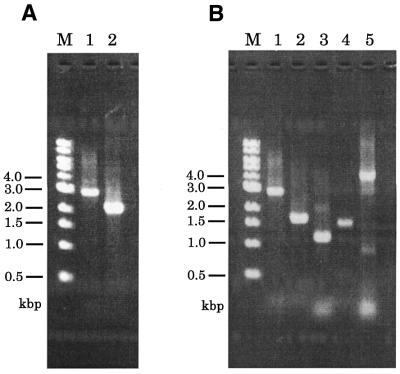
Amplification of the pkaC gene and the three primary products. (A) The PCR product of the pkaC gene synthesized by genomic PCR with primers 1 and 4 is in lane 1. The nested PCR product amplified with primers A and B and the purified full-length pkaC fragment as template are in lane 2. Lane M is the molecular size marker (kb ladder). (B) The PCR products of the full-length and 5′- and 3′-regions of pkaC are in lanes 1–3, respectively. The PCR product of the bsr cassette was amplified using plasmid pUCBsrΔBam as template with primers 5 and 6 (lane 4). A fusion PCR product was produced using the 5′- and 3′-fragments and bsr fragment as template with primers 1 and 4 (lane 5).
Figure 3
Figure 3
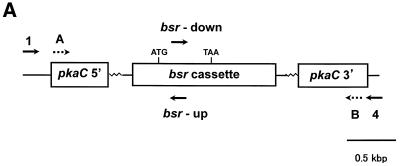
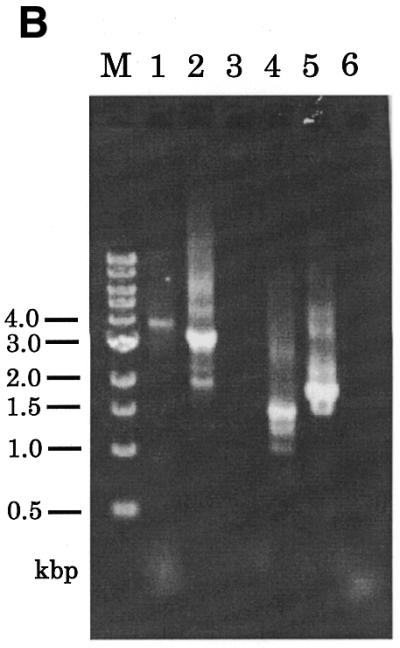
Verification of the constructed gene disruption construct by nested PCR. (A) Schematic drawing of the pkaC gene disruption construct and the locations of specific primers used in verification of the fusion PCR product. (B) The amplified fragment from fusion PCR (Fig. 2B, lane 5) was used as template for nested PCR reactions with the following primer combinations: lane1, primers 1 and 4; lane 2, primers A and B; lane 3, primers A and bsr-down; lane 4, primers A and bsr-up; lane 5, primers B and bsr-down; lane 6, primers B and bsr-up.
Figure 3
Figure 3
Verification of the constructed gene disruption construct by nested PCR. (A) Schematic drawing of the pkaC gene disruption construct and the locations of specific primers used in verification of the fusion PCR product. (B) The amplified fragment from fusion PCR (Fig. 2B, lane 5) was used as template for nested PCR reactions with the following primer combinations: lane1, primers 1 and 4; lane 2, primers A and B; lane 3, primers A and bsr-down; lane 4, primers A and bsr-up; lane 5, primers B and bsr-down; lane 6, primers B and bsr-up.
Figure 4
Figure 4
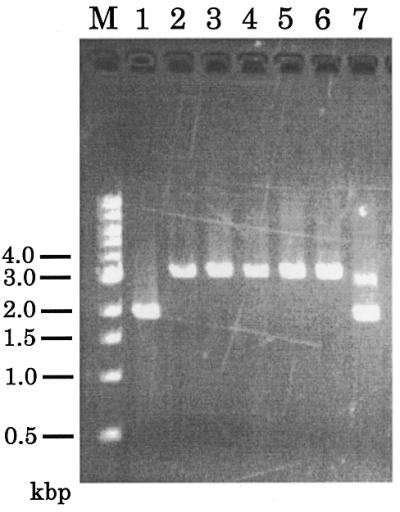
Genomic PCR of the transformants. Genomic PCR was performed on wild-type strain Ax2 (lane 1), five aggregation-negative transformants (lanes 2–6) and one aggregation-positive transformant (lane 7) using primers A and B. The 3.6 kb band corresponds to the gene disrupted allele and the 2.0 kb band corresponds to the intact pkaC gene.

References

    1. Kessin R. (2001) Dictyostelium; Evolution, Cell Biology and the Development of Multicellularity. Cambridge University Press, Cambridge, UK.
    1. De Lozanne A. and Spudich,J.A. (1987) Disruption of the Dictyostelium myosin heavy chain gene by homologous recombination. Science, 236, 1086–1091. - PubMed
    1. Mann S.K. and Firtel,R.A. (1991) A developmentally regulated, putative serine/threonine protein kinase is essential for development in Dictyostelium. Mech. Dev., 35, 89–101. - PubMed
    1. Harwood A., Plyte,S.E., Woodgett,J., Strutt,H. and Kay,R.R. (1995) Glycogen synthetase kinase 3 regulates cell fate in Dictyostelium. Cell, 80, 139–148. - PubMed
    1. Morio T., Urushihara,H., Saito,T., Ugawa,Y., Mizuno,H., Yoshida,M., Yoshino,R., Mitra,B.N., Pi,M., Sato,T., Takemoto,K., Yasukawa,H., Williams,J., Maeda,M., Takeuchi,I., Ochiai,H. and Tanaka,Y. (1998) The Dictyostelium developmental cDNA project: generation and analysis of expressed sequence tags from the first-finger stage of development. DNA Res., 31, 335–340. - PubMed

Publication types

MeSH terms