. 2002 Jan;128(1):194-200.

Phytochrome E controls light-induced germination of Arabidopsis

Affiliations

Phytochrome E controls light-induced germination of Arabidopsis

Lars Hennig et al. Plant Physiol. 2002 Jan.

Abstract

Germination of Arabidopsis seeds is light dependent and under phytochrome control. Previously, phytochromes A and B and at least one additional, unspecified phytochrome were shown to be involved in this process. Here, we used a set of photoreceptor mutants to test whether phytochrome D and/or phytochrome E can control germination of Arabidopsis. The results show that only phytochromes B and E, but not phytochrome D, participate directly in red/far-red light (FR)-reversible germination. Unlike phytochromes B and D, phytochrome E did not inhibit phytochrome A-mediated germination. Surprisingly, phytochrome E was required for germination of Arabidopsis seeds in continuous FR. However, inhibition of hypocotyl elongation by FR, induction of cotyledon unfolding, and induction of agravitropic growth were not affected by loss of phytochrome E. Therefore, phytochrome E is not required per se for phytochrome A-mediated very low fluence responses and the high irradiance response. Immunoblotting revealed that the need of phytochrome E for germination in FR was not caused by altered phytochrome A levels. These results uncover a novel role of phytochrome E in plant development and demonstrate the considerable functional diversification of the closely related phytochromes B, D, and E.


Figures
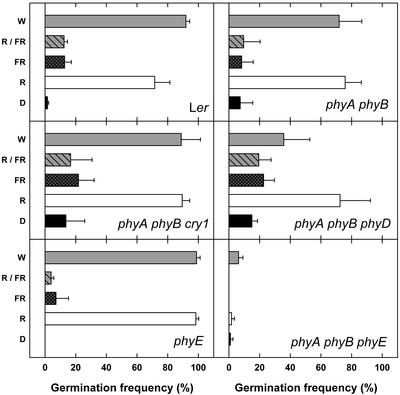
Figure 1
Figure 1
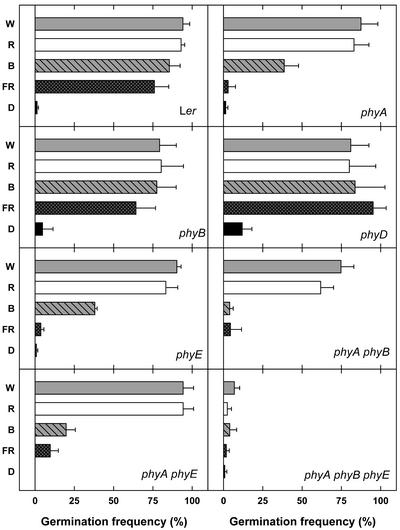
Induction of germination by light pulses. After sowing, seeds were incubated for 24 h at 4°C in darkness, followed by continuous W or hourly pulses of the indicated light quality at 25°C for 3 d. Germination frequencies were determined after further incubation for 3 d in darkness (D).
Figure 2
Figure 2
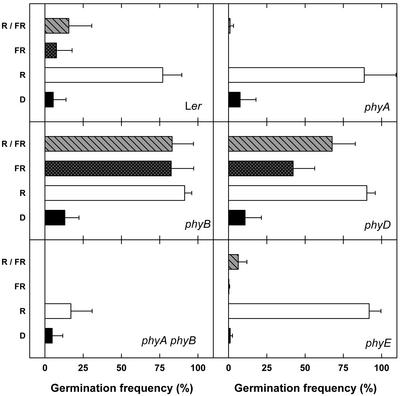
Induction of germination by light periods of 3 h. After sowing, seeds were incubated for 24 h at 4°C in darkness, followed by a treatment at 25°C with R or FR for 3 h or with R for 3 h, followed by FR for 3 h (R/FR). Germination frequencies were determined after further incubation for 6 d in darkness (D).
Figure 3
Figure 3
Induction of germination by continuous light. After sowing, seeds were incubated for 24 h at 4°C and for 24 h at 25°C in darkness, followed by a treatment with the indicated light quality at 25°C for 3 d. Germination frequencies were determined after further incubation for 3 d in darkness (D).
Figure 4
Figure 4
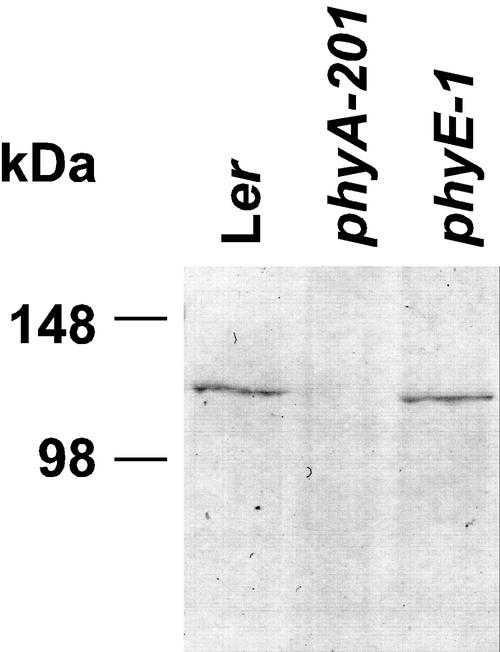
Contents of phyA in Arabidopsis seeds after storage for 24 h at 4°C and for 24 h at 25°C in darkness. Samples were analyzed by immunoblotting of 25 μg of protein and probing with an antiserum against phyA.
Figure 5
Figure 5
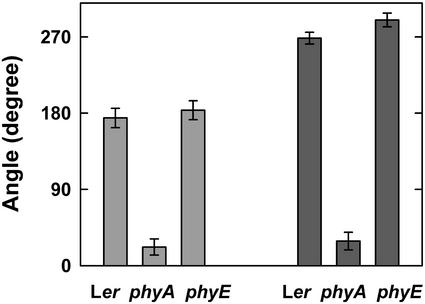
Induction of cotyledon opening by FR. After induction of germination, seeds were exposed either to hourly FR pulses of 5 min (36 μmol m−2 s−1; light-gray bars) or to continuous FR (3 μmol m−2 s−1; dark-gray bars). After 5 d, seedlings were photographed and measurements were taken.
Figure 6
Figure 6
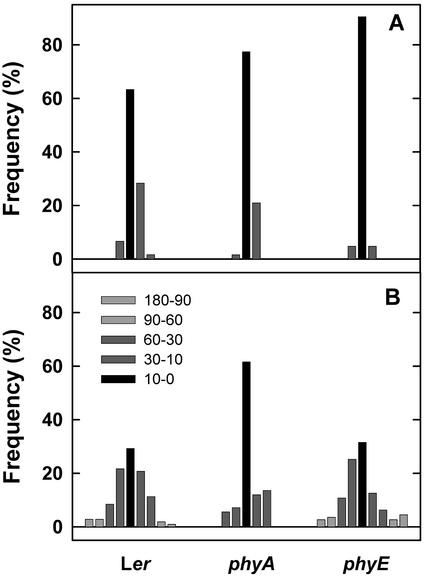
Suppression of gravitropic growth by FR. After induction of germination, seeds were kept in darkness (A) or exposed to hourly FR pulses of 5 min (10 μmol m−2 s−1; B). Growth orientation of at least 60 seedlings was determined after 3 d. Displayed are frequencies of seedlings with angles falling into the indicated ranges (light-gray bars, <−60 or >+60 degrees; dark-gray bars, <−10 or > +10 degrees; black bars, 0 ± 10 degrees).
Figure 7
Figure 7
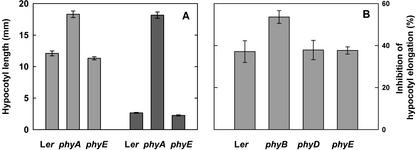
Inhibition of hypocotyl elongation in FR. A, After induction of germination, seeds were exposed either to hourly FR pulses of 5 min (36 μmol m−2 s−1; light-gray bars) or to continuous FR (3 μmol m−2 s−1; dark-gray bars). After 5 d, seedlings were photographed and measurements were taken. B, After induction of germination, seeds were exposed to 0.6 μmol m−2 s−1 FR. Hypocotyl lengths of at least 25 seedlings were determined after 3 d.

References

    1. Ahmad M, Cashmore AR. HY4 gene of Arabidopsis thaliana encodes a protein with characteristics of a blue-light photoreceptor. Nature. 1993;366:162–166. - PubMed
    1. Aukerman MJ, Hirschfeld M, Wester L, Weaver M, Clack T, Amasino RM, Sharrock RA. A deletion in the PHYD gene of the Arabidopsis Wassilewskija ecotype defines a role for phytochrome D in red/far-red light sensing. Plant Cell. 1997;9:1317–1326. - PMC - PubMed
    1. Botto JF, Sanchez RA, Whitelam GC, Casal JJ. Phytochrome A mediates the promotion of seed germination by very low fluences of light and canopy shade light in Arabidopsis. Plant Physiol. 1996;110:439–444. - PMC - PubMed
    1. Casal JJ. Phytochromes, cryptochromes, phototropin: photoreceptor interactions in plants. Photochem Photobiol. 2000;71:1–11. - PubMed
    1. Casal JJ, Sánchez RA. Phytochromes and seed germination. Seed Sci Res. 1998;8:317–329.

Publication types

LinkOut - more resources