


Regulation of mutY and nature of mutator mutations in Escherichia coli populations under nutrient limitation
- PMID: 11790743
- PMCID: PMC139514
- DOI: 10.1128/JB.184.3.739-745.2002
Regulation of mutY and nature of mutator mutations in Escherichia coli populations under nutrient limitation
Abstract
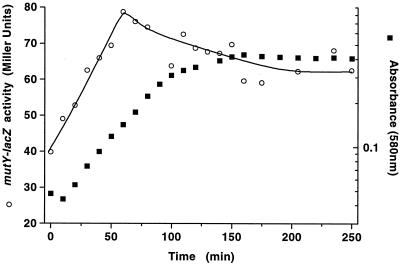
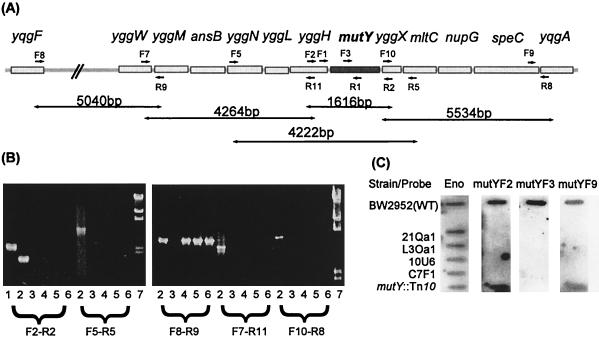
Previous analysis of aerobic, glucose-limited continuous cultures of Escherichia coli revealed that G:C-to-T:A (G:C-->T:A) transversions were the most commonly occurring type of spontaneous mutation. One possible explanation for the preponderance of these mutations was that nutrient limitation repressed MutY-dependent DNA repair, resulting in increased proportions of G:C-->T:A transversions. The regulation of the mutY-dependent DNA repair system was therefore studied with a transcriptional mutY-lacZ fusion recombined into the chromosome. Expression from the mutY promoter was fourfold higher under aerobic conditions than under anaerobic conditions. But mutY expression was higher in glucose- or ammonia-limited chemostats than in nutrient-excess batch culture, so mutY was not downregulated by nutrient limitation. An alternative explanation for the frequency of G:C-->T:A transversions was the common appearance of mutY mutator mutations in the chemostat populations. Of 11 chemostat populations screened in detail, six contained mutators, and the mutator mutation in four cultures was located in the region of mutY at 66 min on the chromosome. The spectrum of mutations and rate of mutation in these isolates were fully consistent with a mutY-deficiency in each strain. Based on PCR analysis of the region within and around mutY, isolates from three individual populations contained deletions extending at least 2 kb upstream of mutY and more than 5 kb downstream. In the fourth population, the deletion was even longer, extending at least 5 kb upstream and 5 kb downstream of mutY. The isolation of mutY mutator strains from four independent populations with extensive chromosomal rearrangements suggests that mutY inactivation by deletion is a means of increasing mutation rates under nutrient limitation and explains the observed frequency of G:C-->T:A mutations in glucose-limited chemostats.
Figures
References
-
- Bregeon, D., I. Matic, M. Radman, and F. Taddei. 1999. Inefficient mismatch repair: genetic defects and down regulation. J. Genet. 78:21–28.
-
- Bridges, B. A., M. Sekiguchi, and T. Tajiri. 1996. Effect of mutY and mutM/fpg-1 mutations on starvation-associated mutation in Escherichia coli: implications for the role of 7,8-dihydro-8-oxoguanine. Mol. Gen. Genet. 251:352–357. - PubMed
-
- Bridges, B. A., and A. Timms. 1998. Effect of endogenous carotenoids and defective RpoS sigma factor on spontaneous mutation under starvation conditions in Escherichia coli: evidence for the possible involvement of singlet oxygen. Mutat. Res. 403:21–28. - PubMed
-
- Casabadan, M. J. 1976. Transposition and fusion of the lac operon to selected promoters in E. coli using bacteriophage Lambda and Mu. J. Mol. Biol. 104:541–555. - PubMed
-
- Chao, L., and E. C. Cox. 1983. Competition between high and low mutating strains of Escherichia coli. Evolution 37:125–134. - PubMed
Publication types
MeSH terms
Substances
LinkOut - more resources
Full Text Sources
