Comparative Study
. 2002 Feb;184(3):746-53.
doi: 10.1128/JB.184.3.746-753.2002.

Rubrivivax gelatinosus acsF (previously orf358) codes for a conserved, putative binuclear-iron-cluster-containing protein involved in aerobic oxidative cyclization of Mg-protoporphyrin IX monomethylester

Affiliations
Comparative Study

Rubrivivax gelatinosus acsF (previously orf358) codes for a conserved, putative binuclear-iron-cluster-containing protein involved in aerobic oxidative cyclization of Mg-protoporphyrin IX monomethylester

Violaine Pinta et al. J Bacteriol. 2002 Feb.

Abstract

This study describes the characterization of orf358, an open reading frame of previously unidentified function, in the purple bacterium Rubrivivax gelatinosus. A strain in which orf358 was disrupted exhibited a phenotype similar to the wild type under photosynthesis or low-aeration respiratory growth conditions. In contrast, under highly aerated respiratory growth conditions, the wild type still produced bacteriochlorophyll a (Bchl a), while the disrupted strain accumulated a compound that had the same absorption and fluorescence emission spectra as Mg-protoporphyrin but was less polar, suggesting that it was Mg-protoporphyrin monomethylester (MgPMe). These data indicated a blockage in Bchl a synthesis at the oxidative cyclization stage and implied the coexistence of two different mechanisms for MgPMe cyclization in R. gelatinosus, an anaerobic mechanism active under photosynthesis or low oxygenation and an aerobic mechanism active under high-oxygenation growth conditions. Based on these results as well as on sequence analysis indicating the presence of conserved putative binuclear-iron-cluster binding motifs, the designation of orf358 as acsF (for aerobic cyclization system Fe-containing subunit) is proposed. Several homologs of AcsF were found in a wide range of photosynthetic organisms, including Chlamydonomas reinhardtii Crd1 and Pharbitis nil PNZIP, suggesting that this aerobic oxidative cyclization mechanism is conserved from bacteria to plants.


Figures
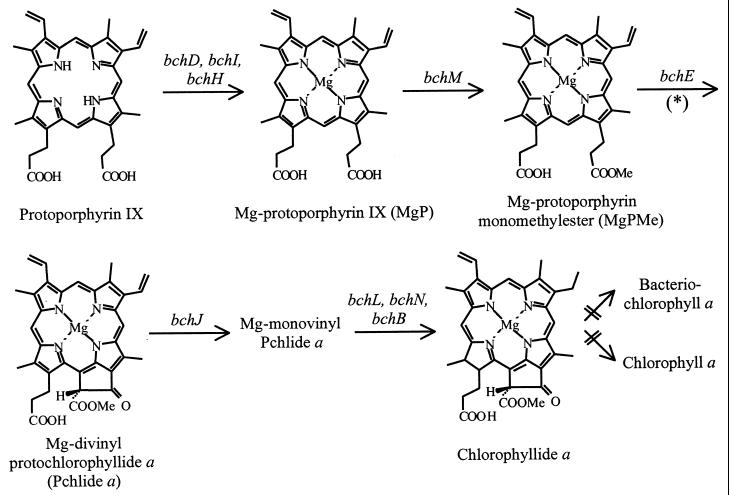
FIG. 1.
FIG. 1.
Biosynthesis pathway from protoporphyrin IX to chlorophyllide a. Bacterial genes coding for biosynthesis enzyme subunits are indicated by an asterisk. Isocyclic ring formation may proceed via an aerobic and/or an anaerobic mechanism, depending on the organism considered, involving various intermediates not detailed here (for a review, see reference 3).
FIG. 2.
FIG. 2.
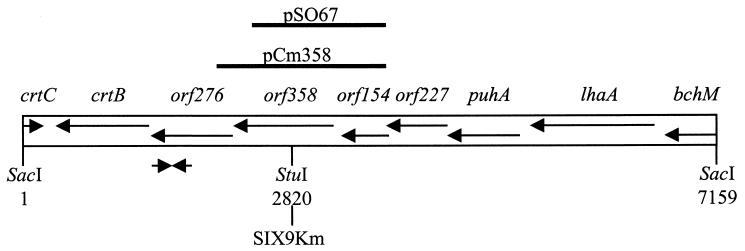
Physical map of the 7.2-kb orf358-containing SacI fragment of R. gelatinosus. Genes and ORFs are represented by arrows and named above in italics. Solid lines above the map represent inserts used to construct pSO67 and pCm358. Converging arrows represent the oligonucleotides used in the PCR screen. The restriction enzyme site used to insert the Km cartridge into pSO67 to construct SIX9Km is indicated below.
FIG. 3.
FIG. 3.
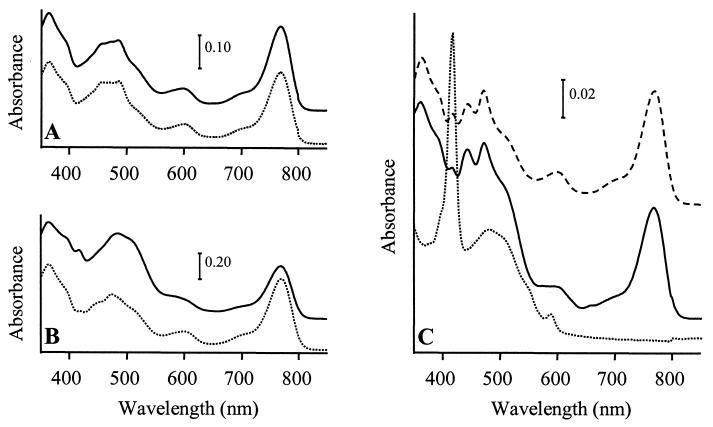
Absorption spectra of pigment extracts from R. gelatinosus cultures grown under photosynthetic conditions (A), darkness and low oxygenation (B), or darkness and high oxygenation (C) and harvested when cultures reached an optical density of 0.8 at 680 nm. Solid lines, WT; dotted lines, SIX9Km; dashed lines, SIX9Km/pCm358. Zero levels were shifted for better viewing.
FIG. 4.
FIG. 4.
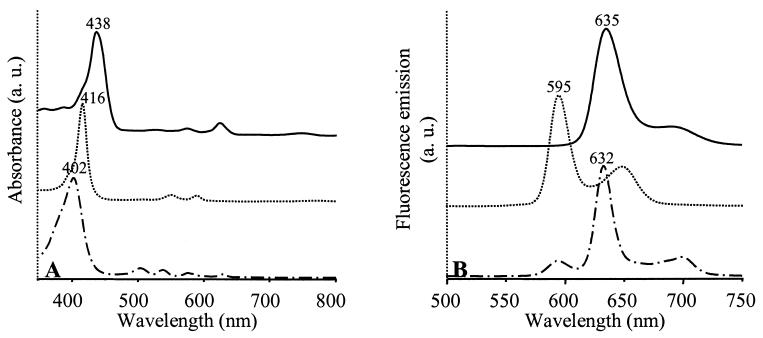
Spectroscopic analysis of Bchl a precursors purified by HPLC from WT or SIX9Km cultures grown under high oxygenation. (A) UV/Vis absorption spectra; (B) fluorescence emission spectra. The absorbance λmax were used as excitation wavelengths for fluorescence measurements. Solid lines, WT fraction 2; dotted and dashed lines, SIX9Km fractions 1 and 3, respectively. The solvent is acetonitrile-methanol-dichloromethane (75:15/:5, vol/vol/vol). Fraction numbers refer to Table 2. Zero levels were shifted for better viewing.
FIG. 5.
FIG. 5.
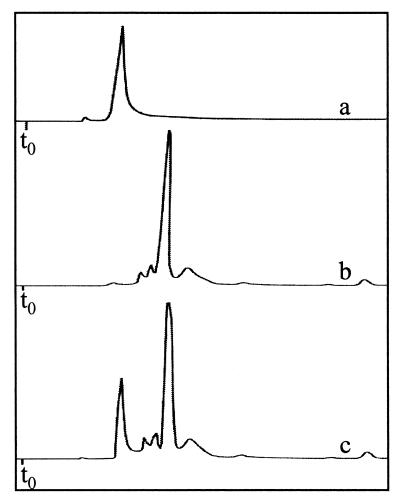
Comparison of the HPLC retention time of a standard solution of MgP (trace a) to that of the SIX9Km fraction 1 compound (trace b). Trace c shows the coinjection of the two samples. The HPLC solvent is acetonitrile-methanol-dichloromethane (75:15:15, vol/vol/vol).
FIG. 6.
FIG. 6.
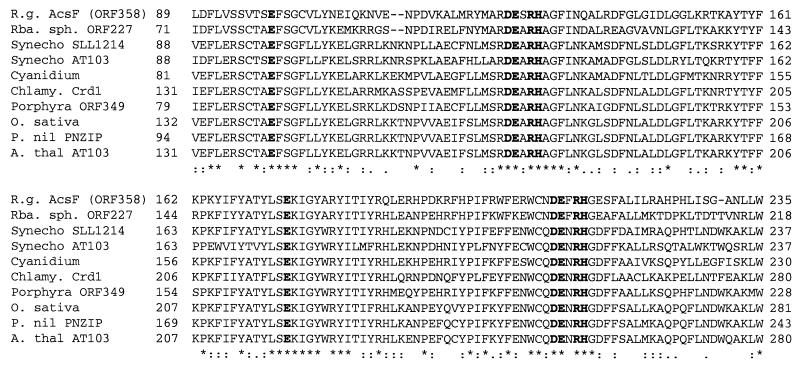
Comparison of the acsF (orf358) putative protein sequence to various homologs. The alignment was generated using ClustalW (http://www2.ebi.ac.uk/clustalw). N- and C-terminal parts of the proteins are not shown. R.g., Rubrivivax gelatinosus (accession number AY057871); Rba. sph., Rhodobacter sphaeroides (AF195122); Synecho., Synechocystis sp. strain PCC 6803 (D90899, D90912); Cyanidium, Cyanidium caldarium (AF022186); Chlamy., Chlamydomonas reinhardtii (AF226628); Porphyra, Porphyra purpurea (PPU38804). O. sativa, Oryza sativa (AP000815); P. nil, Pharbitis nil (INU37437); A. thal, Arabidopsis thaliana (AL138655). The conserved amino acids constituting the putative iron-binding Ex(29–35)DExRH motifs are boldfaced.

References

    1. Agalidis, I., E. Rivas, and F. Reiss-Husson. 1990. Reaction center-light harvesting B875 complex from Rhodocyclus gelatinosus: characterization and identification of quinones. Photosynth. Res. 23:249–255. - PubMed
    1. Aklujkar, M., A. L. Harmer, R. C. Prince, and J. T. Beatty. 2000. The orf162b sequence of Rhodobacter capsulatus encodes a protein required for optimal levels of photosynthetic pigment-protein complexes. J. Bacteriol. 182:5440–5447. - PMC - PubMed
    1. Beale, S. I. 1999. Enzymes of chlorophyll biosynthesis. Photosynth. Res. 60:43–73.
    1. Belanger, F. C., and C. A. Rebeiz. 1980. Chloroplast biogenesis. Detection of divinyl protochlorophyllide in higher plants. J. Biol. Chem. 255:1266–1272. - PubMed
    1. Biel, A. J. 1992. Oxygen-regulated steps in the Rhodobacter capsulatus tetrapyrrole biosynthetic pathway. J. Bacteriol. 174:5272–5274. - PMC - PubMed

Publication types

MeSH terms

Associated data

LinkOut - more resources