


Effects of lipoprotein biogenesis mutations on flagellar assembly in Salmonella
- PMID: 11790747
- PMCID: PMC139530
- DOI: 10.1128/JB.184.3.771-776.2002
Effects of lipoprotein biogenesis mutations on flagellar assembly in Salmonella
Abstract
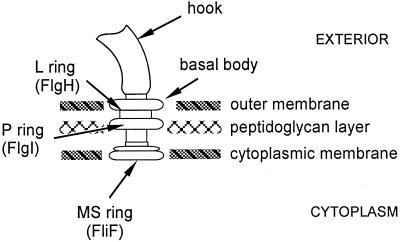
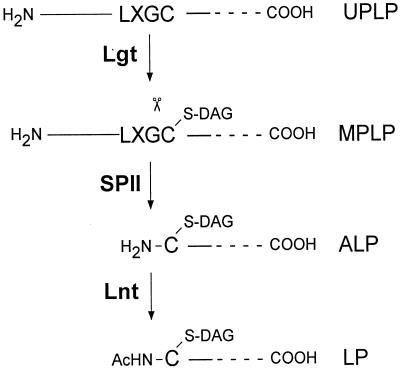
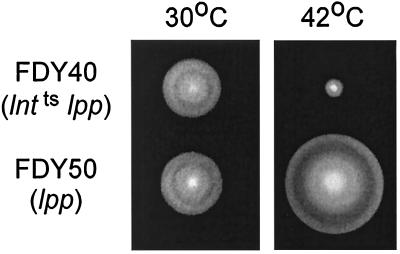
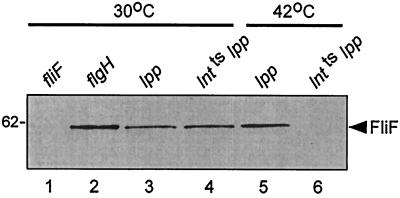
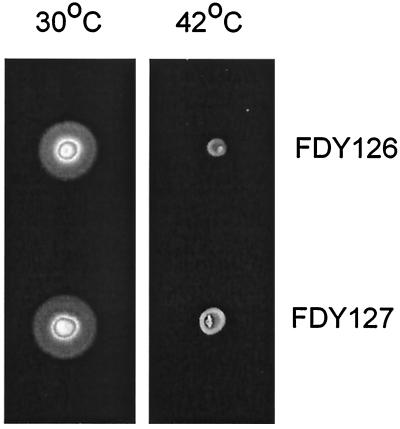
Flagellar assembly requires the expression of a large number of flagellum-specific genes. However, mutations in a number of other genes in Salmonella and Escherichia coli have been shown to have pleiotropic effects that affect flagellar assembly. FlgH (the L-ring subunit of the flagellar basal body) is a lipoprotein whose modification is important for L-ring assembly. We therefore tested whether the lack of motility of Salmonella mutants defective in lipoprotein biogenesis is a result of inability to modify FlgH. Our results show that temperature-sensitive apolipoprotein N-acyltransferase [lnt(Ts)] mutants are nonflagellate at 42 degrees C. However, the flagellar assembly defect occurs at a much earlier step in the pathway than L-ring assembly. These mutants failed to assemble even an MS ring, presumably because of the observed decrease in transcription of fliF. In contrast, temperature-sensitive diacylglycerol transferase [lgt(Ts)] mutants were motile at 42 degrees C, provided the strains carried an lpp (Braun lipoprotein) mutation to permit growth. We have isolated second-site mutants from an lgt(Ts) lpp(+) strain that grow but are nonflagellate at 42 degrees C. Thus, lipoprotein biogenesis is a factor that is important for flagellar assembly.
Figures
References
Publication types
MeSH terms
Substances
Grants and funding
LinkOut - more resources
Full Text Sources
