


Self-assembly properties of a model RING domain
- PMID: 11792829
- PMCID: PMC117363
- DOI: 10.1073/pnas.012317299
Self-assembly properties of a model RING domain
Abstract
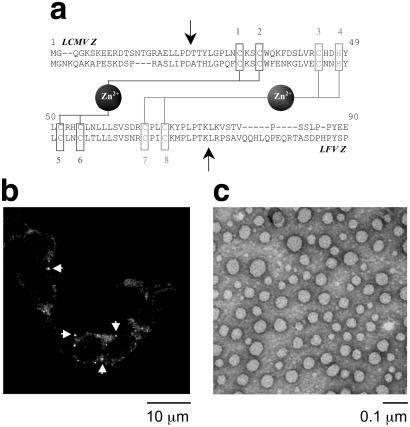
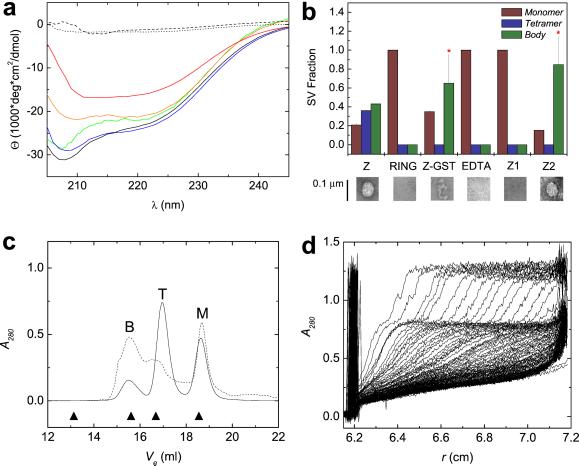
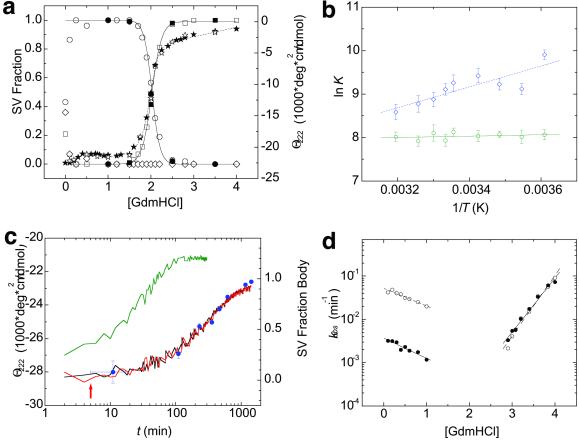
RING domains act in a variety of essential cellular processes but have no general function ascribed to them. Here, we observe that purified arenaviral protein Z, constituted almost entirely by its RING domain, self-assembles in vitro into spherical structures that resemble functional bodies formed by Z in infected cells. By using a variety of biophysical methods we provide a thermodynamic and kinetic framework for the RING-dependent self-assembly of Z. Assembly appears coupled to substantial conformational reorganization and changes in zinc coordination of site II of the RING. Thus, the rate-limiting nature of conformational reorganization observed in the folding of monomeric proteins can also apply to the assembly of macromolecular scaffolds. These studies describe a unique mechanism of nonfibrillar homogeneous self-assembly and suggest a general function of RINGs in the formation of macromolecular scaffolds that are positioned to integrate biochemical processes in cells.
Figures
References
-
- Kentsis A, Borden K L B. Curr Protein Peptide Sci. 2000;1:49–73. - PubMed
-
- Peng H, Begg G E, Schultz D C, Friedman J R, Jensen D E, Speicher D W, Rauscher F J., III J Mol Biol. 2000;295:1139–1162. - PubMed
-
- Kentsis A, Dwyer E C, Perez J M, Sharma M, Chen A, Pan Z Q, Borden K L. J Mol Biol. 2001;312:609–623. - PubMed
Publication types
MeSH terms
Substances
Grants and funding
LinkOut - more resources
Full Text Sources
