. 2002 Jan 22;99(2):896-900.
doi: 10.1073/pnas.022626899. Epub 2002 Jan 15.

Heat shock protein 90 catalyzes activation of the prekallikrein-kininogen complex in the absence of factor XII

Affiliations

Heat shock protein 90 catalyzes activation of the prekallikrein-kininogen complex in the absence of factor XII

Kusumam Joseph et al. Proc Natl Acad Sci U S A. .

Abstract

Bradykinin is a major mediator of swelling in C1 inhibitor deficiency as well as the angioedema seen with ACE inhibitors and may contribute to bronchial hyperreactivity in asthma. Formation of bradykinin occurs in the fluid phase and along cell surfaces requiring interaction of factor XII, prekallikrein, and high M(r) kininogen (HK). Recent data suggest that activation of the kinin-forming cascade can occur on the surface of endothelial cells, even in the absence of factor XII. We sought to further define this factor XII-independent mechanism of kinin formation. Both cytosolic and membrane fractions from endothelial cells possessed the ability to catalyze prekallikrein conversion to kallikrein, and activation depended on the presence of HK and zinc ion. We fractionated the cytosol by ion exchange chromatography and affinity chromatography by using corn trypsin inhibitor as ligand. The fractions with peak activity were subjected to SDS gel electrophoresis and ligand blot with biotinylated corn trypsin inhibitor, and positive bands were sequenced. Heat shock protein 90 (Hsp90) was identified as the protein responsible for zinc-dependent prekallikrein activation in the presence of HK. Zinc-dependent activation of the prekallikrein-HK complex also depended on addition of either alpha and beta isoforms of Hsp90 and the activation on endothelial cells was inhibited on addition of polyclonal Ab to Hsp90 in a dose-dependent manner. Although the mechanism by which Hsp90 activates the kinin-forming cascade is not understood, this protein represents the cellular contribution to the reaction and may become the dominant mechanism in pathologic circumstances in which Hsp90 is highly expressed or secreted.


Figures
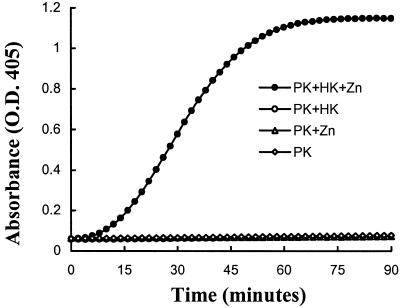
Figure 1
Figure 1
Prekallikrein activation on endothelial cells. Endothelial cells were incubated with prekallikrein (20 nM) alone or prekallikrein (20 nM) and HK (20 nM) in the presence and absence of 50 μM zinc as indicated. Kallikrein activity was measured by using a synthetic substrate (S2302; 0.6 mM). This experiment was performed six times with identical results. A representative experiment is shown here.
Figure 2
Figure 2
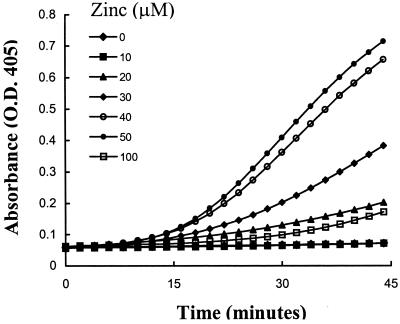
Effect of zinc on prekallikrein activation. Prekallikrein (20 nM), HK (20 nM), S2302 (0.6 mM), and cytosolic fraction (20 μg of total protein) were incubated with varying concentrations of zinc as indicated. The rate of conversion of prekallikrein to kallikrein was monitored at 405 nm. This experiment was repeated four times, each with maximal activity at 50 μM.
Figure 3
Figure 3
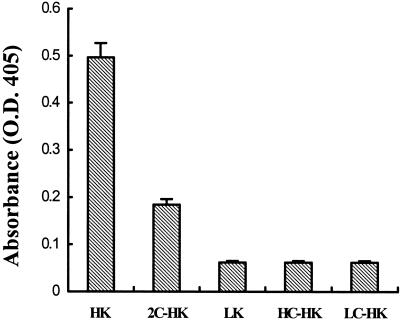
Effect of HK on prekallikrein activation. Cytosol (20 μg) was incubated with 20 nM of either HK, low Mr kininogen (LK), cleaved HK (2C-HK), purified heavy chain of HK (HC-HK), or light chain of HK (LC-HK) in the presence of 20 nM prekallikrein, 50 μM zinc, and 0.6 mM S2302. After 2 h the chromogenic activity was measured at 405 nm.
Figure 4
Figure 4
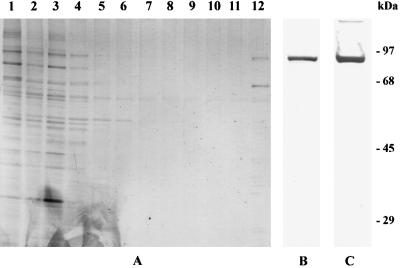
SDS/PAGE analysis of proteins eluted from CTI affinity column. Fractions collected from CTI affinity column were subjected to SDS/PAGE analysis. (A) After electrophoresis, the gel was stained with silver stain showing the starting material in lane 1, effluent in lane 2, washes with 0.25 M NaCl in lanes 3–11, and the final eluate with 0.5 M NaCl in lane 12. (B) Ligand blot of the final eluate with 0.5 M NaCl (lane 12 of A) with biotinylated CTI. (C) Western blot of 0.5 M NaCl eluate fraction with polyclonal Ab to Hsp90.
Figure 5
Figure 5
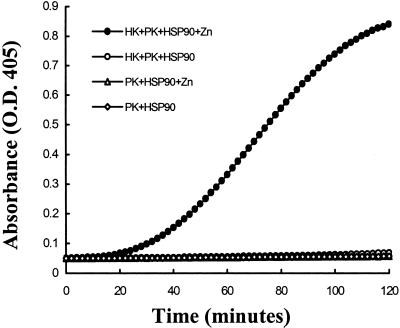
Prekallikrein activation on Hsp90. Purified Hsp90 (2 μg) was incubated with prekallikrein (20 nM), HK (20 nM), zinc (50 μM), and S2302 (0.6 mM), and chromogenic activity was monitored. Controls were either in the absence of zinc or HK or both.
Figure 6
Figure 6
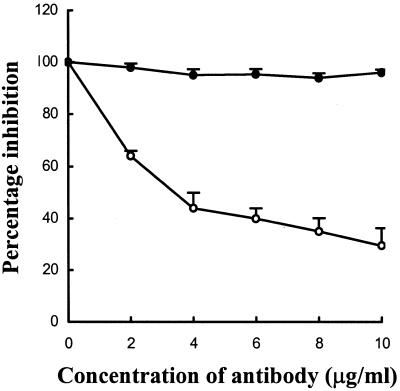
Inhibition of prekallikrein activation by using Ab to Hsp90. Endothelial cells were preincubated with polyclonal Ab to Hsp90 (○) or nonimmune rabbit IgG (●) and assayed for prekallikrein activation.

References

    1. Bock P E, Shore J D. J Biol Chem. 1983;258:15079–15086. - PubMed
    1. Bock P E, Shore J D, Tans G, Griffin J H. J Biol Chem. 1985;260:12434–12443. - PubMed
    1. Mandle R, Jr, Colman R W, Kaplan A P. Proc Natl Acad Sci USA. 1976;73:4179–4183. .R. J. - PMC - PubMed
    1. Thompson R E, Mandle R, Jr, Kaplan A P. J Clin Invest. 1977;60:1376–1380. - PMC - PubMed
    1. Wiggins R C, Bouma B N, Cochrane C G, Griffin J H. Proc Natl Acad Sci USA. 1977;77:4636–4640. - PMC - PubMed

LinkOut - more resources