


Type II topoisomerase quinolone resistance-determining regions of Aeromonas caviae, A. hydrophila, and A. sobria complexes and mutations associated with quinolone resistance
- PMID: 11796341
- PMCID: PMC127024
- DOI: 10.1128/AAC.46.2.350-359.2002
Type II topoisomerase quinolone resistance-determining regions of Aeromonas caviae, A. hydrophila, and A. sobria complexes and mutations associated with quinolone resistance
Abstract
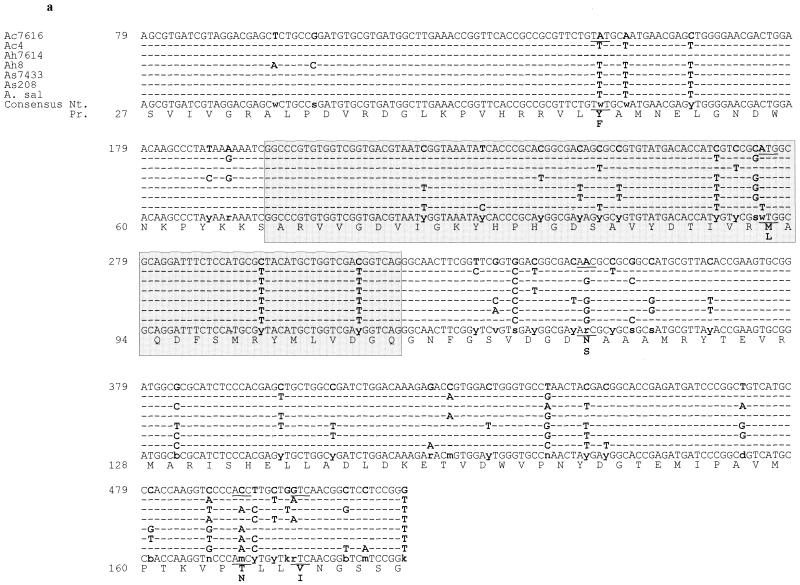
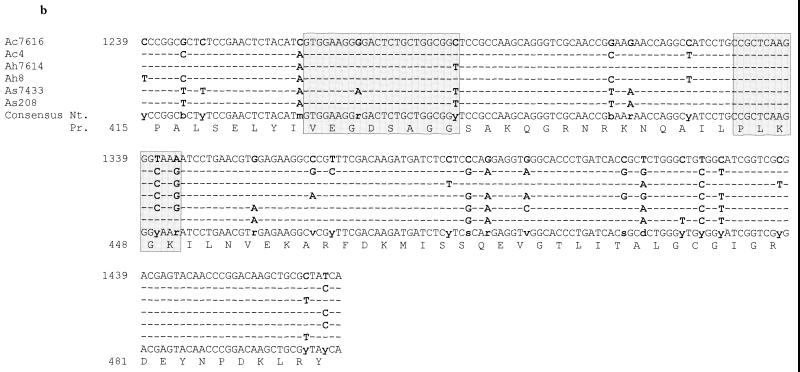
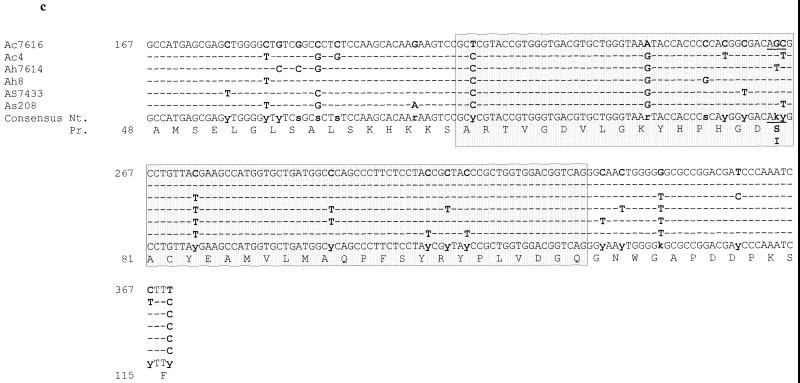
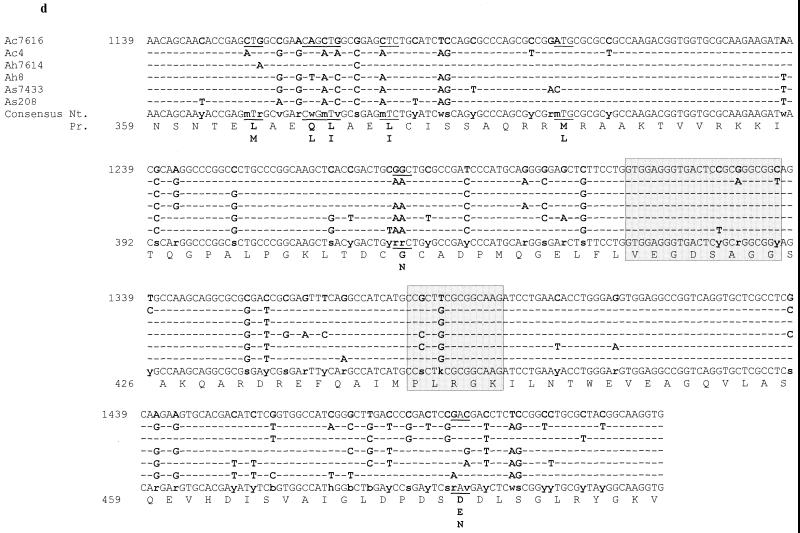
Most Aeromonas strains isolated from two European rivers were previously found to be resistant to nalidixic acid. In order to elucidate the mechanism of this resistance, 20 strains of Aeromonas caviae (n = 10), A. hydrophila (n = 5), and A. sobria (n = 5) complexes, including 3 reference strains and 17 environmental isolates, were investigated. Fragments of the gyrA, gyrB, parC, and parE genes encompassing the quinolone resistance-determining regions (QRDRs) were amplified by PCR and sequenced. Results obtained for the six sensitive strains showed that the GyrA, GyrB, ParC, and ParE QRDR fragments of Aeromonas spp. were highly conserved (> or =96.1% identity), despite some genetic polymorphism; they were most closely related to those of Vibrio spp., Pseudomonas spp., and members of the family Enterobacteriaceae (72.4 to 97.1% homology). All 14 environmental resistant strains carried a point mutation in the GyrA QRDR at codon 83, leading to the substitution Ser-83-->Ile (10 strains) or Ser-83-->Arg. In addition, seven strains harbored a mutation in the ParC QRDR either at position 80 (five strains), generating a Ser-80-->Ile (three strains) or Ser-80-->Arg change, or at position 84, yielding a Glu-84-->Lys modification. No amino acid alterations were discovered in the GyrB and ParE QRDRs. Double gyrA-parC missense mutations were associated with higher levels of quinolone resistance compared with the levels associated with single gyrA mutations. The most resistant strains probably had an additional mechanism(s) of resistance, such as decreased accumulation of the drugs. Our data suggest that, in mesophilic Aeromonas spp., as in other gram-negative bacteria, gyrase and topoisomerase IV are the primary and secondary targets for quinolones, respectively.
Figures
References
-
- Akasaka, T., M. Tanaka, A. Yamaguchi, and K. Sato. 2001. Type II topoisomerase mutations in fluoroquinolone-resistant clinical strains of Pseudomonas aeruginosa isolated in 1998 and 1999: role of target enzyme in mechanism of fluoroquinolone resistance. Antimicrob. Agents Chemother. 45:2263-2268. - PMC - PubMed
-
- Barnes, A. C., C. S. Lewin, T. S. Hastings, and S. G. B. Amyes. 1990. Cross resistance between oxytetracycline and oxolinic acid in Aeromonas salmonicida associated with alterations in outer membrane proteins. FEMS Microbiol. Lett. 72:337-340. - PubMed
-
- Beam, T. R. 1994. Fluoroquinolones in animal feeds. ASM News. 60:348-349.
-
- Berger, J. M. 1998. Structure of DNA topoisomerases. Biochim. Biophys. Acta 1400:3-18. - PubMed
Publication types
MeSH terms
Substances
LinkOut - more resources
Full Text Sources
Medical
Miscellaneous
