. 2002 Feb;70(2):606-11.
doi: 10.1128/IAI.70.2.606-611.2002.

The Helicobacter pylori homologue of the ferric uptake regulator is involved in acid resistance

Affiliations

The Helicobacter pylori homologue of the ferric uptake regulator is involved in acid resistance

Jetta J E Bijlsma et al. Infect Immun. 2002 Feb.

Abstract

The only known niche of the human pathogen Helicobacter pylori is the gastric mucosa, where large fluctuations of pH occur, indicating that the bacterial response and resistance to acid are important for successful colonization. One of the few regulatory proteins in the H. pylori genome is a homologue of the ferric uptake regulator (Fur). In most bacteria, the main function of Fur is the regulation of iron homeostasis. However, in Salmonella enterica serovar Typhimurium, Fur also plays an important role in acid resistance. In this study, we determined the role of the H. pylori Fur homologue in acid resistance. Isogenic fur mutants were generated in three H. pylori strains (1061, 26695, and NCTC 11638). At pH 7 there was no difference between the growth rates of mutants and the parent strains. Under acidic conditions, growth of the fur mutants was severely impaired. No differences were observed between the survival of the fur mutant and parent strain 1061 after acid shock. Addition of extra iron or removal of iron from the growth medium did not improve the growth of the fur mutant at acidic pH. This indicates that the phenotype of the fur mutant at low pH was not due to increased iron sensitivity. Transcription of fur was repressed in response to low pH. From this we conclude that Fur is involved in the growth at acidic pH of H. pylori; as such, it is the first regulatory protein implicated in the acid resistance of this important human pathogen.


Figures
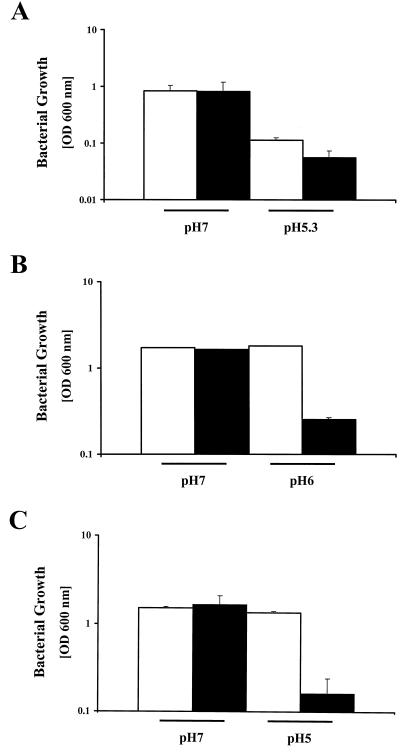
FIG. 1.
FIG. 1.
H. pylori fur mutants are defective in growth under acidic conditions. (A) Growth of H. pylori 1061 (white bars) and its fur mutant (black bars) after 48 h (stationary phase) in broth adjusted to pH 7 or 5.3. Note the logarithmic scale of the y axis. Results are the means of three independent experiments and standard errors of the mean. At pH 5.3, the difference between the parent strain and the mutant was significant, as determined by Student's t test (P < 0.05). (B) Growth of H. pylori NCTC 11638 (white bars) and its fur mutant (black bars) after 48 h (stationary phase) in broth adjusted to pH 7 or 6. Neither the parent strain nor the fur mutant grew at pH 5.3 (data not shown). Results are the means of three independent experiments and standard errors of the mean; due to the small standard errors, most of the error bars are not visible. At pH 6, the difference between the parent strain and mutant was significant (P < 0.05) as determined by Student's t test. (C) Growth of H. pylori 26695 (white bars) and its fur mutant (black bars) after 48 h (stationary phase) at pH 7 or 5. This experiment was repeated five times. Large experimental variation occurred; therefore, the results shown are a representative example of the means and standard errors of the mean of two independent experiments performed at the same day.
FIG. 2.
FIG. 2.
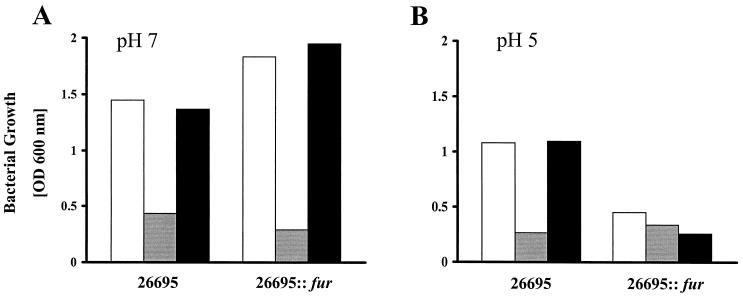
Influence of iron on fur-mediated acid sensitivity. The parent strain 26695 and its fur mutant were grown at pH 7 (A) or pH 5 (B) for 48 h in regular medium (white bars) or in iron-restricted (20 μM desferal; gray bars) or iron-rich (100 μM FeCl3; black bars) medium. The results shown are a representative example of the means of two independent experiments.
FIG. 3.
FIG. 3.
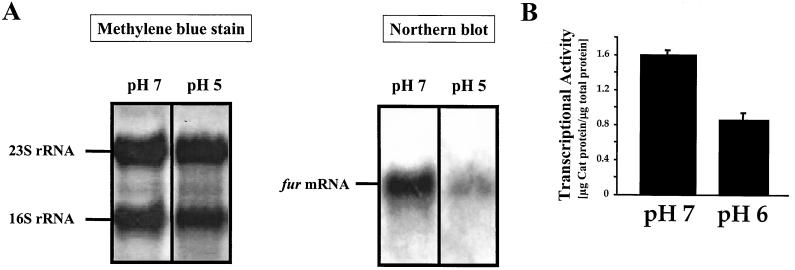
Transcriptional analysis of the fur gene under acidic conditions. (A) The left panel shows a methylene blue stain of transferred RNA prior to hybridization. The positions of 16S and 23S RNA are indicated. The right panel shows total RNA isolated from strain 1061 grown at pH 7 or 5.3 and analyzed by Northern hybridization with DIG-labeled fur antisense RNA. The band corresponding to the 0.5-kb fur mRNA is indicated. The experiment was repeated three times, with similar results. (B) Expression of the fur::cat reporter gene fusion under acidic conditions. The fur mutant of H. pylori strain 1061, where the promoterless cat gene is transcriptionally fused to the fur gene, was grown at pH 7 or 6, and the expression of the Cat protein was assayed by a Cat-specific ELISA. Results shown are the means of four experiments and standard errors of the mean.

References

    1. Alm, R. A., L. S. Ling, D. T. Moir, B. L. King, E. D. Brown, P. C. Doig, D. R. Smith, B. Noonan, B. C. Guild, B. L. deJonge, G. Carmel, P. J. Tummino, A. Caruso, M. Uria-Nickelsen, D. M. Mills, C. Ives, R. Gibson, D. Merberg, S. D. Mills, Q. Jiang, D. E. Taylor, G. F. Vovis, and T. J. Trust. 1999. Genomic-sequence comparison of two unrelated isolates of the human gastric pathogen Helicobacter pylori. Nature 397:176-180. - PubMed
    1. Ang, S., C. Z. Lee, K. Peck, M. Sindici, U. Matrubutham, M. A. Gleeson, and J. T. Wang. 2001. Acid-induced gene expression in Helicobacter pylori: study in genomic scale by microarray. Infect. Immun. 69:1679-1686. - PMC - PubMed
    1. Bearson, S., B. Bearson, and J. W. Foster. 1997. Acid stress responses in enterobacteria. FEMS Microbiol. Lett. 147:173-180. - PubMed
    1. Bereswill, S., S. Greiner, A. H. M. van Vliet, B. Waidner, F. Fassbinder, E. Schiltz, J. G. Kusters, and M. Kist. 2000. Regulation of ferritin-mediated cytoplasmic iron storage by the ferric uptake regulator homolog (Fur) of Helicobacter pylori. J. Bacteriol. 182:5948-5953. - PMC - PubMed
    1. Bereswill, S., F. Lichte, S. Greiner, B. Waidner, F. Fassbinder, and M. Kist. 1999. The ferric uptake regulator (Fur) homologue of Helicobacter pylori: functional analysis of the coding gene and controlled production of the recombinant protein in Escherichia coli. Med. Microbiol. Immunol. 188:31-40. - PubMed

Publication types

MeSH terms

LinkOut - more resources