


Evolution of germ-line signals that regulate growth and aging in nematodes
- PMID: 11805331
- PMCID: PMC117380
- DOI: 10.1073/pnas.012511099
Evolution of germ-line signals that regulate growth and aging in nematodes
Abstract
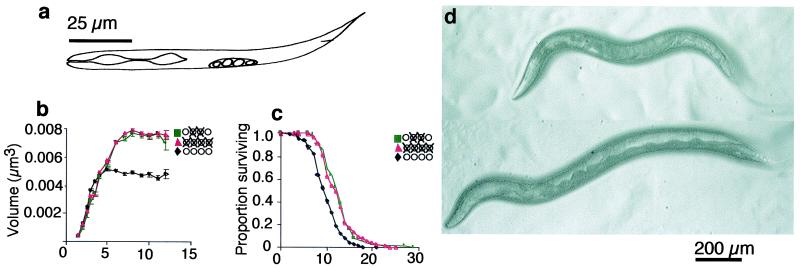
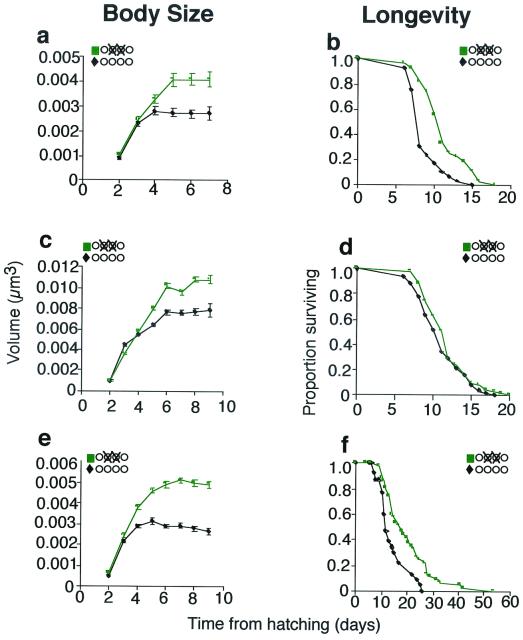
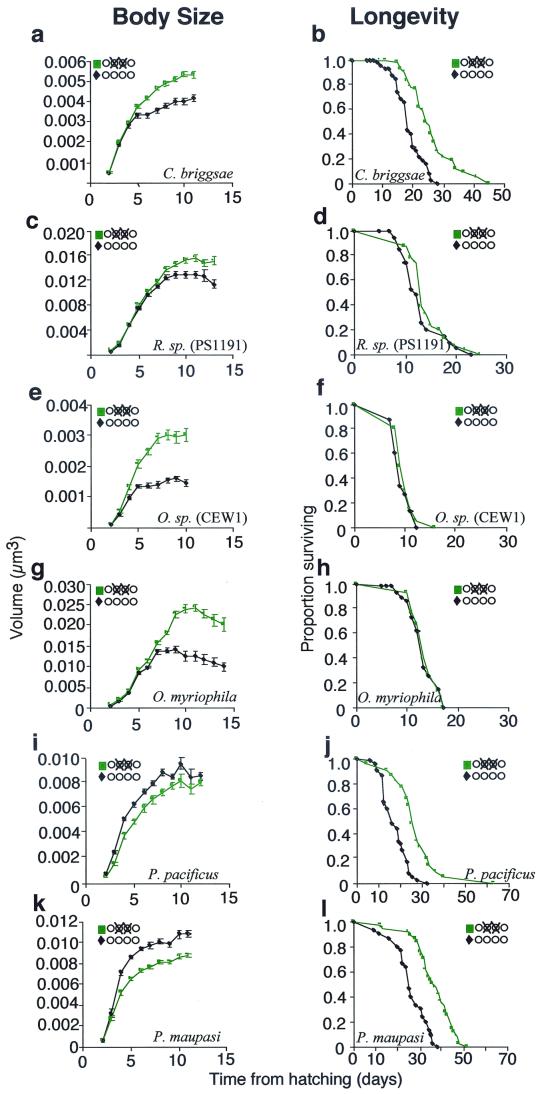
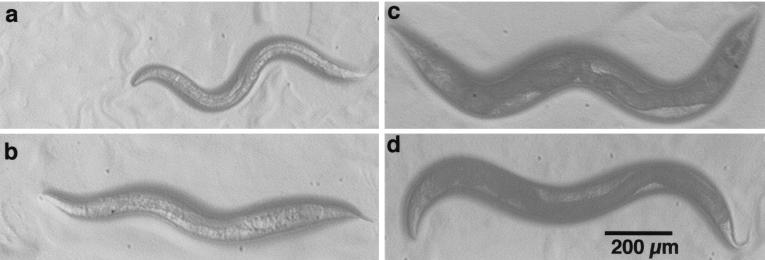
We show that a signal from the germ line represses growth in the nematode Caenorhabditis elegans. Laser-microbeam ablation of cells that give rise to the germ line causes adults to become giant. Ablation of these cells in self-sterile mutant worms also causes gigantism, suggesting that the germ line represses growth because it is the source of a growth-antagonizing signal rather than because of a sink of resources required for reproduction. The C. elegans germ line also emits a signal that represses longevity. This longevity-repressing signal requires the activity of DAF-16, a forkhead/winged-helix transcription factor, but we find that that the growth-repressing signal does not. The growth-repressing signal also does not require the activity of DBL-1, a transforming growth factor beta-related protein that promotes growth in worms. By ablating the germ-line precursors of other species of free-living nematodes, we also found that both the growth-repressing and longevity-repressing signals are evolutionarily variable. Some species have both signals; others have just one or the other. We suggest that variation in germ-line signaling contributes to body size and life-history diversity in the nematodes.
Figures
References
-
- Williams G C. Am Nat. 1966;100:687–690.
-
- Stearns S. The Evolution of Life-Histories. New York: Oxford Univ. Press; 1992.
-
- Roff D A. The Evolution of Life-Histories. New York: Chapman & Hall; 1992.
-
- Bell G, Koufopanou V. Oxford Surv Evol Biol. 1986;3:83–131.
-
- Rose M R, Bradley T J. Oikos. 1998;83:443–451.
Publication types
MeSH terms
Substances
LinkOut - more resources
Full Text Sources
Other Literature Sources
Miscellaneous
