


Review
doi: 10.1186/rr160.
Epub 2001 Nov 28.
Autocrine regulation of asthmatic airway inflammation: role of airway smooth muscle
Affiliations
- PMID: 11806846
- PMCID: PMC64809
- DOI: 10.1186/rr160
Item in Clipboard
Review
Autocrine regulation of asthmatic airway inflammation: role of airway smooth muscle
Respir Res.
2002.
Abstract
Chronic airway inflammation is one of the main features of asthma. Release of mediators from infiltrating inflammatory cells in the airway mucosa has been proposed to contribute directly or indirectly to changes in airway structure and function. The airway smooth muscle, which has been regarded as a contractile component of the airways responding to various mediators and neurotransmitters, has recently been recognised as a rich source of pro-inflammatory cytokines, chemokines and growth factors. In this review, we discuss the role of airway smooth muscle cells in the regulation and perpetuation of airway inflammation that contribute to the pathogenesis of asthma.
Figures
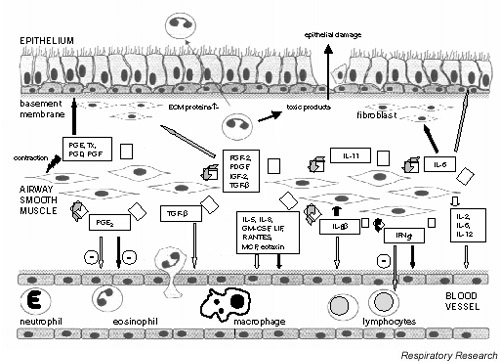
Schematic diagram depicting the role of airway smooth muscle (ASM) cell-derived mediators in airway inflammation. The release of cytokines, chemokines or growth factors (open arrows) can result in ASM as well as inflammatory cell proliferation (dark grey arrows), or the recruitment (light grey arrows) or activation (black arrows) of various cells in the airways. ECM, Extracellular membrane; FGF-2, fibroblast growth factor-2; GM-CSF, granulocyte/macrophage-colony stimulating factor; IGF-2, insulin-like growth factor-2; IFN, interferon; IL, interleukin; LIF, leukaemia inhibitory factor; MCP, monocyte chemotactic protein; PDGF, platelet-derived growth factor; PG, prostaglandin; RANTES, regulated on activation, normal T cell expressed and secreted; TGF-β, transforming growth factor-β; TX, thromboxane.
References
-
- Djukanovic R, Roche WR, Wilson JW, Beasley CR, Twentyman OP, Howarth RH, Holgate ST. Mucosal inflammation in asthma. Am Rev Respir Dis. 1990;142:434–457. - PubMed
-
- Heard BE, Hossain S. Hyperplasia of bronchial muscle in asthma. J Pathol. 1973;110:310–331. - PubMed
-
- James AL. Relationship between airway wall thickness and airway hyperresponsiveness. In Airway Wall Remodelling in Asthma Edited by Stewart AG London: CRC; 1997. pp. 29–63.
Publication types
MeSH terms
LinkOut - more resources
Full Text Sources
Other Literature Sources
Medical
