. 2002 Feb;184(4):1155-62.
doi: 10.1128/jb.184.4.1155-1162.2002.

ccfA, the genetic determinant for the cCF10 peptide pheromone in Enterococcus faecalis OG1RF

Affiliations

ccfA, the genetic determinant for the cCF10 peptide pheromone in Enterococcus faecalis OG1RF

Michelle H Antiporta et al. J Bacteriol. 2002 Feb.

Abstract

The nosocomial pathogen Enterococcus faecalis has a unique pheromone-inducible conjugative mating system. Conjugative transfer of the E. faecalis plasmid pCF10 is specifically induced by the cCF10 peptide pheromone (LVTLVFV). Genomic sequence information has recently allowed the identification of putative structural genes coding for the various enterococcal pheromones (D. B. Clewell et al., Mol. Microbiol. 35:246-247, 2000). The cCF10 pheromone sequence LVTLVFV was found within an open reading frame designated ccfA, encoding a putative lipoprotein precursor. Several other pheromone sequences were found in similar locations within other predicted lipoproteins. CcfA shows significant sequence relatedness to the Escherichia coli protein YidC, an inner membrane protein translocase, as well as to a large number of homologs identified in gram-positive and in gram-negative bacteria. Analysis of the deduced CcfA amino acid sequence suggested that mature cCF10 peptide could be formed from the proteolytic degradation of its signal peptide. Expression of the cloned ccfA gene with an inducible expression vector dramatically increased cCF10 production by E. faecalis and also resulted in cCF10 production by Lactococcus lactis, a non-pheromone producer. Site-directed mutagenesis of the ccfA sequence encoding the cCF10 peptide confirmed that ccfA was a functional genetic determinant for cCF10.


Figures
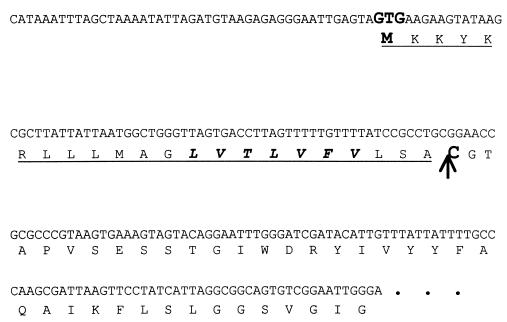
FIG. 1.
FIG. 1.
Partial nucleotide sequence of ccfA. Underlined is the hypothesized lipoprotein signal sequence. The amino acid sequence of the pheromone cCF10 is italicized. Sequencing of this particular locus in E. faecalis OG1RF verified its identity to that of strain E. faecalis V583 as determined by TIGR (http://www.tigr.org).
FIG. 2.
FIG. 2.
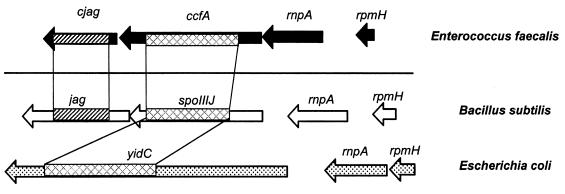
Genetic map of the ccfA cluster in E. faecalis, in comparison to homologous loci in B. subtilis and E. coli. Regions of significant homology are shaded. ccfA is homologous to spoIIIJ and yidC. SpoIIIJ has an unknown function, whereas YidC is an inner membrane translocase. cjag is a homolog of jag, a spoIIIJ-associated gene of unknown function. RnpA is an RNase P protein involved in tRNA processing. rpmH encodes ribosomal protein component L34. Genomic sequence information and annotation were obtained from the NCBI Entrez Genomes website at http://www.ncbi.nlm.nih.gov.
FIG. 3.
FIG. 3.
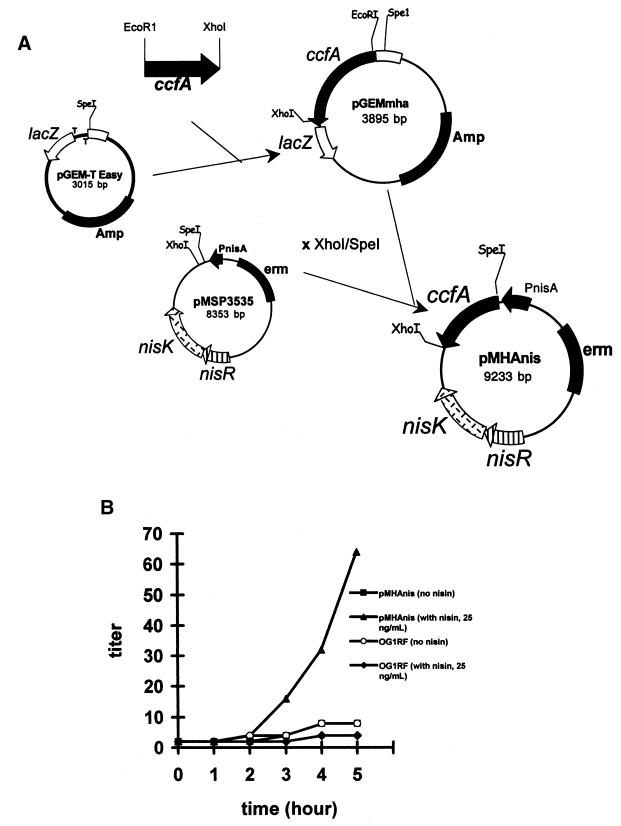
(A) Construction of plasmid pMHAnis. (B) Detection of pheromone activity in culture supernatants. Cultures of E. faecalis OG1RF and E. faecalis OG1RF(pMHAnis) were grown overnight in the presence (25 ng/ml) or absence of nisin. Titer of cCF10 in the corresponding culture supernatants was determined.
FIG. 4.
FIG. 4.
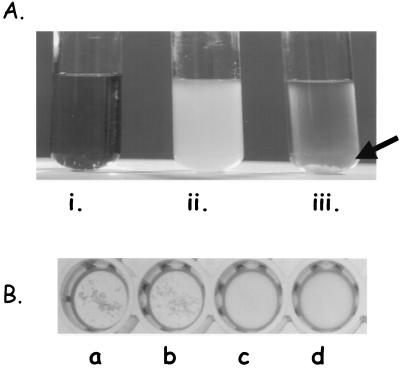
(A) Overriding self-clumping control mechanism with nisin induction. (i) Uninoculated medium (THB); (ii) E. faecalis(pCF10/pMHAnis) 4-h culture; and (iii) E. faecalis(pCF10/pMHAnis) 4-h culture induced with nisin (25 ng/ml). The arrow points to the characteristic clumpy phenotype that results upon pheromone induction. (B) Heterologous expression of cCF10. Results of a clumping assay for pheromone activity in culture filtrates from the following cultures: L. lactis(pMHAnis) induced with nisin (25 ng/ml) (b) and L. lactis(pMHAnis) uninduced (c) in comparison with E. faecalis(pCF10/pMHAnis) induced with nisin (25 ng/ml) (a) and E. faecalis(pCF10/pMHAnis) uninduced (d). E. faecalis OG1RF(pCF10) was used as a responder strain for this assay.
FIG. 5.
FIG. 5.
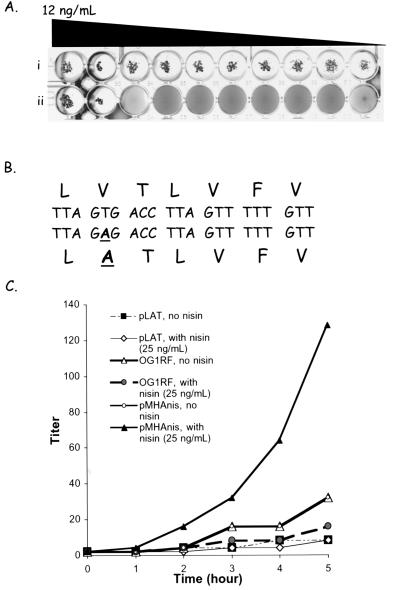
(A) Clumping assay using synthetic (i) cCF10 peptide LVTLVFV and (ii) LATLVFV peptide. The starting concentration (12 ng/ml) was serially diluted (twofold) before it was inoculated with the indicator strain E. faecalis OG1RF(pCF10). At this starting concentration, cCF10 had a clumping titer of 210 (i), whereas LATLVFV had a titer of only 22 (ii). (B) Nucleotide modification generated by site-directed mutagenesis to yield the appropriate V14A change with the prolipoprotein signal peptide. (C) Pheromone activity in culture supernatants. Cultures of E. faecalis OG1RF, E. faecalis OG1RF(pMHAnis), and E. faecalis OG1RF(pLAT) were grown for 5 h in the presence (25 ng/ml) or absence of nisin. Titer of cCF10 in the corresponding culture supernatants was determined.
FIG. 6.
FIG. 6.
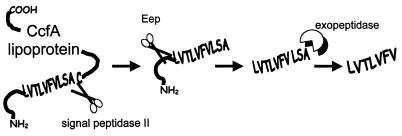
Model for cCF10 biosynthesis. Signal peptidase II cleaves off the signal peptide of nascent prolipoprotein CcfA. The signal peptide is processed further by Eep, which cleaves at the amino-terminal end of the cCF10 peptide sequence. The decapeptide cCF10 precursor is further processed by an exopeptidase, resulting in mature cCF10. The scissors represent an endopeptidase; whereas the pie figure represents an exopeptidase.

References

    1. Altschul, S. F., W. Gish, W. Miller, E. W. Myers, and D. J. Lipman. 1990. Basic local alignment search tool. J. Mol. Biol. 215:403-410. - PubMed
    1. An, F. Y., and D. B. Clewell. 1994. Characterization of the determinant (traB) encoding sex pheromone shutdown by the hemolysin/bacteriocin plasmid, pAD1 in Enterococcus faecalis. Plasmid 31:215-221. - PubMed
    1. An, F. Y., M. C. Sulavik, and D. B. Clewell. 1999. Identification and characterization of a determinant (eep) on the Enterococcus faecalis chromosome that is involved in production of the peptide sex pheromone cAD1. J. Bacteriol. 181:5915-5921. - PMC - PubMed
    1. Anonymous. 2000. TBLASTN, 2.0MP-WashU ed. Washington University, St. Louis, Mo.
    1. Barik, S. 1996. Site-directed mutagenesis in vitro by megaprimer PCR. Methods Mol. Biol. 57:203-215. - PubMed

Publication types

LinkOut - more resources