Fusidic acid cream in the treatment of impetigo in general practice: double blind randomised placebo controlled trial
- PMID: 11809642
- PMCID: PMC64791
- DOI: 10.1136/bmj.324.7331.203
Fusidic acid cream in the treatment of impetigo in general practice: double blind randomised placebo controlled trial
Abstract
Objective: To test the hypothesis that fusidic acid would not increase the treatment effect of disinfecting with povidone-iodine alone in children with impetigo.
Design: Randomised placebo controlled trial.
Setting: General practices in Greater Rotterdam.
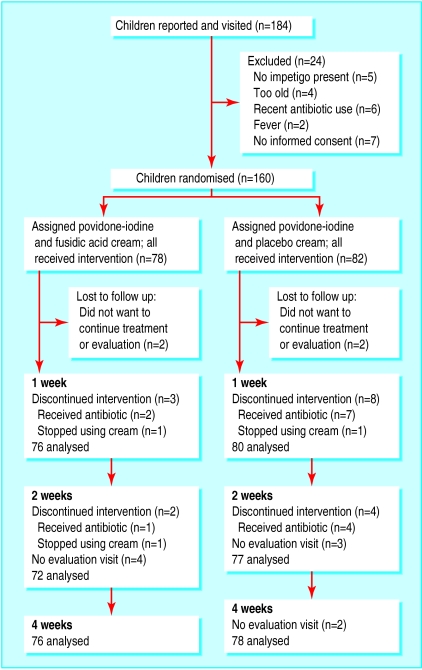
Participants: 184 children aged 0-12 years with impetigo.
Main outcome measures: Clinical cure and bacterial cure after one week.
Results: After one week of treatment 55% of the patients in the fusidic acid group were clinically cured compared with 13% in the placebo group (odds ratio 12.6, 95% confidence interval 5.0 to 31.5, number needed to treat 2.3). After two weeks and four weeks the differences in cure rates between the two groups had become smaller. More children in the placebo group were non-compliant (12 v 5) and received extra antibiotic treatment (11 v 3), and more children in the placebo group reported adverse effects (19 v 7). Staphylococcus aureus was found in 96% of the positive cultures; no strains were resistant to fusidic acid.
Conclusions: Fusidic acid is much more effective than placebo (when both are given in combination with povidone-iodine shampoo) in the treatment of impetigo. Because of the low rate of cure and high rate of adverse events in the placebo group, the value of povidone-iodine in impetigo can be questioned.
Comment in
-
Fusidic acid cream for impetigo. Fusidic acid should be used with restraint.BMJ. 2002 Jun 8;324(7350):1394. doi: 10.1136/bmj.324.7350.1394/a. BMJ. 2002. PMID: 12052817 Free PMC article. No abstract available.
-
Fusidic acid cream for impetigo. Judicious use is advisable.BMJ. 2002 Jun 8;324(7350):1394. BMJ. 2002. PMID: 12053927 No abstract available.
-
Fusidic acid cream for impetigo. Emergence of resistance to fusidic acid limits its use.BMJ. 2002 Jun 8;324(7350):1394. BMJ. 2002. PMID: 12053928 No abstract available.
-
Fusidic acid cream for impetigo. Problem may be clinically important.BMJ. 2002 Jun 8;324(7350):1394. BMJ. 2002. PMID: 12053929 No abstract available.
-
Fusidic acid cream for impetigo. Resistance trends must be monitored.BMJ. 2002 Jun 8;324(7350):1394. BMJ. 2002. PMID: 12053930 No abstract available.
-
Fusidic acid cream for impetigo. Findings cannot be extrapolated.BMJ. 2002 Jun 8;324(7350):1394. BMJ. 2002. PMID: 12053931 No abstract available.
References
-
- Bruijnzeels MA, van Suijlekom-Smit LWA, van der Velden J, van der Wouden JC. The child in general practice. Rotterdam/Utrecht: Erasmus Universiteit/NIVEL; 1993.
-
- Boukes FS, van der Burgh JJ, Nijman FC, Sampers GM, Simon B, Romeijnders AC, et al. NHG-Standaard bacteriële huidinfecties [Dutch College of General Practitioners’ guideline on bacterial skin infections] Huisarts Wet. 1999;41:427–437.
-
- Resnick DS. Staphylococcal and streptococcal skin infections: pyodermas and toxin-mediated syndromes. In: Harper J, Oranje A, Prose N, editors. Textbook of pediatric dermatology. 1st ed. Oxford: Blackwell; 2000. pp. 369–372.
-
- Hay RJ, Adriaans BM. Bacterial infections. In: Champion RH, Burton JL, Ebling FJG, editors. Rook/Wilkinson/Ebling, Textbook of dermatology. 6th ed. Oxford: Blackwell; 1998. pp. 1109–1111.
Publication types
MeSH terms
Substances
LinkOut - more resources
Full Text Sources
Medical