. 2002 Feb;22(4):1246-52.
doi: 10.1128/MCB.22.4.1246-1252.2002.

Convergence of TOR-nitrogen and Snf1-glucose signaling pathways onto Gln3

Affiliations

Convergence of TOR-nitrogen and Snf1-glucose signaling pathways onto Gln3

Paula G Bertram et al. Mol Cell Biol. 2002 Feb.

Abstract

Carbon and nitrogen are two basic nutrient sources for cellular organisms. They supply precursors for energy metabolism and metabolic biosynthesis. In the yeast Saccharomyces cerevisiae, distinct sensing and signaling pathways have been described that regulate gene expression in response to the quality of carbon and nitrogen sources, respectively. Gln3 is a GATA-type transcription factor of nitrogen catabolite-repressible (NCR) genes. Previous observations indicate that the quality of nitrogen sources controls the phosphorylation and cytoplasmic retention of Gln3 via the target of rapamycin (TOR) protein. In this study, we show that glucose also regulates Gln3 phosphorylation and subcellular localization, which is mediated by Snf1, the yeast homolog of AMP-dependent protein kinase and a cytoplasmic glucose sensor. Our data show that glucose and nitrogen signaling pathways converge onto Gln3, which may be critical for both nutrient sensing and starvation responses.


Figures
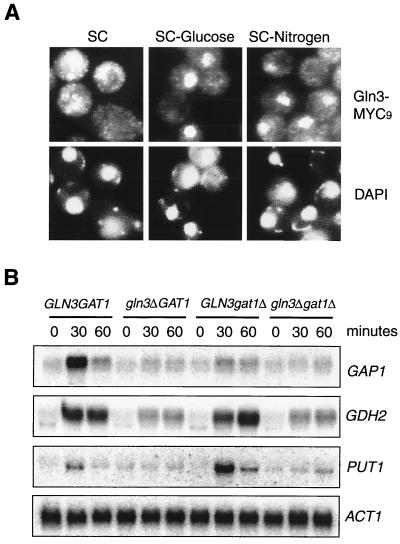
FIG. 1.
FIG. 1.
Glucose availability regulates subcellular localization of Gln3 and Gln3-dependent NCR genes. (A) Glucose availability regulates subcellular localization of Gln3. Early-log-phase cells (OD600 = 0.2) expressing Gln3-MYC9 in SC medium containing 2% glucose were switched to SC medium, SC medium minus glucose, or SC medium minus nitrogen (SC medium minus ammonium sulfate and amino acids) for 30 min. Gln3-MYC9 localization was then analyzed by indirect IF staining with MAb 9E10. Nuclear DNA was stained with 4",6-diamidino-2-phenylindole. The cell staining images were captured with a SPOT digital camera. (B) Glucose availability regulates Gln3-dependent NCR genes. Exponentially growing wild-type and mutant yeast cells (OD600 = 0.4) in SC medium were switched to SC medium minus glucose. Samples were withdrawn at different times and analyzed for expression of GAP1, GDH2, PUT1, and ACT1 by Northern blot.
FIG. 2.
FIG. 2.
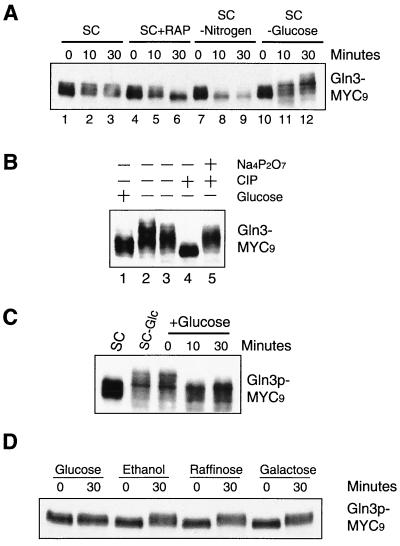
Glucose availability regulates phosphorylation of Gln3. (A) Glucose starvation decreases Gln3 gel mobility. Exponentially growing cells in SC medium (OD600 = 0.4) were switched to SC medium, SC medium plus rapamycin (SXC+RAP), SC medium minus nitrogen (SC-Nitrogen), or SC medium minus glucose (SC-glucose) for 0, 10, and 30 min. Gln3 gel mobility was detected by Western blotting. (B) Electrophoretic decrease of Gln3 during glucose limitation is due to phosphorylation. Exponential-phase yeast cells (OD600 = 0.4) in SC medium (lane 1) were switched to SC medium minus glucose for 30 min (lane 2). Lysates of cells under glucose starvation were incubated with a buffer for CIP (lanes 3 and 4) or CIP plus Na4P2O7 (lane 5). Gln3 electrophoretic mobility was detected by Western blotting with MAb 9E10. (C) Phosphorylation of Gln3 during glucose limitation is reversible. Yeast cells cultured in SC medium minus glucose (SC-Glc) were switched to SC medium for 10 and 30 min. Gln3 gel mobility was detected by Western blotting. (D) Glucose limitation causes phosphorylation of Gln3. Exponential cells in SC medium were switched to SC medium plus glucose or SC medium containing one of the following reagents as the sole carbon source for 30 min: ethanol, raffinose, or galactose. Gln3 gel mobility was detected by Western blotting.
FIG. 3.
FIG. 3.
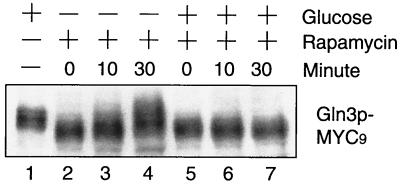
TOR is not required for phosphorylation of Gln3 during glucose limitation. Exponentially growing yeast cells in SC medium (OD600 = 0.4) were treated with rapamycin for 30 min to generate completely dephosphorylated Gln3. These cells were then switched to SC medium with or without glucose in the presence of rapamycin for 10 and 30 min. Shown is the gel mobility of Gln3 as detected by Western blotting.
FIG. 4.
FIG. 4.
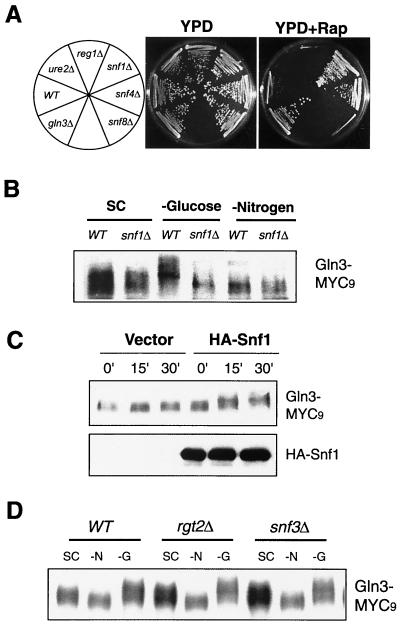
The role of glucose sensors in the in vivo phosphorylation of Gln3. (A) Mutations in the Snf1 pathway confer differential rapamycin sensitivity. The wild-type (WT) and mutant yeast strains were streaked onto YPD and YPD plus rapamycin (YPD+RAP) (25 nM) plates and incubated at 30°C for 2 (YPD) and 4 (YPD plus rapamycin) days, respectively. (B) Snf1 is required for Gln3 phosphorylation during glucose starvation, but not during nitrogen starvation. Exponentially growing wild-type and snf1Δ cells expressing Gln3-MYC9 in SC medium (OD600 = 0.4) were switched to SC medium or SC medium minus glucose or nitrogen for 30 min. (C) Recombinant Snf1 restores the deficiency of Gln3 phosphorylation during glucose limitation in the snf1Δ strain. The snf1Δ strains carrying a plasmid expressing recombinant Snf1 or a vector control were examined for Gln3-MYC9 phosphorylation at different times after glucose limitation. (Upper panel) Western blot for Gln3-MYC9. (Lower panel) Western blot for Snf1. (D) Rgt2 and Snf3 are not required for Gln3 phosphorylation during glucose limitation. Exponentially growing wild-type and mutant cells expressing Gln3-MYC9 in SC medium (OD600 = 0.4) were switched to SC medium or SC medium minus nitrogen or glucose for 30 min. Gln3 phosphorylation was examined by Western blotting.
FIG. 5.
FIG. 5.
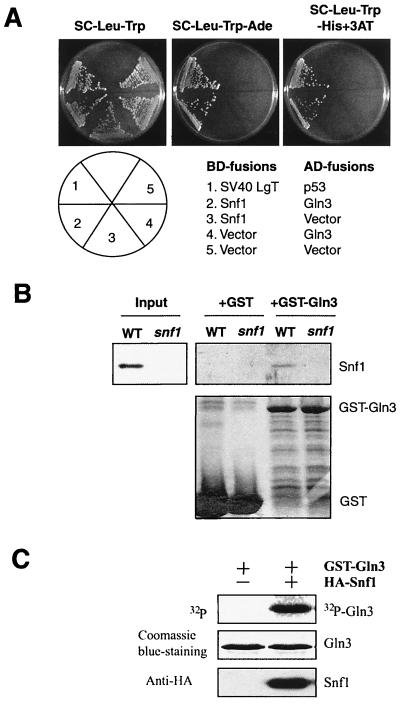
Snf1 interacts with Gln3. (A) Snf1 interacts with Gln3 in a yeast two-hybrid assay. Gal4 DNA binding domain (BD)-Snf1 specifically interacts with Gal4 activation domain (AD)-Gln3, but not with AD alone. The two-hybrid reporter strain (AH109) carrying different BD and AD fusion plasmids was assayed for growth on an adenine dropout plate or a histidine dropout plate containing 3-AT (2 mM). LgT, large T antigen. (B) Snf1 binds to GST-Gln3. Extracts of wild-type (WT) and snf1Δ yeast strains were assayed for their ability to bind to immobilized, bacterially produced GST or GST-Gln3. The bound materials were detected by Western blotting with an anti-polyhistidine antibody that recognizes Snf1. (C) Snf1 phosphorylates Gln3 in vitro. HA-Snf1 was immunoprecipitated and assayed for its ability to phosphorylate bacterial recombinant GST-Gln3 in the presence of [γ-32P]ATP.
FIG. 6.
FIG. 6.
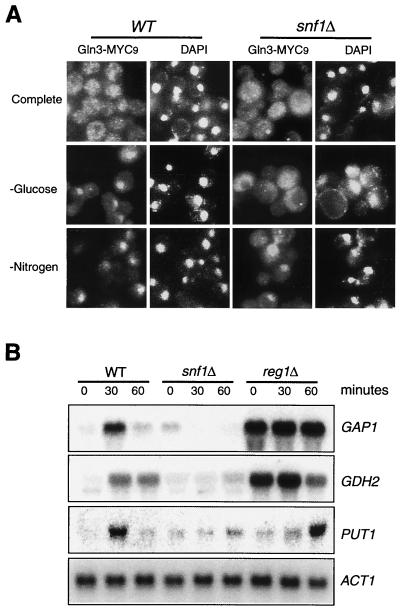
Snf1 is required for Gln3 nuclear accumulation and induction of NCR genes during glucose limitation. (A) Early-log-phase (OD600 = 0.2) wild-type (WT) or snf1Δ yeast cells expressing Gln3-MYC9 in SC medium were switched to SC medium, SC medium minus glucose (−glucose), or SC medium minus nitrogen (−Nitrogen) for 30 min. Gln3 localization was detected by indirect IF with the 9E10 MAb. DAPI, 4",6-diamidino-2-phenylindole. (B) Snf1 is required for expression of NCR genes during glucose limitation. Exponential wild-type or mutant yeast cells (OD600 = 0.4) in SC medium were shifted to SC medium minus glucose. Aliquots of culture were withdrawn at different times (as shown) and analyzed for expression of selected NCR genes by Northern blotting.
FIG. 7.
FIG. 7.
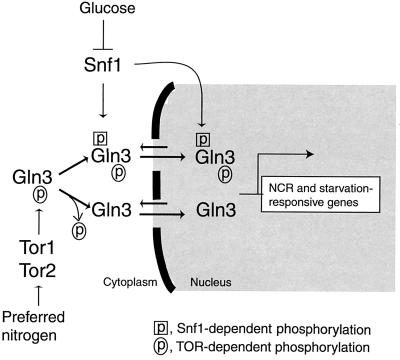
Model for regulation of Gln3 by both nitrogen and glucose. TOR and Snf1 independently mediate nitrogen and glucose signaling pathways, respectively, to regulate Gln3 nuclear localization and specificity for its target genes. Our results suggest that phosphorylation controls the subcellular localization of Gln3. TOR-dependent phosphorylation appears to keep Gln3 in the cytoplasm, while Snf1-dependent phosphorylation leads to nuclear accumulation of Gln3 by promoting nuclear import and/or inhibiting nuclear export.

References

    1. Alberts, B., D. Bray, J. Lewis, M. Raff, K. Roberts, and J. Watson. 1994. Molecular biology of the cell. Garland Publishing, Inc., New York, N.Y.
    1. Beck, T., and M. N. Hall. 1999. The TOR signaling pathway controls nuclear localization of nutrient-regulated transcriptional factors. Nature 402:689-692. - PubMed
    1. Bertram, P. G., J. Choi, J. Carvalho, W. D. Ai, C. B. Zeng, T. F. Chan, and X. F. S. Zheng. 2000. Tripartite regulation of Gln3p by TOR, Ure2p and phosphatases. J. Biol. Chem. 275:35727-35733. - PubMed
    1. Bertram, P. G., C. Zeng, J. Thorson, A. S. Shaw, and X. F. Zheng. 1998. The 14-3-3 proteins positively regulate rapamycin-sensitive signaling. Curr. Biol. 8:1259-1267. - PubMed
    1. Brachmann, C. B., A. Davies, G. J. Cost, E. Caputo, J. Li, P. Hieter, and J. D. Boeke. 1998. Designer deletion strains derived from Saccharomyces cerevisiae S288C: a useful set of strains and plasmids for PCR-mediated gene disruption and other applications. Yeast 14:115-132. - PubMed

Publication types

MeSH terms

LinkOut - more resources