. 2002 Feb 5;99(3):1598-603.
doi: 10.1073/pnas.032225799. Epub 2002 Jan 29.

Evidence of a mate-finding cue in the hermaphrodite nematode Caenorhabditis elegans

Affiliations

Evidence of a mate-finding cue in the hermaphrodite nematode Caenorhabditis elegans

Jasper M Simon et al. Proc Natl Acad Sci U S A. .

Abstract

When males of the roundworm Caenorhabditis elegans come into association with their hermaphroditic counterparts they cease foraging behavior and begin to mate. Here we detail several assays used to demonstrate that a diffusible cue is correlated with this process. This cue is sexually dimorphic, given off only by the hermaphrodite and eliciting a response only in the male. Males are attracted to, reverse direction of movement frequently, and remain in regions of agar conditioned with hermaphrodites. From our studies we suggest a form of kinesis that works by attracting males to their mating partners from a distance and functions, once males arrive, in holding attracted males in close proximity. The hermaphrodite vulva is not required for the cue. Males from general sensory mutants osm-5 and osm-6 fail to respond to the cue, whereas male-specific mutants lov-1 and pkd-2 respond. Finally, that males from multiple isolates of C. elegans also respond similarly to this cue indicates that this cue is robust and has been maintained during recent evolution.


Figures
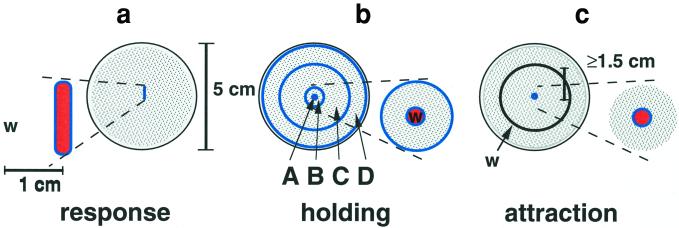
Figure 1
Figure 1
Design of response, holding, and attraction assays. Trials were performed on 5-cm agar plates with 2-day-old bacterial lawns (gray, stippled area). Individual test animals (w) were introduced ≈1 cm from scoring region in the response assay (a), directly on area A in the holding assay, dispersing on their release (b), and more than 1.5 cm from conditioned point source in the attraction assay (c). Unconditioned or conditioned regions are denoted in orange, and blue lines demark scoring region and areas (A–B–C–D).
Figure 2
Figure 2
Time course of N2 males from representative film clips of unconditioned (−) and N2 hermaphrodite-conditioned (+) trials. On average, males moved directly through unconditioned regions, backing less than once and taking ≈30 s to cross through scoring regions. In contrast, during conditioned trials males reversed around six times while turning over scoring regions spending >90 s. Tracks from males are traced over in orange. Scoring regions are outlined in blue. Elapsed time (s) is included within each film frame. (Scale bar is 1 mm.)
Figure 3
Figure 3
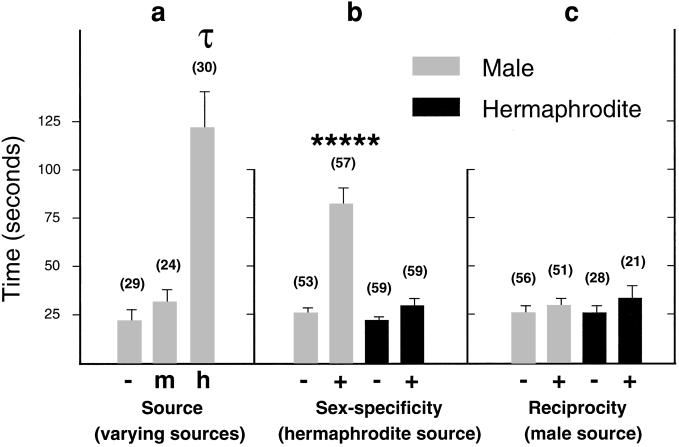
Effects of source and sex on cue response. Individual young-adult test animals were introduced (no. of animals in parentheses) to unconditioned (−) and conditioned (+) agar trials. Trial plates are compared for time in scoring region during a 5-min interval. Statistical comparison of means (error bars represent SEM) between trials in the source experiment were performed by using Tukey's honestly significant difference, τ significance level of 0.05 grouped unconditioned (−) and male-conditioned (m) trials together and found the hermaphrodite-conditioned (h) trial separate. Pairwise Mann–Whitney U tests were used for sex-specificity and reciprocity experiments; *****, P < 0.00001.

References

    1. Jallon J. Behav Genet. 1984;15:441–478. - PubMed
    1. Shorey H. Annu Rev Entomol. 1973;18:349–380. - PubMed
    1. Dulka J. Brain Behav Evol. 1993;42:265–280. - PubMed
    1. Sorensen P, Christensen T, Stacey N. Curr Opin Neurobiol. 1998;8:458–467. - PubMed
    1. Bronson F. Biol Reprod. 1971;4:344–357. - PubMed

Publication types

LinkOut - more resources