. 2002 Feb;68(2):560-8.
doi: 10.1128/AEM.68.2.560-568.2002.

Characterization and application of xylene monooxygenase for multistep biocatalysis

Affiliations

Characterization and application of xylene monooxygenase for multistep biocatalysis

Bruno Bühler et al. Appl Environ Microbiol. 2002 Feb.

Abstract

Xylene monooxygenase of Pseudomonas putida mt-2 catalyzes multistep oxidations of one methyl group of toluene and xylenes. Recombinant Escherichia coli expressing the monooxygenase genes xylM and xylA catalyzes the oxygenation of toluene, pseudocumene, the corresponding alcohols, and the corresponding aldehydes, all by a monooxygenation type of reaction (B. Bühler, A. Schmid, B. Hauer, and B. Witholt, J. Biol. Chem. 275:10085-10092, 2000). Using E. coli expressing xylMA, we investigated the kinetics of this one-enzyme three-step biotransformation. We found that unoxidized substrates like toluene and pseudocumene inhibit the second and third oxygenation steps and that the corresponding alcohols inhibit the third oxygenation step. These inhibitions might promote the energetically more favorable alcohol and aldehyde dehydrogenations in the wild type. Growth of E. coli was strongly affected by low concentrations of pseudocumene and its products. Toxicity and solubility problems were overcome by the use of a two-liquid-phase system with bis(2-ethylhexyl)phthalate as the carrier solvent, allowing high overall substrate and product concentrations. In a fed-batch-based two-liquid-phase process with pseudocumene as the substrate, we observed the consecutive accumulation of aldehyde, acid, and alcohol. Our results indicate that, depending on the reaction conditions, product formation could be directed to one specific product.


Figures
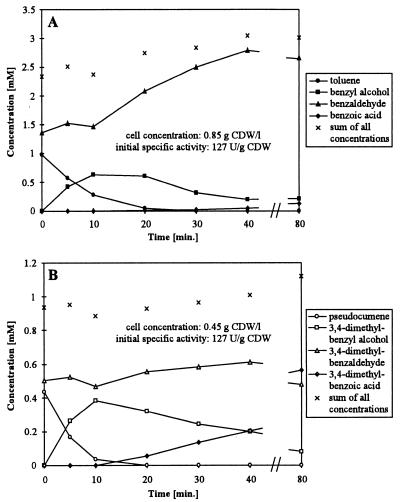
FIG. 1.
FIG. 1.
Product formation after simultaneous addition of toluene and benzaldehyde (A) and of pseudocumene and 3,4-dimethylbenzaldehyde (B) to resting E. coli JM101(pSPZ3) in 50 mM potassium phosphate buffer, pH 7.4, containing 1% (wt/vol) glucose. The assay was performed as described in Materials and Methods.
FIG. 2.
FIG. 2.
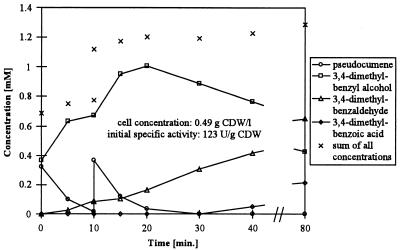
Product formation after simultaneous addition of pseudocumene and 3,4-dimethylbenzyl alcohol to resting E. coli JM101(pSPZ3) in 50 mM potassium phosphate buffer, pH 7.4, containing 1% (wt/vol) glucose. Assays were performed as described in Materials and Methods. After 10 min, pseudocumene was pulsed to the reaction mixtures.
FIG. 3.
FIG. 3.
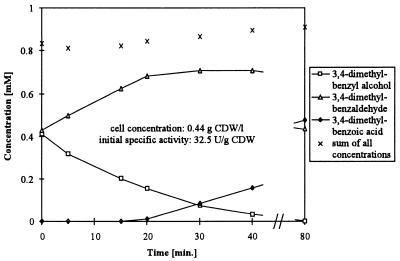
Product formation after simultaneous addition of 3,4-dimethylbenzyl alcohol and 3,4-dimethylbenzaldehyde to resting E. coli JM101(pSPZ3) in 50 mM potassium phosphate buffer, pH 7.4, containing 1% (wt/vol) glucose. Assays were performed as described in Materials and Methods.
FIG. 4.
FIG. 4.
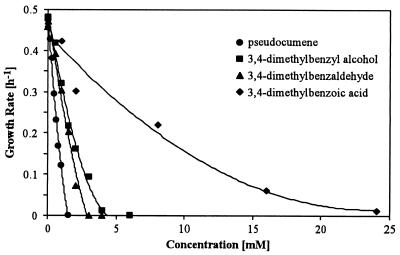
Growth rates of E. coli JM101 after addition of different amounts of pseudocumene, 3,4-dimethylbenzyl alcohol, 3,4-dimethylbenzaldehyde, or 3,4-dimethylbenzoic acid. After entering exponential growth, a 400-ml culture was split into 40-ml subcultures, to which different amounts of the substance of interest were added. Experimental details are described in Materials and Methods.
FIG. 5.
FIG. 5.
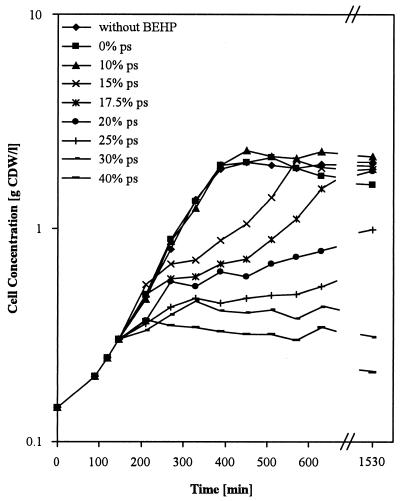
Growth of E. coli JM101 in the absence and in the presence of BEHP containing different volume fractions of pseudocumene. After reaching exponential growth, a 200-ml culture was split into 20-ml subcultures, to which no or 20 ml of BEHP containing different volume fractions of pseudocumene (ps) was added. Experimental details are described in Materials and Methods.
FIG. 6.
FIG. 6.
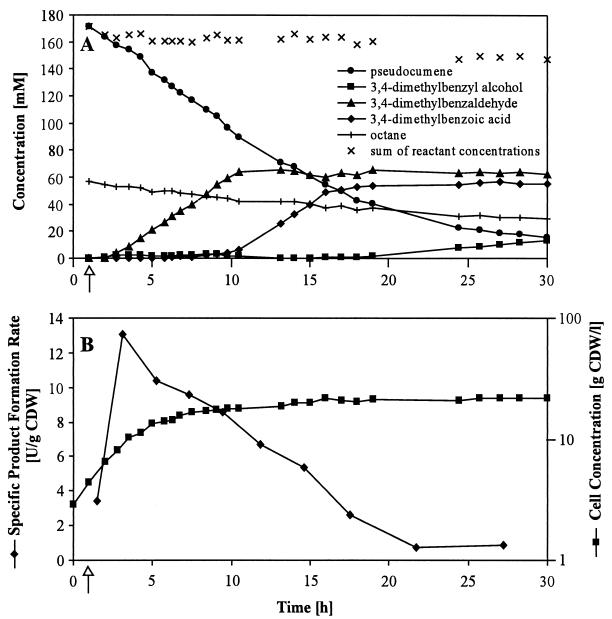
Fed-batch-based two-liquid-phase biotransformation with E. coli JM101(pSPZ3) at a phase ratio of 0.5. The second organic phase consisted of BEHP as the organic carrier solvent, 2% (vol/vol) pseudocumene, and 1% (vol/vol) n-octane (as the inducer). Addition of the organic phase occurred 1 h after feed initiation (arrow). Experimental details of the fed batch are described in Materials and Methods. (A) Reactant and octane concentrations during the fed-batch experiment. All concentrations represent the sum of the respective concentrations in the organic and aqueous phases. (B) Formation of E. coli JM101(pSPZ3) biomass and development of the specific product formation rate, which was calculated by determining the rate of total product formation per gram of CDW as the average for an interval between two data points.

References

    1. Abril, M.-A., C. Michan, K. N. Timmis, and J. L. Ramos. 1989. Regulator and enzyme specificities of the TOL plasmid-encoded upper pathway for degradation of aromatic hydrocarbons and expansion of the substrate range of the pathway. J. Bacteriol. 171:6782-6790. - PMC - PubMed
    1. Bard, M., D. A. Bruner, C. A. Pierson, N. D. Lees, B. Biermann, L. Frye, C. Koegel, and R. Barbuch. 1996. Cloning and characterization of ERG25, the Saccharomyces cerevisiae gene encoding C-4 sterol methyl oxidase. Proc. Natl. Acad. Sci. USA 93:186-190. - PMC - PubMed
    1. Bell-Parikh, L. C., and F. P. Guengerich. 1999. Kinetics of cytochrome P450 2E1-catalyzed oxidation of ethanol to acetic acid via acetaldehyde. J. Biol. Chem. 274:23833-23840. - PubMed
    1. Bühler, B., A. Schmid, B. Hauer, and B. Witholt. 2000. Xylene monooxygenase catalyzes the multistep oxygenation of toluene and pseudocumene to corresponding alcohols, aldehydes, and acids in Escherichia coli JM101. J. Biol. Chem. 275:10085-10092. - PubMed
    1. Burlage, R. S., S. W. Hooper, and G. S. Sayler. 1989. The TOL (pWW0) catabolic plasmid. Appl. Environ. Microbiol. 55:1323-1328. - PMC - PubMed

Publication types

LinkOut - more resources