. 2002 Feb 1;21(3):377-86.
doi: 10.1093/emboj/21.3.377.

Importins fulfil a dual function as nuclear import receptors and cytoplasmic chaperones for exposed basic domains

Affiliations

Importins fulfil a dual function as nuclear import receptors and cytoplasmic chaperones for exposed basic domains

Stefan Jäkel et al. EMBO J. .

Abstract

Many nuclear transport pathways are mediated by importin beta-related transport receptors. Here, we identify human importin (Imp) 4b as well as mouse Imp4a, Imp9a and Imp9b as novel family members. Imp4a mediates import of the ribosomal protein (rp) S3a, while Imp9a and Imp9b import rpS7, rpL18a and apparently numerous other substrates. Ribosomal proteins, histones and many other nuclear import substrates are very basic proteins that aggregate easily with cytoplasmic polyanions such as RNA. Imp9 effectively prevents such precipitation of, for example, rpS7 and rpL18a by covering their basic domains. The same applies to Imp4, Imp5, Imp7 and Impbeta and their respective basic import substrates. The Impbeta-Imp7 heterodimer appears specialized for the most basic proteins, such as rpL4, rpL6 and histone H1, and is necessary and sufficient to keep them soluble in a cytoplasmic environment prior to rRNA or DNA binding, respectively. Thus, just as heat shock proteins function as chaperones for exposed hydrophobic patches, importins act as chaperones for exposed basic domains, and we suggest that this represents a major and general cellular function of importins.


Figures
None
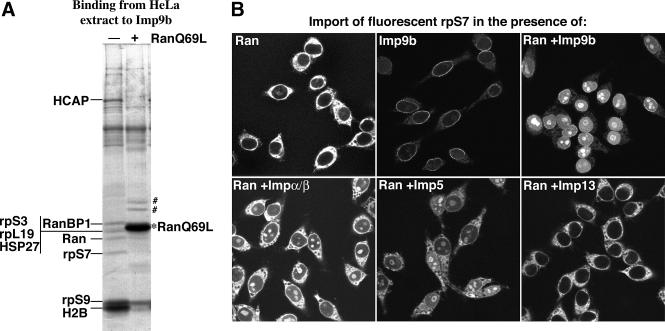
Fig. 1. (A) Identification of potential Imp9-specific transport substrates. Immobilized Imp9b was used to retrieve interacting proteins from a cytosolic HeLa extract. Binding was performed in the absence or presence of RanQ69L GTP (5 µM) to mimic a cytoplasmic and nuclear environment, respectively. Analysis of bound proteins was by SDS–PAGE, followed by Coomassie Blue staining. The hepatocellular carcinoma-associated protein (HCAP), the ribosomal proteins S3, S7, S9 and L19 as well as the heat shock protein HSP27 and the core histone H2B were identified by mass spectrometry as putative import substrates. ‘#’ indicates two bands derived from the added RanQ69L. (B) Imp9 mediates import of rpS7. Import of fluorescently labelled rpS7 (1 µM) into nuclei of permeabilized cells was performed for 15 min with the indicated combinations of nuclear transport receptors (1 µM each). The panels show confocal sections of the rpS7 distribution after import and fixation. Nuclear import of rpS7 was efficient with Imp9b or the Impα/β heterodimer and turned out to be strictly Ran and energy dependent. As expected for a ribosomal protein, rpS7 accumulated strongly in the nucleoli, whenever import was efficient.
None
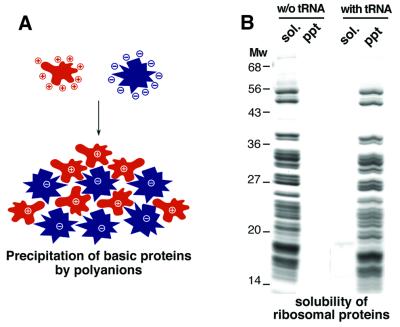
Fig. 2. (A) A schematic illustration of the ‘basic chaperone’ problem. Basic proteins (in red) can form large aggregates through multivalent ionic interactions with polyanions (in blue) such as nucleic acids. (B) A practical demonstration of the basic chaperone problem. Total ribosomal proteins (TP80) were purified from HeLa ribosomes as described in Materials and methods. The pure TP80 preparation (90 µg/ml protein) is perfectly soluble in the absence of polyanions, but the ribosomal proteins collectively precipitate upon addition of tRNA (30 µg/ml). sol. = soluble fraction; ppt = precipitate.
None
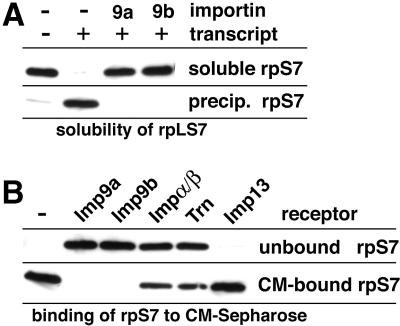
Fig. 3. (A) Imp9 suppresses aggregation of the rpS7 with polyanions. rpS7 (0.5 µM) was incubated with the indicated combinations of in vitro transcribed RNA (60 µg/µl) and Imp9a or 9b (0.75 µM each). Soluble fractions and precipitates were separated by centrifugation and analysed for rpS7 content by western blotting (for details see Materials and methods). Addition of RNA caused a quantitative precipitation of rpS7, which in turn was fully suppressed by the presence of the importins. (B) Imp9 shields basic patches in rpS7 against ionic interactions. rpS7 (0.5 µM) was incubated with various nuclear transport receptors (0.75 µM each) and subsequently subjected to binding to the cation exchanger CM-Sepharose. rpS7 alone bound tightly to CM. This binding was fully suppressed by Imp9a or 9b, indicating an efficient shielding of the exposed basic patches of S7. Imp13, which does not support rpS7 import, was also totally negative in this shielding/anti-aggregation assay. Transportin (Trn) and the Impα/β heterodimer, which are functional but suboptimal import receptors for rpS7, had a partial effect.
None
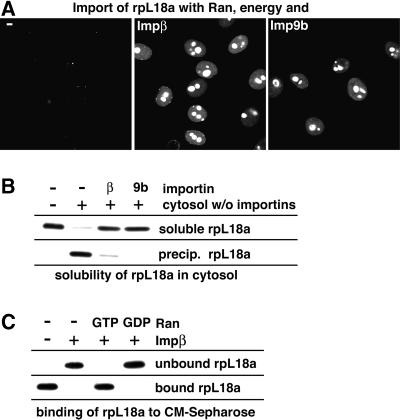
Fig. 4. (A) Nuclear import of the Alexa 488-labelled ribosomal protein L18a (0.5 µM) was performed with Ran and an energy-regenerating system. The presence of either Impβ or Imp9b (0.75 µM each) resulted in efficient nuclear import and nucleolar accumulation of rpL18a. (B) rpL18a (0.5 µM) precipitates in importin-free cytosol, but remained soluble when the cytosol was replenished with 0.75 µM Impβ or Imp9 (for details see Materials and methods). (C) Impβ prevents rpL18a binding to CM-Sepharose (for details see Figure 3B and Materials and methods). This shielding of rpL18a against interactions with polyanionic surfaces was highly specific and could be abrogated by 2.5 µM RanQ69LGTP, which displaces rpL18a from Impβ. The shielding was unaffected by 2.5 µM RanGDP, which leaves the Impβ–rpL18a complex intact.
None
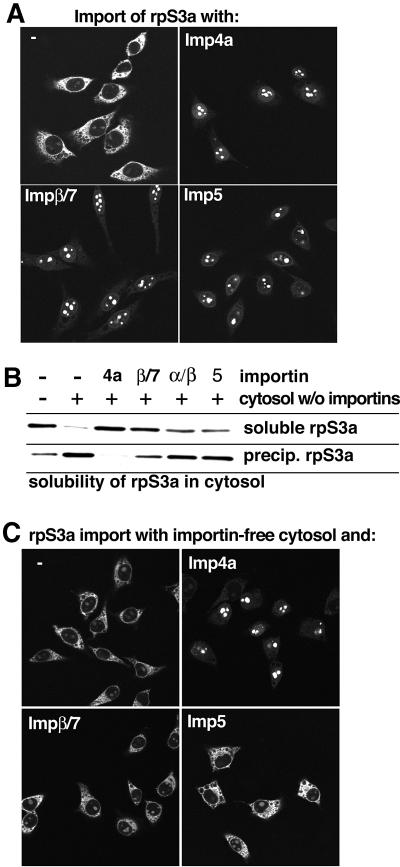
Fig. 5. Imp4 is a functional nuclear import receptor and a cytoplasmic chaperone for the ribosomal protein S3a. (A) Nuclear import of Alexa 488-labelled rpS3a (0.5 µM) was performed with Ran, an energy-regenerating system and the indicated transport receptors (1.5 µM each). Imp4a, Imp5 and the Impβ/7 heterodimer were efficient in rpS3a import. Under these conditions, all three receptor species suppressed aggregation of rpS3a with the cytoplasmic remnants of the permeabilized cells. (B) Imp4a is necessary and sufficient to suppress precipitation of rpS3a in a cytoplasmic environment. The anti-precipitation assays contained 0.5 µM rpS3a in either buffer or a cytoplasmic HeLa extract depleted of importins. Note that rpS3a readily precipitates in a cytoplasmic environment when importins are absent. This aggregation was completely suppressed by re-addition of Imp4a (1.5 µM), while Imp5 (1.5 µM), and the Impα/β (1.5 µM) and Impβ/7 (0.75 µM) heterodimers show only a weak anti-precipitation activity towards this substrate. (C) Nuclear import of rpS3a was performed exactly as in (A), but importin-free cytosol (see Materials and methods) was included in the reaction. Under these conditions, only Imp4a was efficient as a chaperone and import mediator.
None
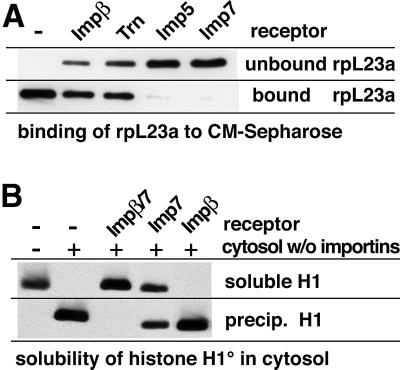
Fig. 6. (A) The ribosomal protein L23a (0.5 µM) was pre-incubated with various nuclear transport receptors (0.75 µM) and subjected to binding to CM-Sepharose. Imp5 and Imp7 efficiently shielded rpL23a against ionic interactions and prevented binding to the cation exchanger, while Impβ and transportin had only a partial effect. (B) Histone H1 was incubated with the indicated combinations of importin-free cytosol, Impβ and Imp7. H1 is perfectly soluble in a pure form, but quantitatively precipitates in a cytosol depleted of importins. Re-addition of a physiological concentration of the Impβ/7 heterodimer (the functional import receptor for H1) suppressed the aggregation completely. Imp7 alone had a partial effect; Impβ had no effect at all.
None
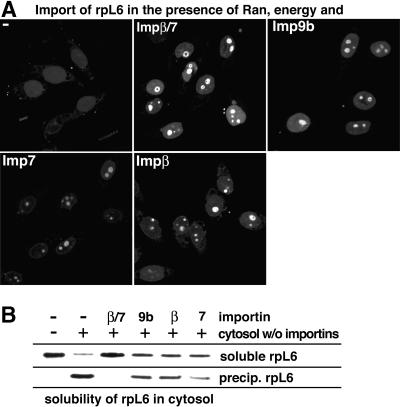
Fig. 7. (A) Efficient nuclear import of rpL6 (0.5 µM) occurred with the Impβ/7 heterodimer (0.75 µM) and to a lesser extent with either Impβ, Imp7 or Imp9b. (B) rpL6 (0.5 µM) was incubated with the indicated combinations of importin-depleted cytosol and transport receptors. rpL6 aggregated in the depleted cytosol, but remained soluble when 0.75 µM Impβ/7 heterodimer was re-added. Impβ, Imp7 or Imp9b (1.5 µM each) could only partially suppress aggregation.
None
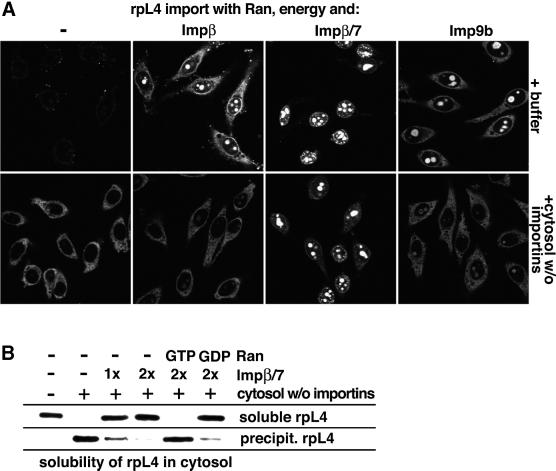
Fig. 8. (A) Import of 0.5 µM rpL4 into the nuclei of permeabilized cells was performed in the presence of Ran and an energy-regenerating system. Nuclear/nucleolar accumulation of rpL4 occurred with either 3 µM Impβ or 3 µM Imp9b, but import was most efficient with 1.5 µM Impβ/7 heterodimer (upper panels). The inclusion of importin-free cytosol in the assay completely abolished Impβ- and Imp9-mediated rpL4 import, but left import by the Impβ/7 heterodimer unaffected (lower panels). In the absence of cytosol and import receptors, most aggregates were deposited outside the cells and remained out of the focal plane. (B) rpL4 is the most positively charged ribosomal protein and relies on the Impβ/7 heterodimer to escape aggregation in a cytoplasmic extract. However, in contrast to rpL6, a higher receptor/cargo ratio was necessary to prevent aggregation. The RanGTP and RanGDP controls demonstrate the specificity of the chaperone function of Impβ/7.

References

    1. Agashe V.R. and Hartl,F.U. (2000) Roles of molecular chaperones in cytoplasmic protein folding. Semin. Cell. Dev. Biol., 11, 15–25. - PubMed
    1. Bukau B. and Horwich,A.L. (1998) The Hsp70 and Hsp60 chaperone machines. Cell, 92, 351–366. - PubMed
    1. Chi N.C., Adam,E.J. and Adam,S.A. (1995) Sequence and characterization of cytoplasmic nuclear protein import factor p97. J. Cell Biol., 130, 265–274. - PMC - PubMed
    1. Chi N.C., Adam,E.J.H., Visser,G.D. and Adam,S.A. (1996) RanBP1 stabilises the interaction of Ran with p97 in nuclear protein import. J. Cell Biol., 135, 559–569. - PMC - PubMed
    1. Cokol M., Nair,R. and Rost,B. (2000) Finding nuclear localization signals. EMBO rep., 1, 411–415. - PMC - PubMed

Publication types