. 2002 Feb 1;538(Pt 3):717-28.
doi: 10.1113/jphysiol.2001.013101.

A Ca2+-permeable non-selective cation channel activated by depletion of internal Ca2+ stores in single rabbit portal vein myocytes

Affiliations

A Ca2+-permeable non-selective cation channel activated by depletion of internal Ca2+ stores in single rabbit portal vein myocytes

A P Albert et al. J Physiol. .

Abstract

In vascular smooth muscle cells many agonists cause the release of Ca2+ ions from internal stores. An important problem concerns the mechanism by which the intracellular stores are refilled subsequent to depletion. In the present study, we describe the properties of a Ca2+-permeable non-selective cation channel current that is activated in rabbit portal vein myocytes by depletion of internal Ca2+ stores. Application of cyclopiazonic acid (CPA), which depletes internal Ca2+ stores, activated whole-cell currents that had a reversal potential (E(r)) of about +50 mV in 1.5 mM external Ca2+ (Ca2+o). In 0 mM Ca2+o, the currents were larger and E(r) was approximately 0 mV. Application of CPA and caffeine during cell-attached recording activated single inward channel currents at negative potentials, which had a slope conductance of 2-3 pS and an E(r) of +20 mV. The slope conductance in 0 and 110 mM Ca2+o was 7 and 1.5 pS, respectively, and E(r) values indicated that these non-selective cation channels are highly permeable to Ca2+ ions. Bath application of the cell-permeant Ca2+ chelator, BAPTA-AM, also activated similar currents, indicating that these channels are not activated by Ca2+. Spontaneous channel currents with similar properties to store-operated channels were observed in some patches. Application of W-7, an inhibitor of the Ca2+-binding protein calmodulin, also activated similar Ca2+-permeable channel currents. In conclusion, it is demonstrated that agents that deplete Ca2+ stores and inhibit calmodulin binding activate Ca2+-permeable non-selective cation channel currents in rabbit portal vein myocytes. These channels may have an important role in vascular smooth muscle in providing an influx of Ca2+ to refill depleted internal Ca2+ stores and appear to possess different characteristics to store-operated channels described in other vascular smooth muscle preparations.


Figures
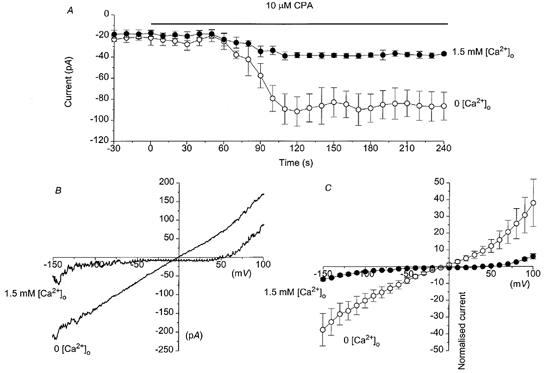
Figure 1
Figure 1. CPA activates a non-selective cation current in rabbit portal vein smooth muscle cells recorded with the whole-cell method
A, the mean time course of the CPA-evoked cation currents recorded at −50 mV in either 1.5 mm (•) or 0 mm (○) Cao2+. Each data point is the mean of at least 4 cells. B, examples of IV relationship of the CPA-evoked cation currents recorded in either 1.5 mm or 0 Cao2+. Note the larger CPA-evoked current, linear IV relationship and more negative reversal potential (Er) in 0 mm Cao2+ compared to 1.5 mm Cao2+. C, the mean I-V relationships of the CPA-evoked cation currents in 1.5 mm (•) or 0 mm (○) Cao2+. Each point is the mean of 5 cells. The plots have been normalized to the amplitudes of the whole-cell cation currents in 1.5 mm Cao2+ at −50 mV (= −1 on y-axis).
Figure 2
Figure 2. Application of CPA or caffeine activates single channel currents in cell-attached patches from rabbit portal vein smooth muscle cells
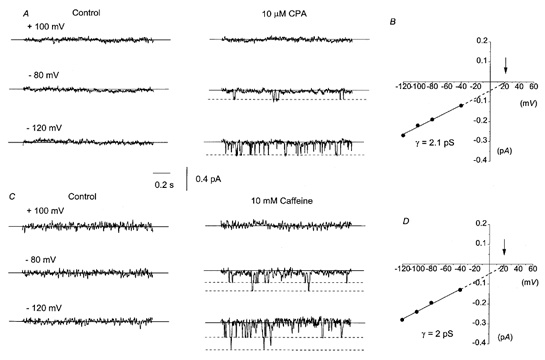
A, using 126 mm NaCl with 1.5 mm Ca2+ patch pipette solution, bath application of 10 μm CPA activated single channel currents in a patch that had not previously shown single channel activity. Note that inward currents are represented as downward deflections and that there is no CPA-evoked single channel activity at +100 mV. Continuous lines indicate the closed level, whereas dashed lines indicate open levels. B, the IV relationship of the CPA-evoked single inward channel currents shown in A had a slope conductance (γ) of 2.1 pS between −120 and −40 mV and an extrapolated Er (↓) of +23 mV. C, bath application of 10 mm caffeine evoked single channel currents in a different cell-attached patch. Note the multiple single channel current openings at negative patch potentials. D, the IV relationship of the caffeine-evoked single inward currents shown in C that had a slope conductance of 2 pS between −120 and −40 mV and an extrapolated Er (↓) of +22 mV.
Figure 3
Figure 3. Application of the cell-permeant Ca2+ chelator, BAPTA-AM, activates inward channel currents that have similar properties to the CPA- and caffeine-evoked channel currents
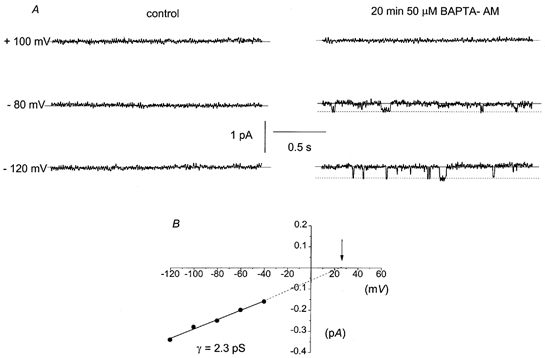
A, activation of inward channel currents at negative membrane potentials after bath application of BAPTA-AM for ∼20 min. Note that no channel currents could be observed at positive membrane potentials. B, the IV relationship of the channel currents shown in A. The channel currents had a slope conductance of 2.3 pS between −120 and −40 mV and an extrapolated Er (↓) of +25 mV.
Figure 4
Figure 4. Application of CPA activates single cation channels that are permeable to Ca2+ ions
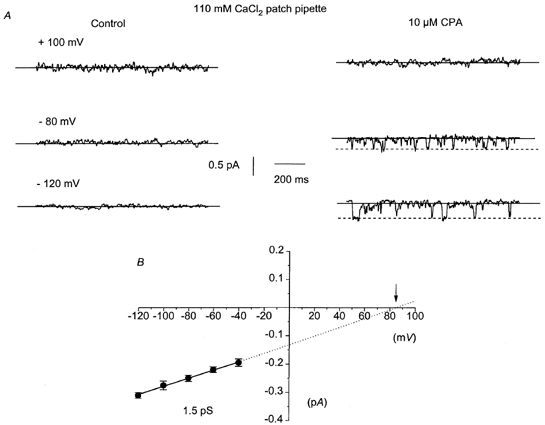
A, with a 110 mm CaCl2 patch pipette solution, bath application of 10 μm CPA activated single cation currents in a previously quiescent patch. The CPA-evoked single cation currents were only observed at negative patch potentials. B, the pooled IV relationships of CPA-evoked single cation currents recorded with 110 mm CaCl2 patch pipette solution. The IV relationship had a slope conductance of 1.5 pS between −120 and −40 mV and an extrapolated Er (↓)of +86 mV. Each point is the mean of at least 4 patches.
Figure 5
Figure 5. Cell-attached patches contain spontaneous single channel currents with characteristics similar to the CPA- and caffeine-evoked cation channels
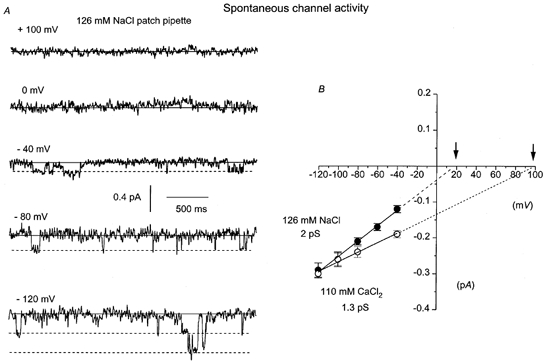
A, spontaneous channel activity between −40 and −120 mV in one patch recorded with 126 mm NaCl patch pipette solution. B, pooled IV relationship of spontaneous non-selective cation channels recorded with 126 mm NaCl with 1.5 mm Cao2+ (•) or 110 mm CaCl2 (○) in the patch pipette solution. In 126 mm NaCl, the IV relationship had a slope conductance of 2 pS between −120 and −40 mV and an extrapolated Er (↓) of +18 mV. In 110 mm CaCl2, the IV relationship had a slope conductance of 1.3 pS and an extrapolated Er (↓) of + 98 mV. Each point is the mean of at least 4 patches.
Figure 6
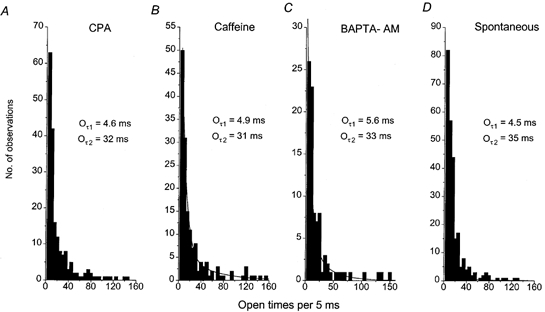
Figure 6. Open lifetime distributions of the CPA-, caffeine-, BAPTA-AM-evoked and spontaneous cation channel currents recorded with a 126 mm NaCl patch pipette solution
The open lifetime distributions of CPA- (A), caffeine- (B), BAPTA-AM-evoked (C) and spontaneous (D) cation channels could all be fitted with (continuous lines) the sum of two exponentials with time constants of approximately 5 ms (Oτ1) and 30 ms (Oτ2). The holding potential was −80 mV in all cases.
Figure 7
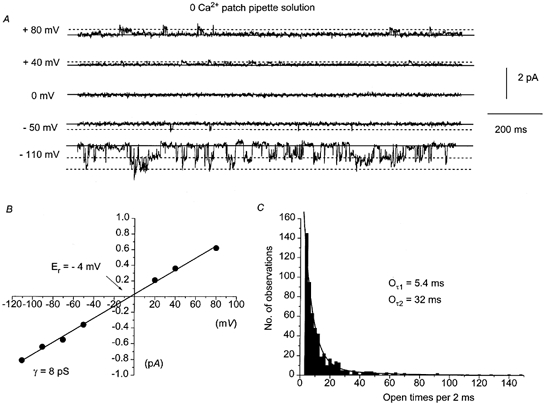
Figure 7. Characteristics of non-selective cation channel currents in the absence of Cao2+
A, spontaneous channel currents recorded at different membrane potentials with a 0 mm Cao2+ patch pipette solution. Note that outward channel currents (denoted by upward deflections) can be observed at positive membrane potentials. B, the IV relationship of the channel currents shown in A. The IV relationship was linear between −110 and +80 mV with a slope conductance of 8 pS and an Er of −4 mV. C, open time distribution of the channel currents shown in A at −110 mV. The open times could be described by the sum of two exponentials with time constants of 5.4 ms (Oτ1) and 32 ms (Oτ2).
Figure 8
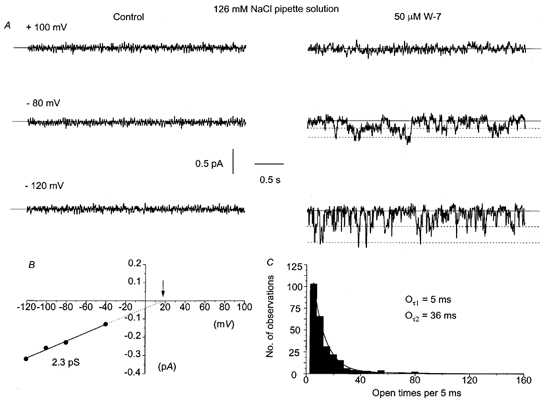
Figure 8. Application of the calmodulin inhibitor, W-7, activates single channel currents with properties that are similar to CPA-evoked cation channel currents
A, with a 126 mm NaCl pipette solution, bath application of 50 μm W-7 evoked single channel currents at negative patch potentials. B, the IV relationship of the W-7-evoked single channels currents shown in A. C, at −80 mV, the open time distribution of the W-7-evoked single channels shown in A could be described by the sum of two exponentials with time constants of 5 ms (Oτ1) and 36 ms (Oτ2).

References

    1. Albert AP, Large WA. Store-operated inward ion channels in rabbit portal vein myocytes. Journal of Physiology. 2001;531P:80P. - PMC - PubMed
    1. Benham CD, Bolton TB. Spontaneous transient outward currents in single visceral and vascular smooth muscle cells of the rabbit. Journal of Physiology. 1986;381:385–406. - PMC - PubMed
    1. Berridge MJ. Capacititive calcium entry. Biochemical Journal. 1995;312:1–11. - PMC - PubMed
    1. Curtis TM, Scholfield CN. Nifedipine blocks Ca2+ store refilling through a pathway not involving L-type Ca2+ channels in rabbit arteriolar smooth muscle. Journal of Physiology. 2001;532:609–623. - PMC - PubMed
    1. Golovina VA, Platoshyn O, Bailey CL, Wang J, Limsuwan A, Sweeney M, Rubin LJ, Yuan JX-J. Upregulated TRP and enhanced capacitative Ca2+ entry in human pulmonary artery myocytes during proliferation. American Journal of Physiology - Heart and Circulatory Physiology. 2001;H280:746–755. - PubMed

Publication types

MeSH terms

LinkOut - more resources