. 2002 Feb 1;538(Pt 3):747-57.
doi: 10.1113/jphysiol.2001.013300.

Characterization of basolateral K+ channels underlying anion secretion in the human airway cell line Calu-3

Affiliations

Characterization of basolateral K+ channels underlying anion secretion in the human airway cell line Calu-3

Elizabeth A Cowley et al. J Physiol. .

Abstract

Transepithelial anion secretion in many tissues depends upon the activity of basolateral channels. Using monolayers of the Calu-3 cell line, a human submucosal serous cell model mounted in an Ussing chamber apparatus, we investigated the nature of the K+ channels involved in basal, cAMP- and Ca2+-stimulated anion secretion, as reflected by the transepithelial short circuit current (I(sc)). The non-specific K+ channel inhibitor Ba2+ inhibited the basal I(sc) by either 77 or 16 % when applied directly to the basolateral or apical membranes, respectively, indicating that a basolateral K+ conductance is required for maintenance of basal anion secretion. Using the K+ channel blockers clofilium and clotrimazole, we found basal I(sc) to be sensitive to clofilium, with a small clotrimazole-sensitive component. By stimulating the cAMP and Ca2+ pathways, we determined that cAMP-stimulated anion secretion was almost entirely abolished by clofilium, but insensitive to clotrimazole. In contrast, the Ca2+-stimulated response was sensitive to both clofilium and clotrimazole. Thus, pharmacologically distinct basolateral K+ channels are differentially involved in the control of anion secretion under different conditions. Isolation of the basolateral K+ conductance in permeabilized monolayers revealed a small basal and forskolin-stimulated I(sc). Finally, using the reverse transcriptase-polymerase chain reaction, we found that Calu-3 cells express the K+ channel genes KCNN4 and KCNQ1 and the subunits KCNE2 and KCNE3. We conclude that while KCNN4 contributes to Ca2+-activated anion secretion by Calu-3 cells, basal and cAMP-activated secretion are more critically dependent on other K+ channel types, possibly involving one or more class of KCNQ1-containing channel complexes.


Figures
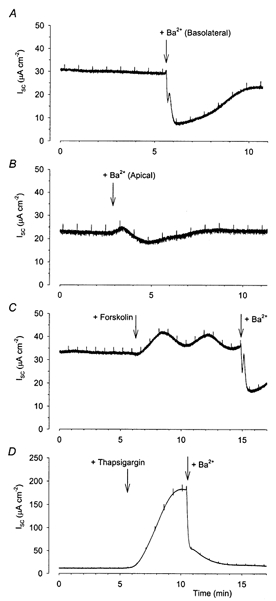
Figure 1
Figure 1. Inhibition of short circuit current (Isc) across Calu-3 monolayers by Ba2+
Basal Isc in Calu-3 monolayers was inhibited by the addition of 5 mm Ba2+, a non-specific inhibitor of K+ channels, to both the basolateral (A) and apical (B) membranes. Forskolin- and thapsigargin-stimulated Isc were also inhibited by basolateral application of Ba2+ (C and D). The transient inhibition frequently seen following the addition of Ba2+ was due to precipitation of Ba2+ from solution as previously reported (Moon et al. 1997).
Figure 2
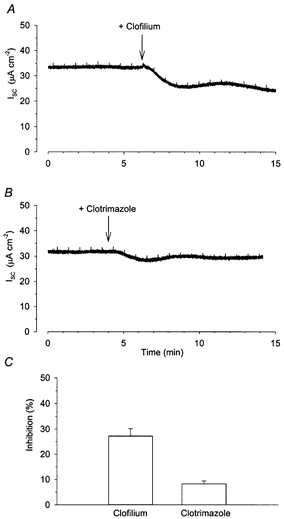
Figure 2. Inhibition of the basal Isc in Calu-3 cells by clofilium and clotrimazole
Addition of 100 μm clofilium to the basolateral membrane of Calu-3 cells reduced the basal Isc (A, n = 6). Addition of 30 μm clotrimazole to the basolateral membrane resulted in a much smaller decrease in basal Isc (B, n = 8). C shows the percentage of basal Isc inhibited by these agents.
Figure 3
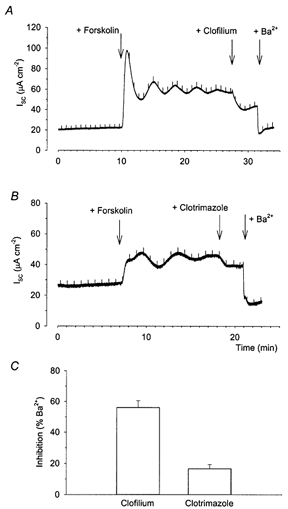
Figure 3. Effects of clofilium and clotrimazole on the cAMP-stimulated increase in Isc in Calu-3 cells
When Calu-3 monolayers were stimulated with 2 μm forskolin applied to both apical and basolateral sides of the membrane, the subsequent addition of 100 μm clofilium to the basolateral membrane reduced the Isc (A, n = 8). Addition of 30 μm clotrimazole to the basolateral membrane (B, n = 8) resulted in a much smaller decrease in Isc. At the end of every experiment 5 mm Ba2+ was added to the basolateral membrane, which further inhibited the Isc. C, reduction in Isc caused by clofilium and clotrimazole expressed as a percentage of the Ba2+-inhibitable Isc (as described in the text).
Figure 4
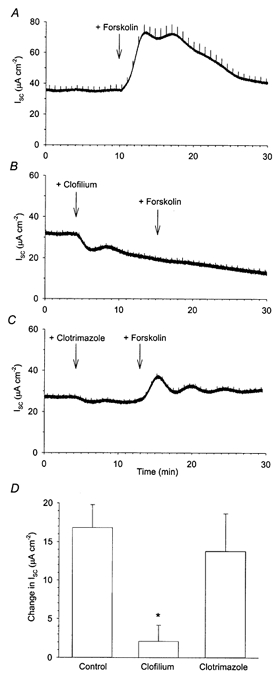
Figure 4. Effect of prior treatment with clofilium or clotrimazole on the cAMP-stimulated increase in Isc in Calu-3 cells
Addition of 2 μm forskolin to Calu-3 monolayers produced an increase in Isc (A, n = 16). When 100 μm clofilium was applied to the basolateral membrane prior to the forskolin stimulus, the increase in Isc was virtually abolished (B and D). In contrast, the increase in Isc recorded following the application of 2 μm forskolin when 30 μm clotrimazole had been pre-applied to the monolayers was not significantly different from the forskolin-alone response (* significantly different from forskolin stimulated as determined by Student's t test; P < 0.05).
Figure 5
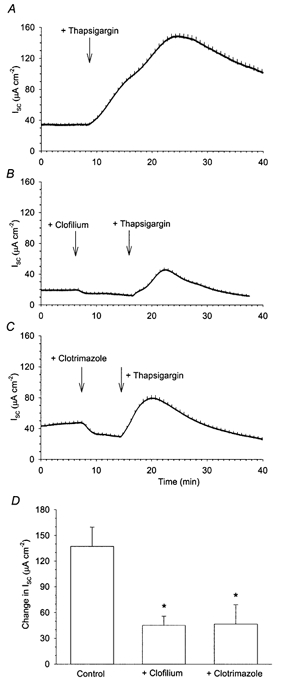
Figure 5. Thapsigargin stimulation of Isc in Calu-3 monolayers
Addition of 300 nm thapsigargin to Calu-3 monolayers produced a large increase in Isc (A; n = 7). When 100 μm clofilium was applied to the basolateral membrane prior to the thapsigargin stimulus, there was a large increase in Isc, though it was significantly reduced from the thapsigargin-alone response (B and D). Addition of 30 μm clotrimazole prior to the thapsigargin stimulus also significantly reduced the amplitude of the thapsigargin response (C and D). * Significantly different from thapsigargin-stimulated Isc as determined by Student's t test (P < 0.05).
Figure 6
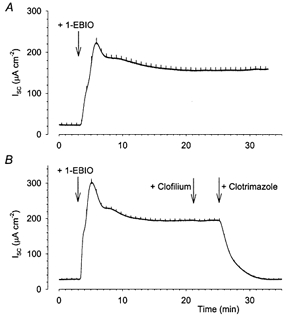
Figure 6. Clotrimazole, but not clofilium, inhibits the 1-EBIO stimulation of Isc in Calu-3 cells
1-EBIO (1 mm) produced a large increase in Isc (A, n = 3), which was unaffected by the subsequent addition of 100 μm clofilium, but entirely abolished by the addition of 30 μm clotrimazole (B).
Figure 7
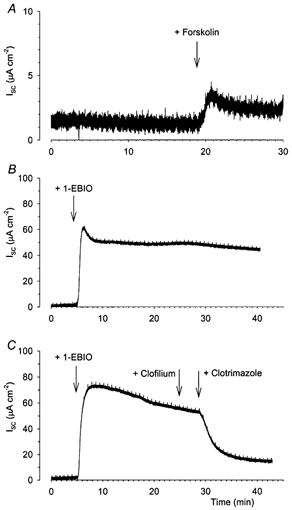
Figure 7. Basolateral K+ conductances in permeabilized Calu-3 cells
The basolateral K+ conductance in Calu-3 cells was isolated by permeabilizing the apical membrane. A small basal Isc was recorded under these conditions and the addition of 2 μm forskolin induced a small increase in Isc (A, n = 8) while the addition of 1 mm 1-EBIO induced a much larger increase in Isc (B, n = 3). This 1-EBIO-stimulated response in the permeabilized monolayers was unaffected by the addition of 100 μm clofilium, but entirely abolished by the addition of 30 μm clotrimazole (C).
Figure 8
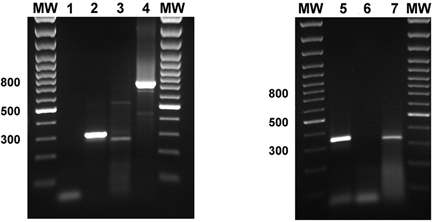
Figure 8. PCR analysis on RNA extracted from Calu-3 cells
Transcripts were detected for KCNE2 (lane 2), KCNE3 (lane 3), KCNQ1 (lane 4), KCNN4 (lane 5) and CFTR (lane 7) but not KCNE1 (lane 1) or KCNH2 (lane 6).

References

    1. Abbott GW, Sesti F, Splawski I, Buck ME, Lehmann MH, Timothy KW, Keating MT, Goldstein SAN. MiRP1 forms Ikr potassium channels with HERG and is associated with cardiac arrhythmia. Cell. 1999;97:175–187. - PubMed
    1. Basbaum CB, Berthold J, Finkbeiner WE. The serous cell. Annual Review of Physiology. 1990;52:97–113. - PubMed
    1. Boucher RC. Molecular insights into the physiology of the ‘thin film’ of airway surface liquid. Journal of Physiology. 1999;516:631–638. - PMC - PubMed
    1. Cotton CU. Basolateral potassium channels and epithelial ion transport. American Journal of Respiratory Cell and Molecular Biology. 2000;23:270–272. - PubMed
    1. Dawson DC, Richards NW. Basolateral K conductance in regulation of NaCl absorption and secretion. American Journal of Physiology. 1990;259:C181–195. - PubMed

Publication types

MeSH terms

LinkOut - more resources