


Lipopolysaccharide induced synthesis of CD14 proteins and its gene expression in hepatocytes during endotoxemia
- PMID: 11833086
- PMCID: PMC4656601
- DOI: 10.3748/wjg.v8.i1.124
Lipopolysaccharide induced synthesis of CD14 proteins and its gene expression in hepatocytes during endotoxemia
Abstract
Aim: To observe synthesis of CD14 protein and expression of CD14 mRNA in hepatic tissue and hepatocytes of rats during endotoxemia.
Methods: The endotoxemia model of Wistar rat was established by injection of a dose of lipopolysaccharide (LPS) (5mg x kg(-1), Escherichia coli O111:B4) via the tail vein, then the rats were sacrificed after 3, 6, 12 and 24 h in batches respectively. Hepatocytes were isolated from normal and LPS-injected rats by in situ collagenase perfusion technique and were collected to measure the expression of CD14 mRNA and synthesis of CD14 protein by reverse transcript-polymerase chain reaction (RT-PCR) or Western blot analysis. The binding of fluorescein isothiocyanate (FITC)-CD14 polyclonal antibody to isolated hepatocytes was also assessed by flow cytometric analysis (FCM).
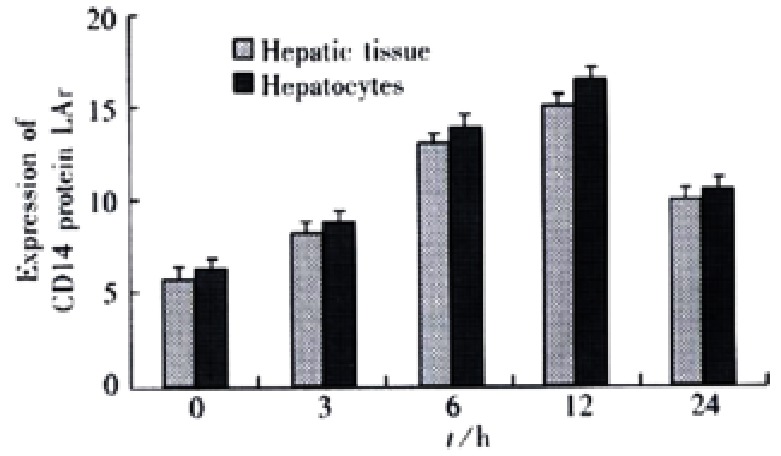
Results: In the rats with endotoxemia, the expressions of CD14 mRNA in hepatic tissue and isolated hepatocytes were stronger at 3, 6, and 12 h than that in control rats (3.48+/-0.15, 5.89+/-0.62, 4.33+/-0.18, vs 1.35+/-0.14 in hepatic tissue, P<0.01; 4.12+/-0.17, 6.24+/-0.64, 4.35+/-0.18, vs 1.87+/-0.15 in hepatocytoes, P<0.01). The synthesis of CD14 protein in hepatic tissue and isolated hepatocytes increases also obviously in 6 and 12 h when compared to that in control rats (13.27+/-1.27, 17.32+/-1.35, 11.42+/-1.20, vs 7.34+/-0.72 in hepatic tissue, P<0.01; 14.68+/-1.30, 17.95+/-1.34,11.65+/-1.19, vs 7.91+/-0.70 in hepatocytes, P<0.01). FCM showed that mean fluorescence intensity (MFI) and numbers of FITC-CD14 positive cells in the rats with endotoxemia increased obviously at 3,6,12 and 24h when compared with normal control group (43.4%, 70.2%, 91.4%, 32.6% vs 4.5%, P<0.01).
Conclusion: LPS can markedly promote the synthesis of CD14 protein and up-regulate the expression of CD14 mRNA in isolated hepatocytes and hepatic tissue. Liver might be a main source for soluble CD14 production during endotoxemia.
Figures


References
-
- Lichtman SN, Wang J, Lemasters JJ. LPS receptor CD14 participates in release of TNF-alpha in RAW 264.7 and peritoneal cells but not in kupffer cells. Am J Physiol. 1998;275:G39–G46. - PubMed
-
- Fearns C, Ulevitch RJ. Effect of recombinant interleukin-1beta on murine CD14 gene expression in vivo. Shock. 1998;9:157–163. - PubMed
-
- Su GL, Dorko K, Strom SC, Nüssler AK, Wang SC. CD14 expression and production by human hepatocytes. J Hepatol. 1999;31:435–442. - PubMed
-
- Li S, Wu C, Shi Y, Liu C. [Lipopolysaccharide upregulates expression of CD14 gene and CD14 proteins of hepatocytes in rats] Zhonghua Ganzangbing Zazhi. 2001;9:103–104. - PubMed
-
- Pan Z, Zhou L, Hetherington CJ, Zhang DE. Hepatocytes contribute to soluble CD14 production, and CD14 expression is differentially regulated in hepatocytes and monocytes. J Biol Chem. 2000;275:36430–36435. - PubMed
Publication types
MeSH terms
Substances
LinkOut - more resources
Full Text Sources
Other Literature Sources
Research Materials
