Review
. 2002 Feb 15;30(4):866-75.
doi: 10.1093/nar/30.4.866.

Integration sites for genetic elements in prokaryotic tRNA and tmRNA genes: sublocation preference of integrase subfamilies

Affiliations
Review

Integration sites for genetic elements in prokaryotic tRNA and tmRNA genes: sublocation preference of integrase subfamilies

Kelly P Williams. Nucleic Acids Res. .

Abstract

Most classical integrases of prokaryotic genetic elements specify integration into tRNA or tmRNA genes. Sequences shared between element and host integration sites suggest that crossover can occur at any of three sublocations within a tRNA gene, two with flanking symmetry (anticodon-loop and T-loop tDNA) and the third at the asymmetric 3' end of the gene. Integrase phylogeny matches this classification: integrase subfamilies use exclusively either the symmetric sublocations or the asymmetric sublocation, although tRNA genes of several different aminoacylation identities may be used within any subfamily. These two familial sublocation preferences imply two modes by which new integration site usage evolves. The tmRNA gene has been adopted as an integration site in both modes, and its distinctive structure imposes some constraints on proposed evolutionary mechanisms.


Figures
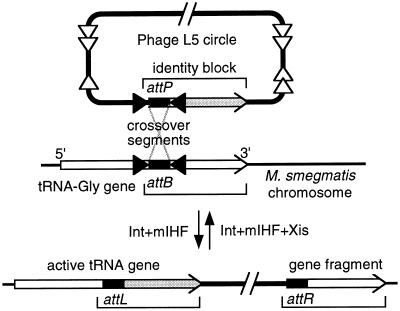
Figure 1
Figure 1
Integrase action at a tRNA gene. The crossover segment (solid box) where strands exchange is small; in this case it is precisely the 7-bp anticodon-loop tDNA, with anticodon stem tDNA serving as symmetrical integrase core-type sites (filled triangles), and with arm-type sites (open triangles) more distant (14). Blocks of sequence identity (brackets) between reacting DNAs usually extend from the crossover segment to or beyond the downstream end of the gene, and may also extend slightly in the upstream direction. tRNA gene function is retained after integration. For uniformity, the attL and attR designations used in this article refer to tRNA gene orientation as in this diagram and may not match those of previous descriptions of the integrated elements.
Figure 2
Figure 2
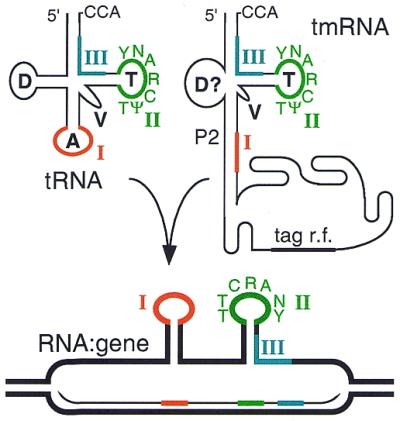
Secondary structures. The 7-nt anticodon and T loops of tRNAs are flanked by the symmetrical sequences that form 5-bp stems. The region corresponding to the tRNA anticodon is instead part of a long stem in tmRNA. For both RNA types, a similar structure might form in a hypothetical hybrid between RNA and gene if an analog of the anticodon stem–loop can fortuitously form in the tmRNA hybrid (gray shading in Fig. 3). T-loop consensus sequence is shown. Three presumed crossover sites used in both types of RNA gene are marked with Roman numerals.
Figure 3
Figure 3
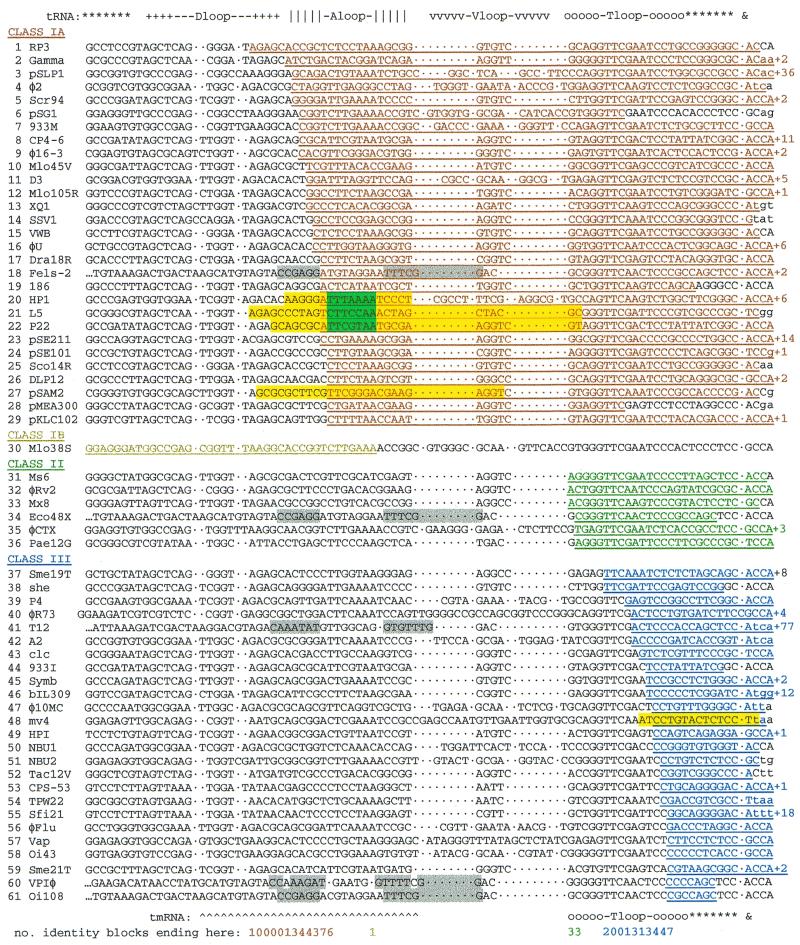
Sequence identity between attPs and attBs in tRNA and tmRNA genes. Genes are aligned according to the secondary structure of the encoded RNA, indicated above for tRNA and below for tmRNA (discriminator position marked by ampersand). attBs are ordered by the gene-internal endpoint of the identity block (underlined) shared with attP, as summarized on the bottom line. The length of continued rightward extension of the identity block is given. Yellow shading marks reported minimal attBs; cyan shading marks crossover segments that have been mapped (all three corresponding precisely to the anticodon loop); gray shading marks symmetry in tmRNA genes resembling anticodon stem–loop tDNA. Lower case marks terminal positions where the gene does not encode the full CCA tail of the mature RNA. Sequence data references not in Table 1: line 4 (16); line 5, E.coli tDNA (24) substitutes for unavailable sequence from natural host; line 17 (58); line 28, M.tuberculosis tDNA (59) substitutes for unavailable sequence from natural host; line 36 (60); lines 37 and 59 (61); line 51, Bacteroides fragilis genome project at The Sanger Centre (www.sanger.ac.uk); line 52 (62). HTML version available at sunflower.bio.indiana.edu/~kwilliam/tDNAint.
Figure 4
Figure 4
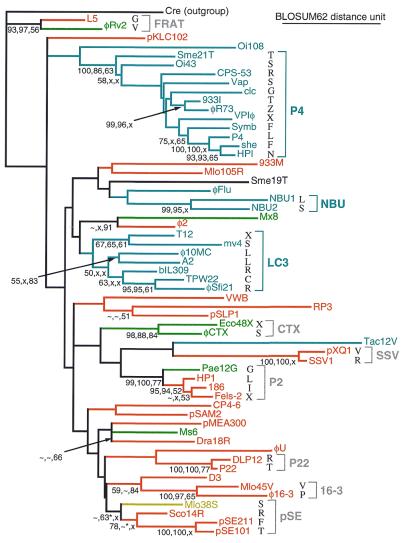
Subfamilies of integrases recognizing tDNA or tmDNA. Fitch-Margoliash tree showing percent support (if >50%) for each node, from three phylogenetic analyses (order: Fitch-Margoliash, parsimony, quartet puzzling); tilde, <50% support; x, node absent. attB usage is color-coded: red, class IA; mustard, class IB; green, class II; blue, class III. Brackets mark subfamilies that were recognized previously, and the new 16-3 family; symmetry-preferring subfamilies are in gray and 3′-end-preferring subfamilies are in blue. Aminoacylation identities of attB tRNA genes are shown for subfamilies. *, Node included pSAM2 integrase. Parsimony supported nodes not present on this tree: Oi108 apart from all others (69%); HPI, she and clc (74%); 933I, φR73 and CPS-53 (61%); TPW22, Sfi21 and φ10MC (63%); and the pSE subfamily with φ2 and Dra18R (56%); none of these mix attB class usage. Methods: an alignment of the catalytic segment, corresponding to lambda integrase residues 202–345, of 43 integrases from Figure 3 (and Cre recombinase as an outgroup) was taken from the Tyrosine Recombinase Website, with some manual realignment and addition of 15 integrases absent from the website (final alignment available at sunflower.bio.indiana.edu/~kwilliam/tDNAint). One thousand bootstrap subsamples of this alignment were constructed by SEQBOOT, and trees for the subsamples were found using either FITCH (in a parallelized format implemented by Robert Cruise at Indiana University Information Technology Services) with distances evaluated by Blocks Substitution Matrix 62 or PROTPARS, each with 10 jumblings; majority-rule trees were taken using CONSENSE (65,66). Distance and branch length calculations and quartet puzzling were performed with PUZZLE (67).

References

    1. Azaro M.A. and Landy,A. (2002) λ Integrase and the λ Int family. In Craig,N.L., Craigie,R., Gellert,M. and Lambowitz,A. (eds), Mobile DNA II. ASM Press, Washington DC, 118–148.
    1. Campbell A.M. (1962) Episomes. Adv. Genet., 11, 101–145.
    1. Weisberg R.A. and Landy,A. (1983) Site-specific recombination in phage lambda. In Hendrix,R.W., Roberts,J.W., Stahl,F.W. and Weisberg,R.A. (eds), Lambda II. Cold Spring Harbor Laboratory Press, Cold Spring Harbor, NY, pp. 211–250.
    1. Esposito D. and Scocca,J.J. (1997) The integrase family of tyrosine recombinases: evolution of a conserved active site domain. Nucleic Acids Res., 25, 3605–3614. - PMC - PubMed
    1. Nunes-Duby S.E., Kwon,H.J., Tirumalai,R.S., Ellenberger,T. and Landy,A. (1998) Similarities and differences among 105 members of the Int family of site-specific recombinases. Nucleic Acids Res., 26, 391–406. - PMC - PubMed