. 2002 Feb;128(2):482-90.
doi: 10.1104/pp.010822.

Resistance against herbicide isoxaben and cellulose deficiency caused by distinct mutations in same cellulose synthase isoform CESA6

Affiliations

Resistance against herbicide isoxaben and cellulose deficiency caused by distinct mutations in same cellulose synthase isoform CESA6

Thierry Desprez et al. Plant Physiol. 2002 Feb.

Abstract

Isoxaben is a pre-emergence herbicide that inhibits cellulose biosynthesis in higher plants. Two loci identified by isoxaben-resistant mutants (ixr1-1, ixr1-2, and ixr2-1) in Arabidopsis have been reported previously. IXR1 was recently shown to encode the cellulose synthase catalytic subunit CESA3 (W.-R. Scheible, R. Eshed, T. Richmond, D. Delmer, and C. Somerville [2001] Proc Natl Acad Sci USA 98: 10079-10084). Here, we report on the cloning of IXR2, and show that it encodes another cellulose synthase isoform, CESA6. ixr2-1 carries a mutation substituting an amino acid close to the C terminus of CESA6 that is highly conserved among CESA family members. Transformation of wild-type plants with the mutated gene and not with the wild-type gene conferred increased resistance against the herbicide. The simplest interpretation for the existence of these two isoxaben-resistant loci is that CESA3 and CESA6 have redundant functions. However, loss of function procuste1 alleles of CESA6 were previously shown to have a strong growth defect and reduced cellulose content in roots and dark-grown hypocotyls. This indicates that in these mutants, the presence of CESA3 does not compensate for the absence of CESA6 in roots and dark-grown hypocotyls, which argues against redundant functions for CESA3 and CESA6. Together, these observations are compatible with a model in which CESA6 and CESA3 are active as a protein complex.


Figures
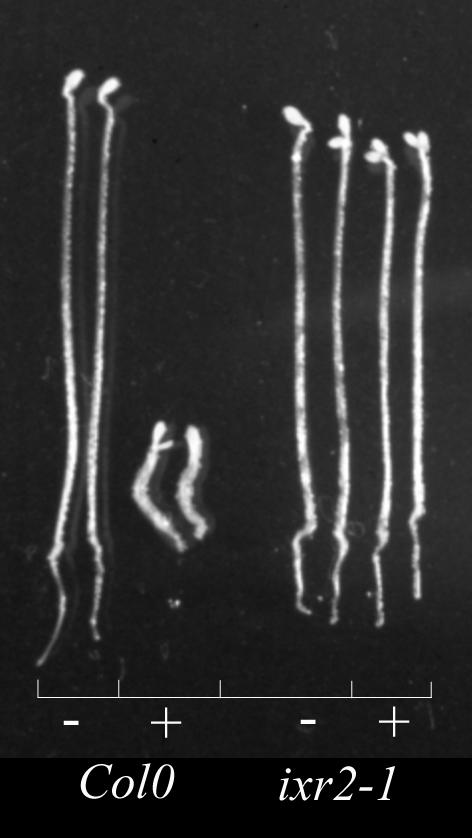
Figure 1
Figure 1
The effect of isoxaben on hypocotyl growth in wild type and ixr2-1. Wild-type Col0 and ixr2-1 seedlings were grown for 4 d in the dark in the absence (−) or presence (+) of 5 nm isoxaben.
Figure 2
Figure 2
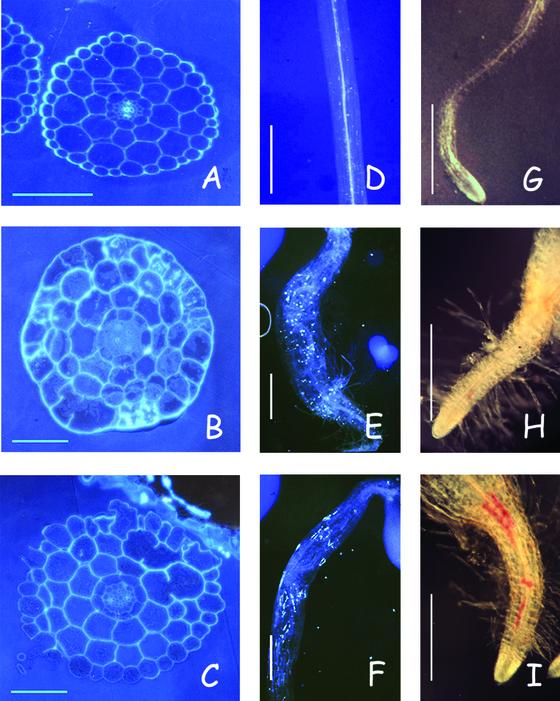
Similar effects of isoxaben and DCB are displayed on hypocotyl and root of wild-type seedlings. A–C, Transverse sections halfway through hypocotyls show gapped walls in seedlings treated with either herbicide. D--F, Hypocotyls stained with sirofluor present an accumulation of callose for both herbicides. G–I, Roots stained with phloroglucinol show an accumulation of lignin for both herbicides, with a stronger staining for DCB. A, D, and G, Control: 4-d-old dark-grown seedlings. B, E, and H, In the presence of 5 nm or (B) 7 nm isoxaben. C, F, and I, In the presence of 0.5 μm or (C) 1.5 μm DCB. Bars in A through C = 100 μm; D through I = 250 μm.
Figure 3
Figure 3
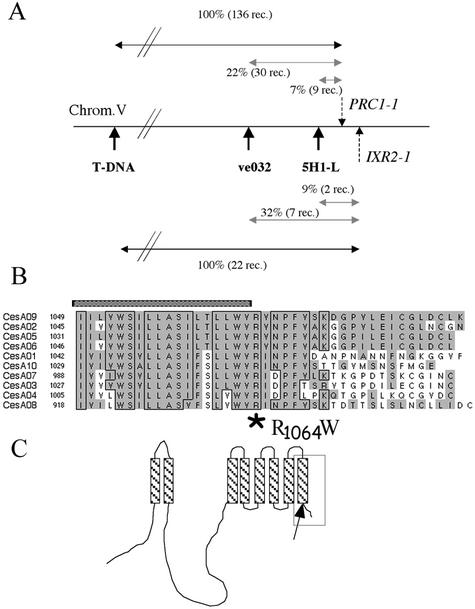
The ixr2-1 mutation causes a R1064W change in a residue conserved for all CESA isoforms in Arabidopsis. A, Fine mapping of IXR2. Twenty-two recombinants were isolated between a T-DNA insertion in a C-24 background, and ixr2-1 in Col0 and recombination breakpoints were mapped using the PCR markers ve032 and 5H1-L. PRC1 was mapped using the same markers on 136 recombinants between prc1-1 in Col0 and the same T-DNA insertion in C-24 (Fagard et al., 2000). The comparison of the maps showed a very close proximity between IXR2 and PRC1. B, Multiple alignment of the C-terminal amino acid sequences of the 10 Arabidopsis CESAs. The numbers indicate the positions of the first amino acid presented in the alignment. Hatched bar indicates the last predicted transmembrane domain. Shaded residues represent a high consensus value of 85%, specified in the program. Boxed residues are identical for at least seven isoforms. The position of the R1064W mutation in the IXR2-1 allele of CESA6 is indicated by the star below the alignment. C, Hypothetical diagram of the membrane topology of CESA proteins. Area in rectangle refers to the part of the sequence shown in B. Predicted transmembrane domains are hatched. The arrow indicates the position of the ixr2-1 mutation.
Figure 4
Figure 4
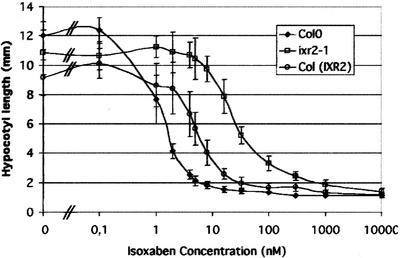
Transgenic Col0 homozygous for an insertion carrying CESA6-R1064W shows increased resistance to isoxaben. Isoxaben dose-response curve for hypocotyl length of 4-d-old dark-grown seedlings. Curves for wild-type Col0, ixr2-1 homozygotes, and Col0 plants homozygote for CESA6-R1064W [Col(IXR2)] are shown.
Figure 5
Figure 5
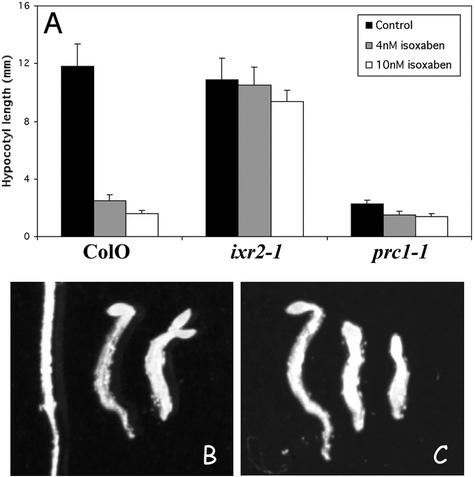
Evidence for additional isoxaben targets. A, Dark-grown hypocotyl length of 4-d-old seedlings of Col0, ixr2-1 homozygotes, and prc1-1 homozygotes in the absence or presence of 5 or 10 nm isoxaben. B, Seedling phenotype of Col0 grown without (left) and with (middle) 5 nm or (right) 10 nm isoxaben. C, Same conditions as in B, but for prc1-1 seedlings. Note the stronger phenotype for wild-type seedlings grown in the presence of 10 nm isoxaben than that of prc1-1 homozygotes.
Figure 6
Figure 6
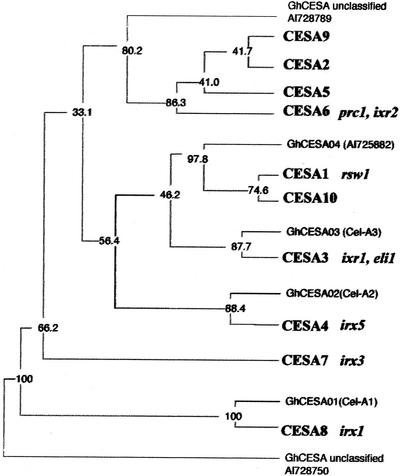
Members of the CESA family are functionally specialized as shown by loss-of-function and isoxaben-resistant alleles. A phylogenetic tree based on a hypervariable region among CESA protein sequences is shown (Fagard et al., 2000). Sequences from Arabidopsis (in bold) were aligned with those from cotton (Gossypium hirsutum), and a parsimonious consensus tree was constructed. Numbers are bootstrapped values (n = 100). Corresponding mutant alleles are indicated in italics and mutant phenotypes are discussed in the text. Clustering of one or more specific Arabidopsis sequences with cotton homologs suggests a functional specialization of the corresponding isoforms. CESA6 clusters with three other Arabidopsis isoforms, suggesting that they have arisen by more recent gene duplications.

References

    1. Arioli T, Peng L, Betzner AS, Burn J, Wittke W, Herth W, Camilleri C, Höfte H, Plazinski J, Birch R et al. Molecular analysis of cellulose biosynthesis in Arabidopsis. Science. 1998;279:717–720. - PubMed
    1. Bechtold N, Pelletier G. In planta Agrobacterium-mediated transformation of adult Arabidopsis thalianaplants by vacuum infiltration. Methods Mol Biol. 1998;82:259–266. - PubMed
    1. Bouchez D, Camilleri C. High molecular weight DNA extraction from Arabidopsis. Methods Mol Biol. 1998;82:61–70. - PubMed
    1. Delmer D. Cellulose biosynthesis: exciting times for a difficult field of study. Annu Rev Plant Physiol Plant Mol Biol. 1999;50:245–276. - PubMed
    1. Denecke J, De Rycke R, Botterman J. Plant and mammalian sorting signals for protein retention in the endoplasmic reticulum contain a conserved epitope. EMBO J. 1992;11:2345–2355. - PMC - PubMed

Publication types

MeSH terms

LinkOut - more resources