doi: 10.1101/gad.219202.
Mutual genetic antagonism involving GLI3 and dHAND prepatterns the vertebrate limb bud mesenchyme prior to SHH signaling
Affiliations
- PMID: 11850405
- PMCID: PMC155343
- DOI: 10.1101/gad.219202
Item in Clipboard
Mutual genetic antagonism involving GLI3 and dHAND prepatterns the vertebrate limb bud mesenchyme prior to SHH signaling
Genes Dev.
.
Abstract
The bHLH transcription factor dHAND is required for establishment of SHH signaling by the limb bud organizer in posterior mesenchyme, a step crucial to development of vertebrate paired appendages. We show that the transcriptional repressor GLI3 restricts dHAND expression to posterior mesenchyme prior to activation of SHH signaling in mouse limb buds. dHAND, in turn, excludes anterior genes such as Gli3 and Alx4 from posterior mesenchyme. Furthermore, genetic interaction of GLI3 and dHAND directs establishment of the SHH/FGF signaling feedback loop by restricting the BMP antagonist GREMLIN posteriorly. These interactions polarize the nascent limb bud mesenchyme prior to SHH signaling.
Figures
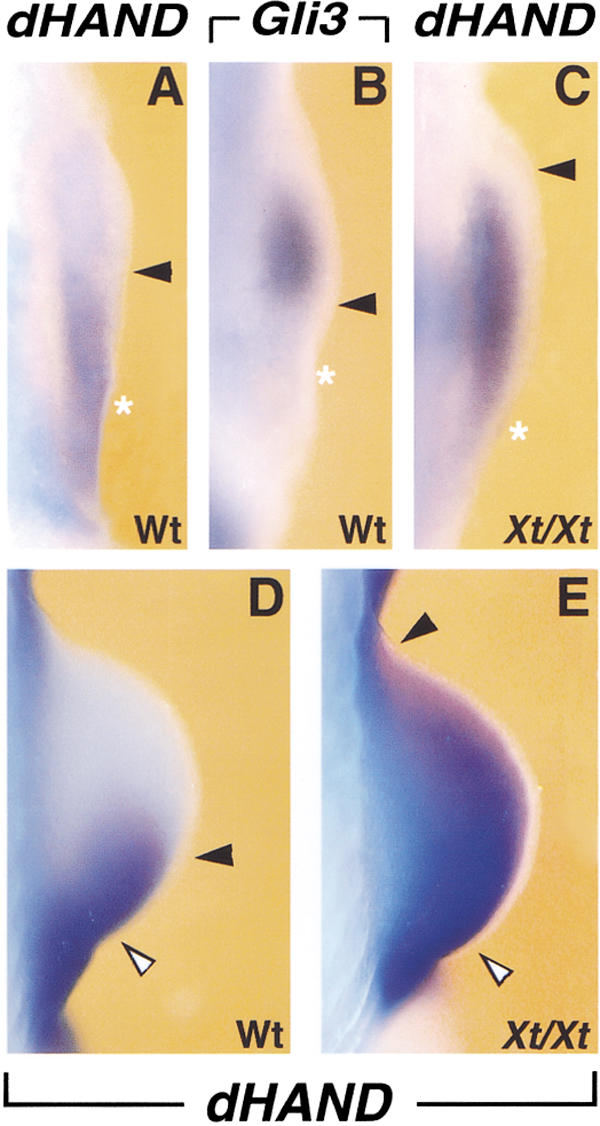
dHAND expression is restricted to the posterior limb bud mesenchyme by Gli3 repressor activity. (A) dHAND expression in the limb bud of a wild-type embryo (22–23 somites). dHAND expression is restricted to the posterior limb bud mesenchyme. (B) Gli3 expression in the limb bud mesenchyme of a wild-type embryo (22–23 somites). (C) dHAND expression extends anteriorly in the limb bud of an Xt/Xt homozygous embryo (22–23 somites). (D,E) Expression of dHAND in limb buds of wild-type (D) and Xt/Xt (E) mutant embryos with 27 somites. dHAND expression is up-regulated in the posterior mesenchyme under the influence of SHH signaling (open arrowheads). All limb buds shown are forelimb buds. Arrowheads indicate boundaries of expression domains; asterisks in A–C indicate the posterior margins of forelimb buds, with anterior to the top and posterior to the bottom.
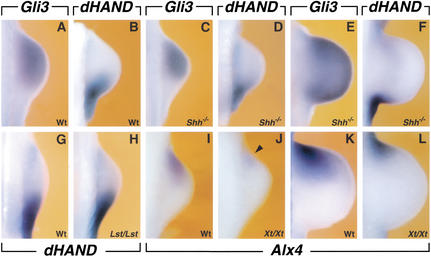
Complementary expression of Gli3 and dHAND is independent of SHH signaling and ALX4 function. (A,B) Complementary expression of Gli3 (A) and dHAND (B) in contralateral limb buds of a wild-type embryo (25 somites). (C,D) Complementary expression of Gli3 (C) and dHAND (D) in contralateral limb buds of an Shh-deficient embryo (25 somites). (E,F) Expression of Gli3 (E) and dHAND (F) in contralateral limb buds of older Shh-deficient embryos (34 somites). (G,H) dHAND expression in wild-type (G) and Lst/Lst (H) mutant limb buds (25 somites). (I–L) Comparative analysis of Alx4 expression in wild-type and Xt/Xt homozygous limb buds. (I) Wild-type (25 somites); (J) Xt/Xt homozygous (25 somites), arrowhead points to weak Alx4 expression; (K) wild-type (34 somites); (L) Xt/Xt homozygous (34 somites). All limb buds shown are forelimb buds, with anterior to the top and posterior to the bottom.
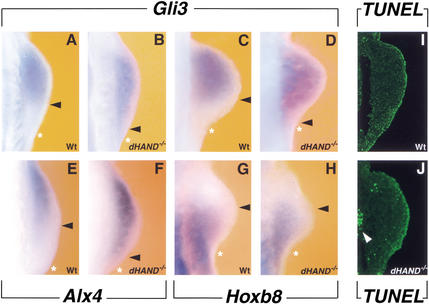
dHAND keeps Gli3 and Alx4 from being expressed by posterior limb bud mesenchyme. (A–D) Gli3 expression in limb buds of wild-type (A,C) and dHAND-deficient (B,D) embryos (A,B: 22 somites; C,D: 24–25 somites). (E,F) Alx4 expression in limb buds of wild-type (E) and dHAND-deficient (F) embryos (24 somites). (G,H) Expression of Hoxb8 in limb buds contralateral to the ones shown in panels C and D. (G) Wild-type limb bud (24–25 somites); (H) dHAND mutant limb bud (24–25 somites). Arrowheads in panels A–H indicate posterior boundaries of expression domains. Asterisks indicate posterior edges of limb buds. (I,J) TUNEL analysis to detect apoptotic cells. (I) Wild-type limb bud (24 somites); (J) dHAND mutant limb bud (24 somites). White arrowhead points to apoptotic cells in a somite (Srivastava et al. 1997). All limb buds shown are forelimb buds, with anterior to the top and posterior to the bottom.
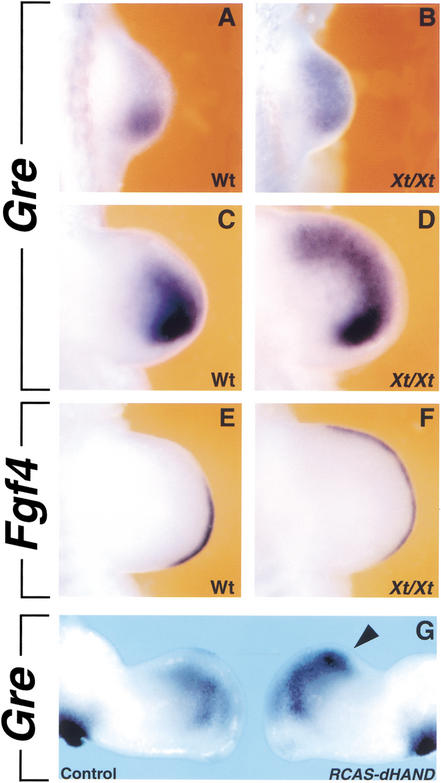
Genetic interaction of GLI3 and dHAND restricts GREMLIN-mediated competence to establish the SHH/FGF signaling feedback loop to the posterior limb bud mesenchyme. (A) Gremlin expression in a wild-type limb bud (29–30 somites). (B) Gremlin expression expands anteriorly in an Xt/Xt limb bud (29–30 somites). (C) Gremlin expression in a wild-type limb bud (37 somites). (D) Gremlin expression in an Xt/Xt limb bud (37 somites). (E,F) Fgf4 expression in the limb buds contralateral to the ones shown in panels C and D. (E) Wild-type limb bud (37 somites); (F) Xt/Xt limb bud (37 somites). (G) Retroviral overexpression of dHAND in chicken limb buds results in similar up-regulation of Gremlin expression in the anterior mesenchyme (arrowhead) in all embryos analyzed (n = 6). All limb buds shown are forelimb buds, with anterior to the top and posterior to the bottom.
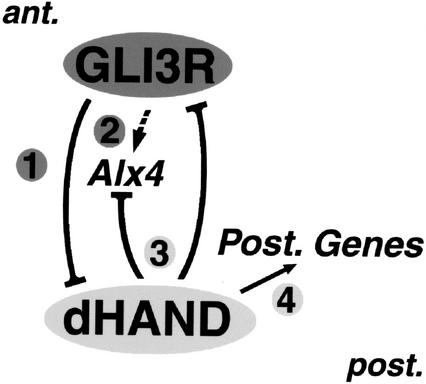
Reciprocal genetic repression between GLI3 and dHAND prepatterns the limb bud mesenchyme prior to activation of SHH signaling. (1) GLI3 repressor activity (GLI3-R) restricts expression of the bHLH transcription factor dHAND to the posterior mesenchyme during onset of limb bud morphogenesis. (2) GLI3-R participates in positive transcriptional regulation (dashed arrow) of another anterior transcription factor, Alx4. (3) dHAND is necessary to keep Gli3 and Alx4 expression restricted to the anterior mesenchyme. (4) In posterior mesenchyme, dHAND is necessary for activating expression of posterior genes, among them 5′HoxD genes, Bmp2, and Shh (for details and references, see text). These genetic interactions prepattern the limb bud mesenchyme independent of SHH signaling.
References
-
- Buscher D, Bosse B, Heymer J, Ruther U. Evidence for genetic control of Sonic hedgehog by Gli3 in mouse limb development. Mech Dev. 1997;1997:175–182. - PubMed
-
- Charité J, de Graaff W, Shen S, Deschamps J. Ectopic expression of Hoxb-8 causes duplication of the ZPA in the forelimb and homeotic transformation of axial structures. Cell. 1994;78:589–601. - PubMed
-
- Charité J, McFadden DG, Olson EN. The bHLH transcription factor dHAND controls Sonic hedgehog expression and establishment of the zone of polarizing activity during limb development. Development. 2000;127:2461–2470. - PubMed
-
- Chiang C, Litingtung Y, Harris MP, Simandl BK, Li Y, Beachy PA, Fallon JF. Manifestation of the limb prepattern: Limb development in the absence of Sonic hedgehog function. Dev Biol. 2001;236:421–435. - PubMed
-
- Cohn MJ. Giving limbs a hand. Nature. 2000;406:953–954. - PubMed
Publication types
MeSH terms
Substances
LinkOut - more resources
Full Text Sources
Molecular Biology Databases