. 2002 Feb;109(4):475-80.
doi: 10.1172/JCI14341.

Choreoathetosis, hypothyroidism, and pulmonary alterations due to human NKX2-1 haploinsufficiency

Affiliations

Choreoathetosis, hypothyroidism, and pulmonary alterations due to human NKX2-1 haploinsufficiency

Heiko Krude et al. J Clin Invest. 2002 Feb.

Abstract

The occurrence of neurological symptoms and developmental delay in patients affected by congenital hypothyroidism (CH) has been attributed to the lack of thyroid hormone in the developing CNS. Accordingly, after the introduction of neonatal screening programs for CH, which allowed early and adequate treatment, an almost normal outcome for most CH patients could be achieved. However, a few patients did not reach this favorable outcome despite early and adequate treatment. Here we describe five patients with variable degrees of CH who suffered from choreoathetosis, muscular hypotonia, and pulmonary problems, an association of symptoms that had not been described before this study. Since this clinical picture matched the phenotype of mice targeted for deletion of the transcription factor gene Nkx2-1, we investigated the human NKX2-1 gene in these five patients. We found heterozygous loss of function mutations in each of these five patients, e.g., one complete gene deletion, one missense mutation (G2626T), and three nonsense mutations (2595insGG, C2519A, C1302A). Therefore, the unfavorable outcome in patients with CH, especially those with choreoathetosis and pulmonary symptoms, can be explained by mutations in the NKX2-1 gene rather than by hypothyroidism. Moreover, the association of symptoms in the patients with NKX2-1 mutations points to an important role of human NKX2-1 in the development and function of thyroid, basal ganglia, and lung, as already described for rodents.


Figures
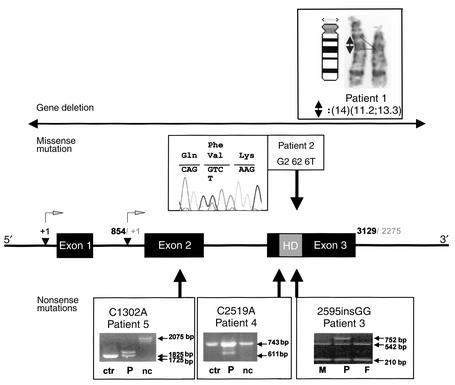
Figure 1
Figure 1
Genotype of NKX2-1–deficient patients. The complete genomic structure of NKX2-1 gene is shown. Different transcription start sites have been described leading to 5′-alternative transcripts indicated by +1 in black, according to Hamdan et al. (25), and in gray, according to Ikeda et al. (26). Numbering of nucleotides are shown according to both references and have been used to indicate the mutations according to the most extended genomic sequence reported by Hamdan et al. (25). Numbering of aa residues are relative to the first residue of the DNA-binding HD to achieve the best comparison between mutations in different HDs containing transcription factors, as suggested by the terminology of vnd/NK2 gene mutations (13). Mutations are indicated as arrows. If possible mutations were confirmed by restriction enzyme analysis, as shown for patients 3, 4, and 5, parental samples were obtained for patient 2 (sequence data show normal results, not shown) and patient 3; ctr, control DNA; nc, non-cut DNA; M, mother; F, father; P, patient.
Figure 2
Figure 2
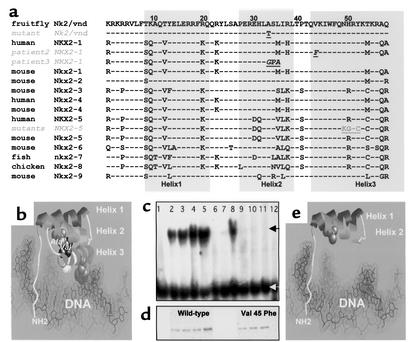
Position of aa exchange due to the NKX2-1 mutations and structural consequences for the DNA interaction. (a) Alignment of the nine known mammalian NK2 HDs (3, 27); Tyr54, which is characteristic for NK2 HDs, is shown in white, mutations detected in our patients are shown in white italic underlined, the known missense mutations of the NKX2-5 HD are shown in gray (20). (b) Three-dimensional model of NK2 HD-DNA complex. Position of Val45Phe mutation in patient 2 is shown in black. (c) EMSA performed with in vitro–expressed HD protein show a clear loss of binding capacity in the mutant. Lane 1: without protein, lanes 2–5: wild-type protein (0.5, 1, 2, and 5 μl purified protein) lane 6: unrelated oligo; lanes 7 and 8: competition with 100-fold excess of unlabeled oligo-C (lane 7) and unrelated oligo (lane 8) (amount of protein applied corresponding to lane 3); lanes 9–11: mutant protein (2, 5, and 10 μl of purified protein); lane 12: mutant protein with unrelated and unlabeled oligo; black arrow marks bound oligo, white arrow marks free oligo. (d) Western blots using anti-Flag–antibody are aligned with lanes 2–5 and 9–11 of (c) showing the equivalence in amounts of HD protein used.(e) The truncated HD due to the 2595insGG nonsense mutation in patient 3 is shown in the predicted conformation relative to the DNA-binding groove lacking helix 3.
Figure 3
Figure 3
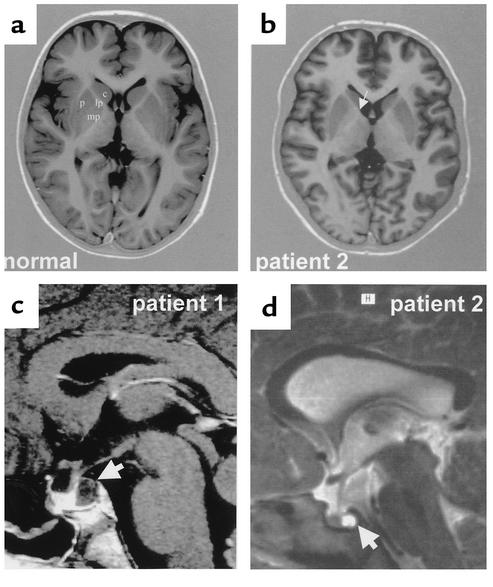
Morphological brain alterations of patients with NKX2-1 mutations. (a) Inversion recovery view of MRI sequence of supratentorial structures in a normal age-matched proband. White matter maturation is complete; basal ganglia appear hypointense in comparison. Medial and lateral parts of the pallidum are clearly distinguishable. c, caudate; p, putamen; lp, lateral part; mp, medial part. (b) MRI of patient 2 demonstrates abnormal basal ganglia. At a comparable level of MRI section a hypoplastic pallidum with a lack of differentiation into medial and lateral part can be seen (arrow). Structure and signal intensity of putamen and caudate nucleus are normal. Brain maturation is unaltered, and there is no malformation of cerebral cortical structure. (c) MRI of the pituitary-diencephalic region of patient 1 (T1-image) showing a cystic mass in the posterior part of the sella turcica (arrow). (d) MRI of this region of patient 2 (T2-image) showing an identical mass at the same position (arrow). Isodense appearance in respect to ventricular structures clearly demonstrates its cystic character.
Figure 4
Figure 4
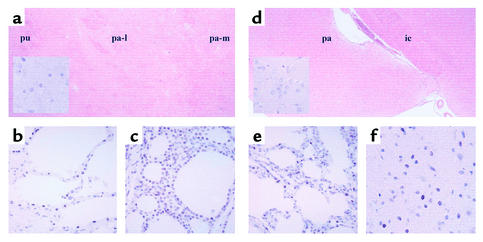
Expression of the NKX2-1 protein in human and rat adult tissues. (a) Human basal ganglia. The inset shows no nuclear staining of the NKX2-1 Ab. Nuclear staining is visible in human lung (b) and human thyroid (c). In the rat brain (d) staining is negative in the pallidum (as shown in the inset) on a cellular level but positive in the lung (e) and the hypothalamus (f). pu, putamen; pa-l, lateral pallidum; pa-m, medial pallidum; ic, internal capsle.

Comment in

References

    1. Hodgson JG. A YAC mouse model for Huntington's disease with full length mutant huntingtin, cytoplasmic toxicity, and selective striatal neurodegeneration. Neuron. 1999;23:181–192. - PubMed
    1. de Vries BB, et al. Benign hereditary chorea of early onset maps to chromosome 14q. Am J Hum Genet. 2000;66:136–142. - PMC - PubMed
    1. Harvey RP. NK-2 homeobox genes and heart development. Dev Biol. 1996;178:203–216. - PubMed
    1. Guazzi S, et al. Thyroid nuclear factor 1 (TTF-1) contains a homeodomain and displays a novel DNA binding specificity. EMBO J. 1990;9:3631–3639. - PMC - PubMed
    1. Lazzaro D, Price M, de Felice M, Di Lauro R. The transcription factor TTF-1 is expressed at the onset of thyroid and lung morphogenesis and in restricted regions of the foetal brain. Development. 1991;113:1093–1104. - PubMed

Publication types

MeSH terms