. 2002 Mar 5;99(5):2672-7.
doi: 10.1073/pnas.052698099. Epub 2002 Feb 19.

Cell senescence and telomere shortening induced by a new series of specific G-quadruplex DNA ligands

Affiliations

Cell senescence and telomere shortening induced by a new series of specific G-quadruplex DNA ligands

J F Riou et al. Proc Natl Acad Sci U S A. .

Abstract

Telomeres of human chromosomes contain a G-rich 3'-overhang that adopts an intramolecular G-quadruplex structure in vitro which blocks the catalytic reaction of telomerase. Agents that stabilize G-quadruplexes have the potential to interfere with telomere replication by blocking the elongation step catalyzed by telomerase and can therefore act as antitumor agents. We have identified by Fluorescence Resonance Energy Transfer a new series of quinoline-based G-quadruplex ligands that also exhibit potent and specific anti-telomerase activity with IC50 in the nanomolar concentration range. Long term treatment of tumor cells at subapoptotic dosage induces a delayed growth arrest that depends on the initial telomere length. This growth arrest is associated with telomere erosion and the appearance of the senescent cell phenotype (large size and expression of beta-galactosidase activity). Our data show that a G-quadruplex interacting agent is able to impair telomerase function in a tumor cell thus providing a basis for the development of new anticancer agents.


Figures
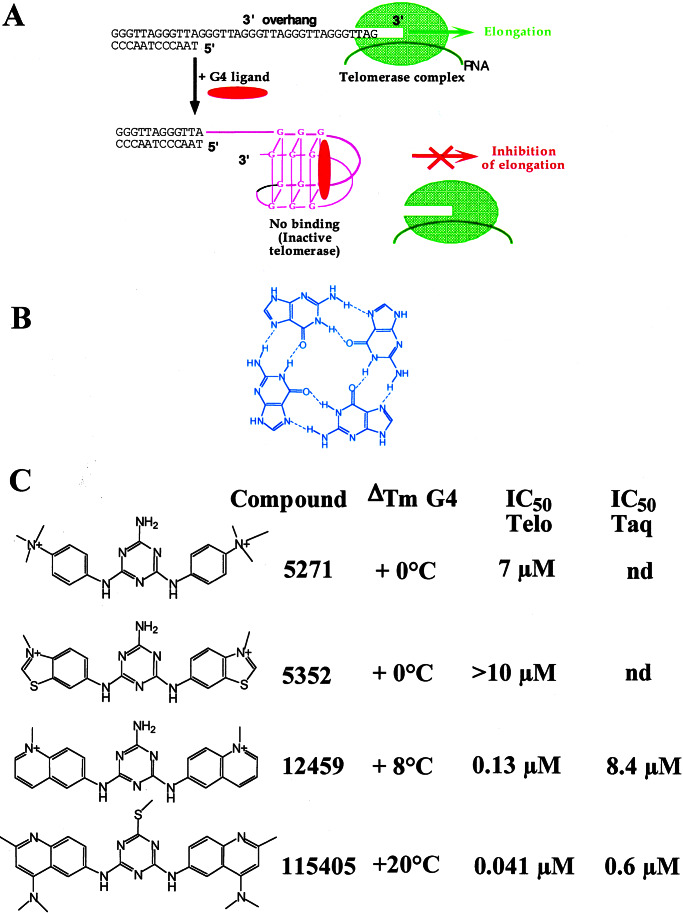
Figure 1
Figure 1
Presentation of the system. (A) Possible mechanism of telomerase inhibition by G-quadruplex induction. (B) Structure of the G-quartet (G4) also known as a G- or G4-tetrad. (C) Chemical formula of triazine derivatives tested as G4 ligands. ΔTm (°C) values measured by G4 FRET assay. IC50 values measured in telomerase assay (Telo) and in Taq polymerase assay (Taq).
Figure 2
Figure 2
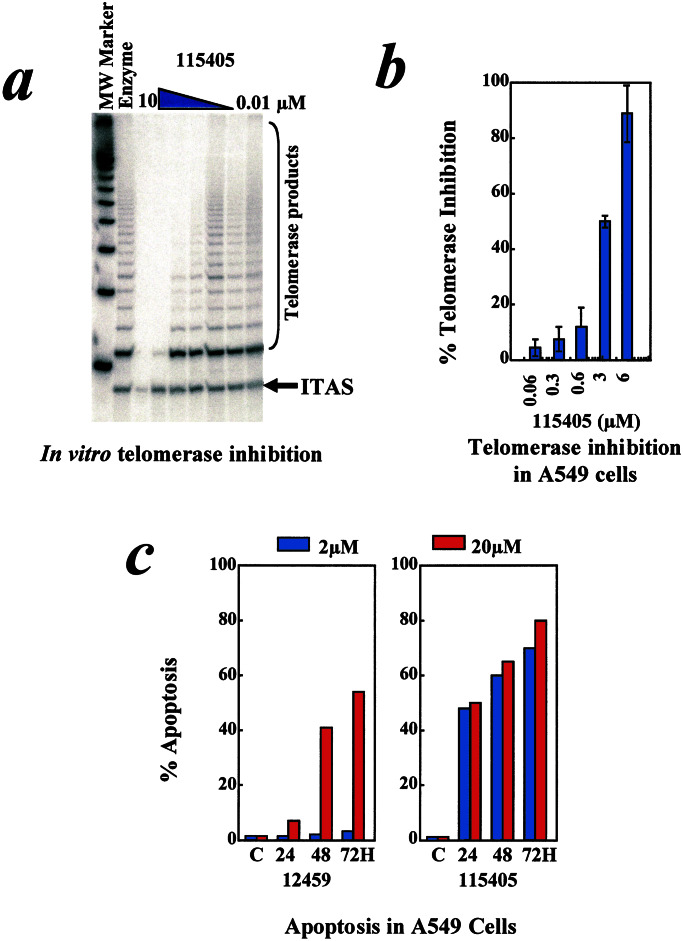
TRAP inhibition and short-term cellular properties of triazines. (a) In vitro telomerase inhibition by 115405. Decreasing concentrations of 115405 [10–0.01 μM were added in a TRAP assay containing an internal standard (ITAS) (25)]. Inhibition of ITAS (Taq polymerase activity) is observed at higher concentrations than for telomerase inhibition (Telomerase products). (b) Telomerase inhibitory effect of 115405 on cultured A549 cells originating from a human lung carcinoma. TRAP activity was determined on A549 cell extracts (200 ng) after 24-h treatment with different concentrations of 115405. Values (triplicate determination ± SD) are expressed as percent inhibition of telomerase relative to untreated controls. The addition of active telomerase to treated samples allowed activity recovery, indicating that telomerase inhibition may result from indirect down-regulation. (c) Apoptosis induction by triazine derivatives in A549 cells. Cells were treated for 24, 48, and 72 h with either 12459 or 115405 at 2 and 20 μM. Cells were fixed and stained with Hoechst 33342 and the percentage of cells exhibiting apoptotic nuclei was calculated relative to untreated cells.
Figure 3
Figure 3
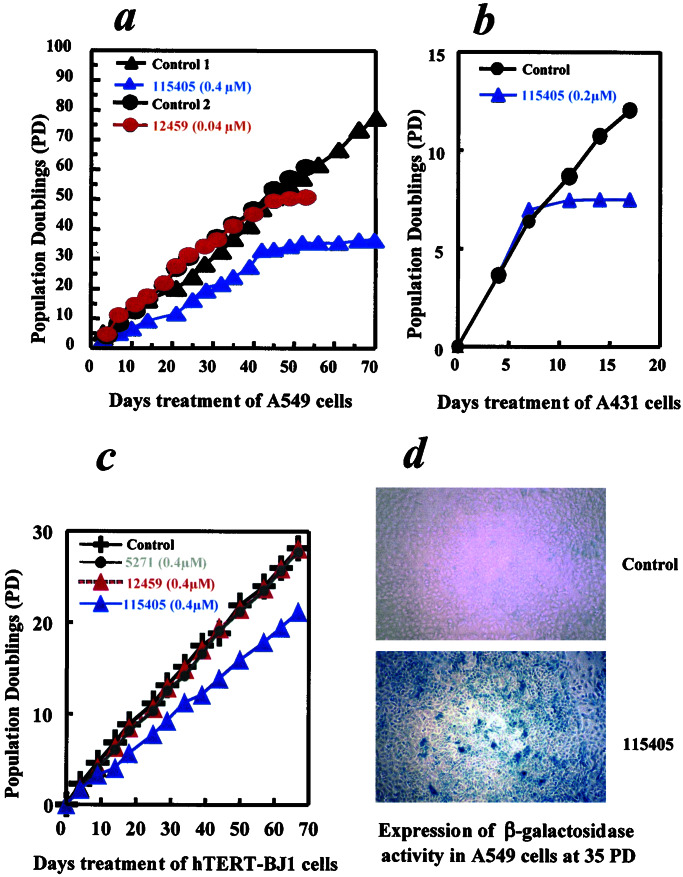
Delayed growth arrest and senescence-like phenotype induced by long-term treatment. (a) Cells with medium telomere length (6 kb). A549 cells were maintained in culture in the presence of 12459 (0.04 μM) or 115405 (0.4 μM) for an extended period. A cell-growth plateau appears at day 45, compared with control untreated cells. Cultures could not be replated at day 53 for 12459 and day 70 for 115405. Growth arrest corresponds to the appearance of a senescence-like phenotype and an increase in the number of apoptotic cells. (B) Cells with short telomere length (4 kb). A431 cells were maintained in culture in the presence of 115405 (0.2 μM) for an extended period. Culture could not be replated at day 66. Growth arrest corresponds to an increase in the number of apoptotic cells. (C) Cells with long telomere length (>10 kb). hTERT-BJ1 cells were maintained in culture in the presence of 5271 (0.4 μM), 12459 (0.4 μM), or 115405 (0.4 μM) for up to 70 days. Cells were still dividing at day 100 (not shown) and the appearance of cells expressing βgalactosidase activity started at day 55 only for 115405. (d) Expression of β-galactosidase activity in A549 cells treated (Lower) or untreated (Upper) with 115405 (0.4 μM) harvested at 35 population doublings (35 PD). Treatment with 115405 increases the number of senescent-like cells (Lower).
Figure 4
Figure 4
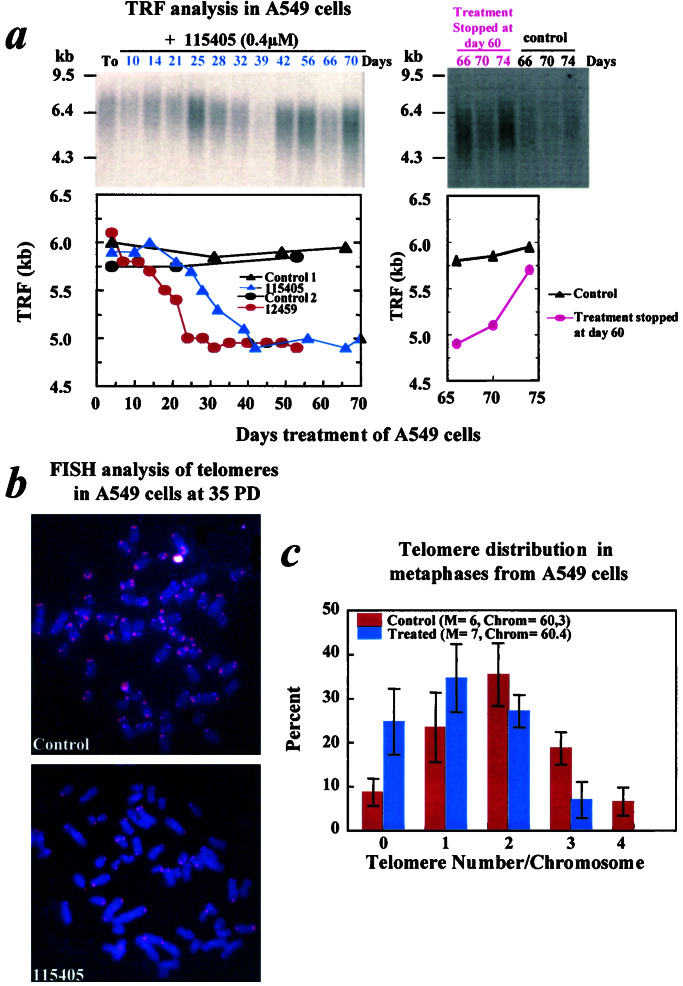
Effect of triazines on telomere length. (a Left) TRF analysis in A549 cells treated with 115405 (0.4 μM) and harvested at different times (days) of the culture. “To ” corresponds to control-untreated A549 cells harvested at day 32 (Upper). TRF mean values (kb) were expressed as a function of the duration of treatment (days) for 115405 and 12459 (Lower). (a Right) TRF analysis in A549 cells pretreated for 60 days with 115405 (0.4 μM), then untreated and harvested at days 66, 70, and 74. Control-untreated cells seeded at day 0 were harvested at days 66, 70, and 74 (Upper). TRF values (kb) were expressed as a function of the duration of the treatment for control or untreated at day 60 cells (Lower). (b) Representative images of in situ hybridization of Cy3-telomeric probe (red) to metaphase chromosome (blue). Fluorescence in situ hybridization (FISH) analysis of telomeric repeats in A549 cells harvested at 35 population doublings, using a fluorescent oligonucleotide (31). (c) Analysis of in situ hybridization in metaphases from control or 115405-treated A549 cells. Red and blue bars indicate the percentage of the mean number of telomeres/chromosome (± SD) calculated in six metaphases (control) and seven metaphases (treated). Chrom is the mean number of chromosomes/ metaphase.

References

    1. White L K, Wright W E, Shay J W. Trends Biotechnol. 2001;19:114–120. - PubMed
    1. Keith W N, Evans T R J, Glasspool R M. J Pathol. 2001;195:404–414. - PubMed
    1. Makarov V L, Hirose Y, Langmore J P. Cell. 1997;88:657–666. - PubMed
    1. Zahler A M, Williamson J R, Cech T R, Prescott D M. Nature (London) 1991;350:718–720. - PubMed
    1. Chen Q, Kuntz I D, Shafer R H. Proc Natl Acad Sci USA. 1996;93:2635–2639. - PMC - PubMed

Publication types

LinkOut - more resources