


Pathophysiological tissue changes associated with repetitive movement: a review of the evidence
- PMID: 11856068
- PMCID: PMC1550512
- DOI: 10.1093/ptj/82.2.173
Pathophysiological tissue changes associated with repetitive movement: a review of the evidence
Abstract
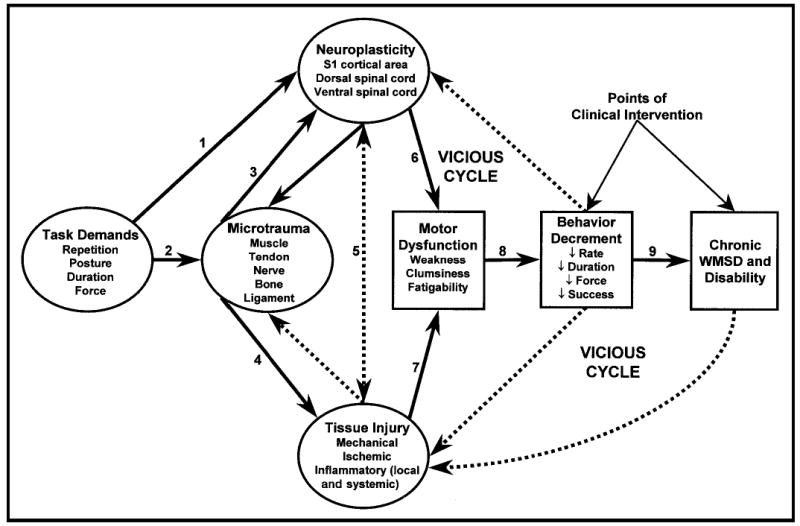
Work-related musculoskeletal disorders (WMSDs) represent approximately one third of workers' compensation costs in US private industry, yet estimates of acceptable exposure levels for forceful and repetitive tasks are imprecise, in part, due to lack of measures of tissue injury in humans. In this review, the authors discuss the scope of upper-extremity WMSDs, the relationship between repetition rate and forcefulness of reaching tasks and WMSDs, cellular responses to injury in vivo and in vitro, and animal injury models of repetitive, forceful tasks. The authors describe a model using albino rats and present evidence related to tissue injury and inflammation due to a highly repetitive reaching task. A conceptual schematic for WMSD development and suggestions for further research are presented. Animal models can enhance our ability to predict risk and to manage WMSDs in humans because such models permit the direct observation of exposed tissues as well as motor behavior.
Figures
References
-
- Bernard BP, ed. Musculoskeletal Disorders (MSDs) and Workplace Factors: A Critical Review of Epidemiologic Evidence for Work-Related Musculoskeletal Disorders of the Neck, Upper Extremity, and Low Back Washington, DC: US Dept of Health and Human Services, National Institute of Occupational Safety and Health; 1997. Publication No. 97–141.
-
- Ergonomics Program. Final Rule: 29 CFR Part 1910, US Dept of Labor, Occupational Safety and Health Administration. Federal Register. 2000;64(part II):68262–68870.
-
- Elements of Ergonomics Programs: A Primer Based on Workplace Evaluations of Musculoskeletal Disorders Washington, DC: US Dept of Health and Human Services, National Institute of Occupational Safety and Health; 1997. Publication No. 97–117.
-
- Management of Work-Related Musculoskeletal Disorders [working draft]. Itasca, Ill: National Safety Council, Accredited Standards Committee Z365; 2000
-
- Feuerstein M, Marshall L, Shaw WS, Burrell LM. Mulitcomponent intervention for work-related upper extremity disorders. J Occup Rehabil. 2000;10:71–83.
Publication types
MeSH terms
Grants and funding
LinkOut - more resources
Full Text Sources
