Attachment and autonomy as predictors of the development of social skills and delinquency during midadolescence
- PMID: 11860056
- PMCID: PMC1770857
- DOI: 10.1037//0022-006x.70.1.56
Attachment and autonomy as predictors of the development of social skills and delinquency during midadolescence
Abstract
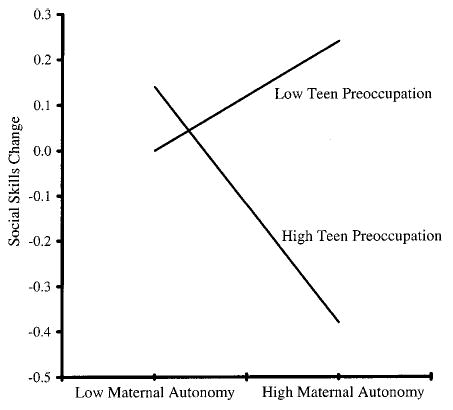
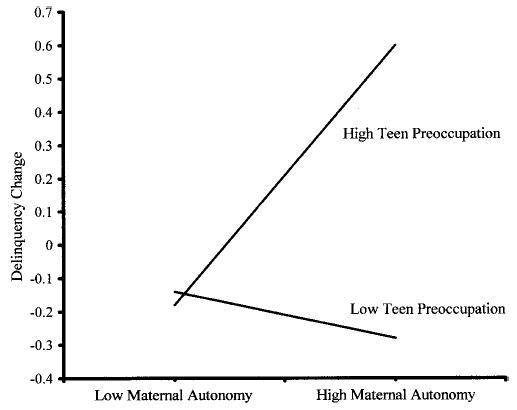
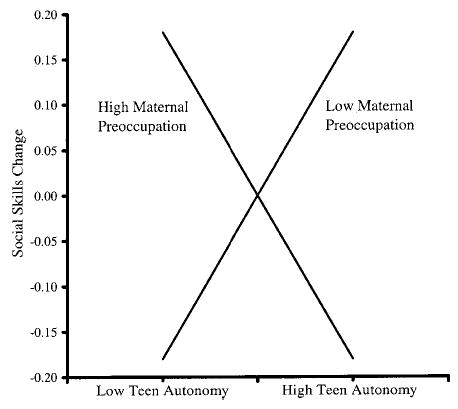
This study examined adolescent attachment organization as a predictor of the development of social skills and delinquent behavior during midadolescence. Delinquent activity and skill levels were assessed for 117 moderately at-risk adolescents at ages 16 and 18, and maternal and adolescent attachment organization and autonomy in interactions were assessed at age 16. Adolescent attachment security predicted relative increases in social skills from age 16 to 18, whereas an insecure-preoccupied attachment organization predicted increasing delinquency during this period. In addition, preoccupied teens interacting with highly autonomous mothers showed greater relative decreases in skill levels and increases in delinquent activity over time, suggesting a heightened risk for deviance among preoccupied teens who may be threatened by growing autonomy in adolescent-parent interactions.
Figures
References
-
- Aiken LS, West SG. Multiple regression: Testing and interpreting interactions. Newbury Park, CA: Sage; 1991.
-
- Ainsworth MDS, Blehar MC, Waters E, Wall S. Patterns of attachment: A psychological study of the strange situation. Hillsdale, NJ: Erlbaum; 1978.
-
- Allen JP, Hauser ST, Bell KL, McElhaney KB, Tate DC. The autonomy and relatedness coding system. 1998. Unpublished manuscript, University of Virginia.
-
- Allen JP, Hauser ST, Bell KL, O’Connor TG. Longitudinal assessment of autonomy and relatedness in adolescent-family interactions as predictors of adolescent ego development and self-esteem. Child Development. 1994;65:179–194. - PubMed
-
- Allen JP, Hauser ST, Borman-Spurrell E. Attachment theory as a framework for understanding sequelae of severe adolescent psychopathology: An 11-year follow-up study. Journal of Consulting and Clinical Psychology. 1996;64:254–263. - PubMed