


doi: 10.1128/jvi.76.6.3045-3048.2002.
Porcine endogenous retrovirus transmission characteristics of an inbred herd of miniature swine
Affiliations
- PMID: 11861871
- PMCID: PMC135987
- DOI: 10.1128/jvi.76.6.3045-3048.2002
Item in Clipboard
Porcine endogenous retrovirus transmission characteristics of an inbred herd of miniature swine
J Virol.
2002 Mar.
Abstract
Here we report the identification of inbred miniature swine that failed to produce human-tropic replication-competent porcine endogenous retroviruses (HTRC PERVs), using in vitro coculture assays. When HTRC PERVs were isolated from transmitting animals, all were recombinant viruses, with the receptor-binding domain of PERV-A combining with PERV-C-related sequences.
Figures

Alignment of pre-VRA (A) and VRA (B) regions of the env genes of HTRC PERV. Only those nucleotides that vary between the PERV-A (shaded boxes) and PERV-C (unshaded boxes) reference sequences are indicated. HTRC PERV loci were PCR amplified from PERV-infected 293 cells using oligonucleotides designed to match LTR sequences conserved between the three infectious classes of PERV (5′-CCTGGTGGTCTCCTACTGTCG-3′ and 5′-GCTTTTATGGGGTTCACAACAAA-3′) with TaKaRa DNA polymerase (Intergen). The sequences were divided into three families as defined by the position at which their nucleotide sequence underwent transition between PERV-C and PERV-A. Representative members of each family are presented. A nucleotide substitution that did not correlate with either reference sequence was identified at base 192 in sequence T6E5 (black box).
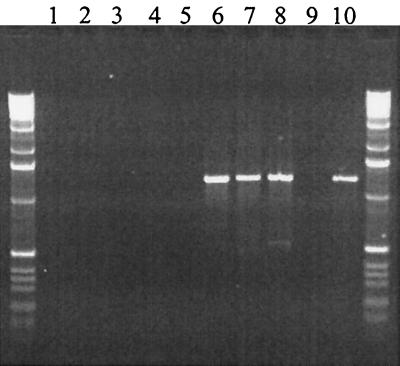
PCR analysis of miniature swine genomic DNA indicating that PERV-A-PERV-C TM recombinants are not present in miniature swine genomic DNA but develop during tissue culture. The sense primer specific for PERV-A is located in the VRA region, and the PERV-C specific antisense primer is located in the TM region. Samples are as follows: water control (lane 1), DNA from miniature swine (nontransmitting animals, lanes 2 and 3; transmitting animals, lanes 4 and 5), 293 cells infected with HTRC-PERV (lanes 6 to 8), 293 cells (lane 9), and a plasmid-positive control of a cloned HTRC-PERV env gene (lane 10). Control amplifications of cytochrome b sequences were successful and comparable from each sample (data not shown).
References
-
- Birmingham, K. 1999. FDA subcommittee finds no evidence of PERV transmission. Nat. Med. 5:855. - PubMed
-
- Boeke, J. D., and J. P. Stoye. 1997. Retrotransposons, endogenous retroviruses, and the evolution of retroelements, p. 343-436. In J. M. Coffin, S. H. Hughes, and H. E. Varmus (ed.), Retroviruses. Cold Spring Harbor Laboratory Press, Cold Spring Harbor, N.Y. - PubMed
-
- Cozzi, E., S. Masroor, B. Soin, C. Vial, and D. J. White. 2000. Progress in xenotransplantation. Clin. Nephrol. 53:13-18. - PubMed
Publication types
MeSH terms
Associated data
- Actions
- Actions
- Actions
- Actions
- Actions
- Actions
- Actions
- Actions
- Actions
- Actions
- Actions
- Actions
- Actions
Grants and funding
LinkOut - more resources
Full Text Sources
