


doi: 10.1128/jvi.76.6.3078-3083.2002.
The phosphoprotein (P) binding site resides in the N terminus of the L polymerase subunit of sendai virus
Affiliations
- PMID: 11861877
- PMCID: PMC135992
- DOI: 10.1128/jvi.76.6.3078-3083.2002
Item in Clipboard
The phosphoprotein (P) binding site resides in the N terminus of the L polymerase subunit of sendai virus
J Virol.
2002 Mar.
Abstract
Sendai virus encodes an RNA-dependent RNA polymerase which is composed of the L and P proteins. Site-directed mutagenesis of the N terminus of L has identified amino acids important for binding P. Seven of nine mutants in amino acids 1 to 350 of Sendai L lost the ability to bind to Sendai P, although they were still able to bind the viral C protein. Loss of P binding correlated with the loss of all RNA synthesis activities. Two L mutants gave limited P-L complex formation and limited viral transcription and replication.
Figures
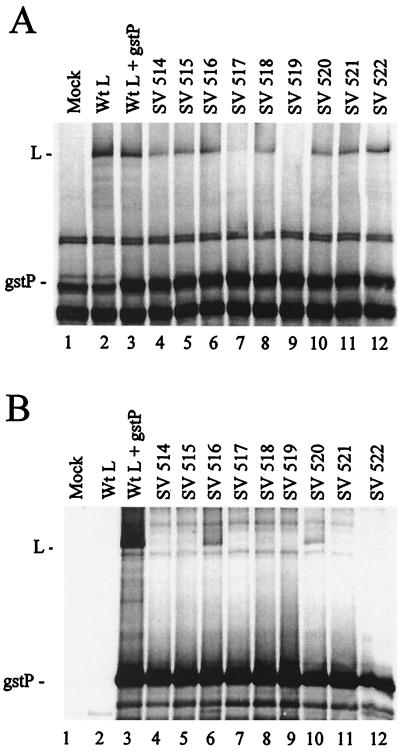
P-L complex formation with the Sendai virus L mutants. A549 cells in 35-mm-diameter dishes were infected with VVT7 at a multiplicity of infection of 2.5 PFU/ml and transfected with no plasmids (Mock) or Sendai virus gstP (0.2 μg) and the indicated wt or mutant Sendai virus L (1.67 μg) plasmids. The cells were incubated for 10 h and then labeled for 30 min using Express-35S (100 μCi/ml), and cytoplasmic extracts were prepared. Samples of the extracts were analyzed directly by sodium dodecyl sulfate-polyacrylamide gel electrophoresis (SDS-PAGE) for total protein expression (A) or incubated with glutathione-Sepharose beads, after which the bound proteins were separated by SDS-PAGE (B). The positions of the proteins are indicated.
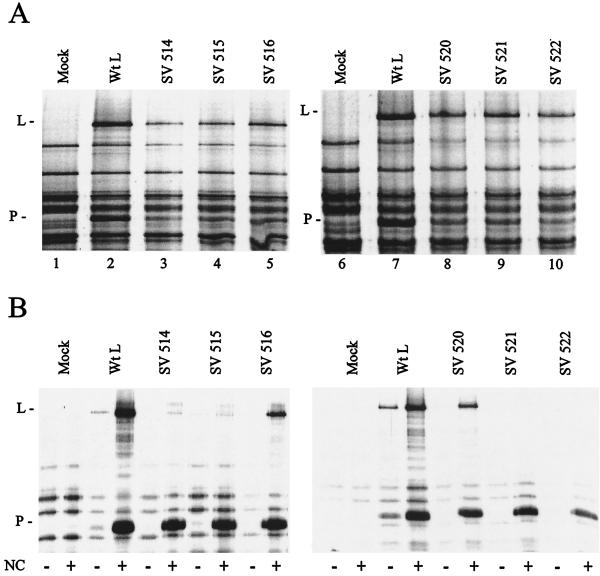
Mutant virus Sendai polymerase binding to nucleocapsids. VVT7-infected A549 cells were transfected with no plasmids (Mock) or the Sendai virus P and the indicated wt or mutant L plasmids. The cells were incubated overnight with Express-35S, and extracts were prepared. (A) Total samples were separated by sodium dodecyl sulfate-polyacrylamide gel electrophoresis (SDS-PAGE). (B) Samples were incubated in the absence (−) and presence (+) of Sendai virus nucleocapsids (NC; 1 μg) and then pelleted through glycerol as described previously (11). The NC-associated proteins were analyzed by SDS-PAGE. The positions of the proteins are indicated.
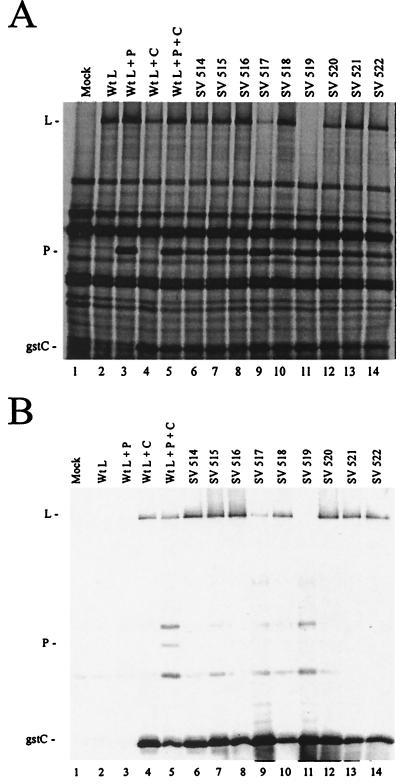
Complex formation between Sendai virus gstC and the L mutants. A549 cells in 35-mm-diameter dishes were infected with VVT7 and transfected with no plasmids (Mock) or with the Sendai virus gstC (0.2 μg), P (1.67 μg), and the indicated wt or mutant L (1.67 μg) plasmids. At 10 h the cells were incubated with Express-35S for 30 min, and cytoplasmic extracts were prepared. Samples were analyzed directly by sodium dodecyl sulfate-polyacrylamide gel electrophoresis (SDS-PAGE) (A) or incubated with glutathione-Sepharose beads after which the bound proteins were separated by SDS-PAGE as described previously (B) (9). The positions of the proteins are indicated.

In vitro transcription with the Sendai virus L mutants. VVT7-infected A549 cells were transfected with no plasmids (Mock) or with the Sendai virus P (1.5 μg) and the indicated wt or mutant L (0.5 μg) plasmids. (A) Cytoplasmic cell extracts were incubated with polymerase-free wt Sendai virus RNA-NP (1 μg) and [α-32P]CTP (200 μCi/ml) as described previously (7, 8). Total RNA was isolated and separated on an agarose-urea gel. The position of the NP and P transcripts which comigrate is indicated. (B) Samples of the extracts were immunoblotted with α-P antibody. The position of the P protein is indicated. (C) For leader RNA synthesis the extracts were incubated with polymerase-free wt RNA-NP and unlabeled nucleotides, and the leader RNA was detected by Northern analysis with a 32P-labeled oligonucleotide probe complementary to le+ RNA as described previously (7). The position of the le+ product is indicated.
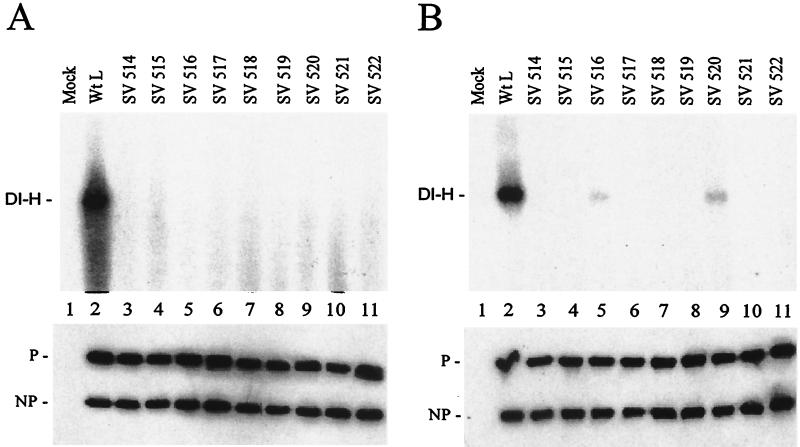
DI-H replication with the Sendai virus L mutants. (A) A549 cells were infected with VVT7 and transfected with no plasmids (Mock) or the Sendai virus NP, P, and the indicated wt or mutant L plasmids. Cytoplasmic extracts were incubated with polymerase-free DI-H RNA-NP in the presence of [α-32P]CTP, and total RNA was isolated and analyzed on an agarose-urea gel as described previously (8). The position of DI-H RNA is indicated. (B) For in vivo replication infected cells were transfected as above with the addition of pSPDI-H plasmid, and extracts were prepared. The extracts were nuclease treated, and the nuclease-resistant RNA was isolated and then separated on an agarose-urea gel. The RNA was transferred to a nylon membrane, and the blot was probed with a DI-H-specific (+) sense 32P-labeled riboprobe as described previously (8). The position of the DI-H RNA is indicated. (Bottom panels) Samples of the extracts were immunoblotted using α-SV and α-P antibodies. The positions of the proteins are indicated.
References
-
- Chandrika, R., S. M. Horikami, S. Smallwood, and S. A. Moyer. 1995. Mutations in conserved domain I of the Sendai virus L polymerase protein uncouple transcription and replication. Virology 213:352-363. - PubMed
-
- Cortese, C. K., J. A. Feller, and S. A. Moyer. 2000. Mutations in domain V of the Sendai virus L polymerase protein uncouple transcription and replication and differentially affect replication in vitro and in vivo. Virology 277:387-396. - PubMed
-
- Curran, J., R. Boeck, N. Lin-Marq, A. Lupas, and D. Kolakofsky. 1995. Paramyxovirus phosphoproteins form homotrimers as determined by an epitope dilution assay, via predicted coiled coils. Virology 214:139-149. - PubMed
Publication types
MeSH terms
Substances
Grants and funding
LinkOut - more resources
Full Text Sources
