. 2002 Mar 1;21(5):1132-8.
doi: 10.1093/emboj/21.5.1132.

RNA quality control: degradation of defective transfer RNA

Affiliations

RNA quality control: degradation of defective transfer RNA

Zhongwei Li et al. EMBO J. .

Abstract

The distinction between stable (tRNA and rRNA) and unstable (mRNA) RNA has been considered an important feature of bacterial RNA metabolism. One factor thought to contribute to the difference between these RNA populations is polyadenylation, which promotes degradation of unstable RNA. However, the recent discovery that polyadenylation also occurs on stable RNA led us to examine whether poly(A) might serve as a signal for eliminating defective stable RNAs, and thus play a role in RNA quality control. Here we show that a readily denaturable, mutant tRNA(Trp) does not accumulate to normal levels in Escherichia coli because its precursor is rapidly degraded. Degradation is largely dependent on polyadenylation of the precursor by poly(A) polymerase and on its removal by polynucleotide phosphorylase. Thus, in the absence of these two enzymes large amounts of tRNA(Trp) precursor accumulate. We propose that defective stable RNA precursors that are poorly converted to their mature forms may be polyadenylated and subsequently degraded. These data indicate that quality control of stable RNA metabolism in many ways resembles normal turnover of unstable RNA.


Figures
None
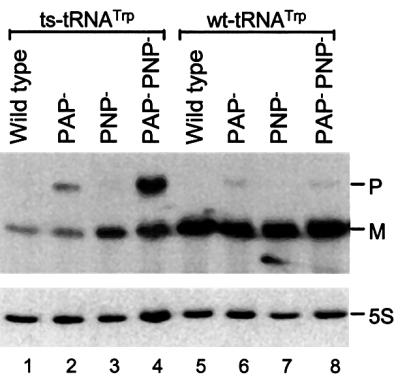
Fig. 1. Northern blot analysis of wt-tRNATrp and ts-tRNATrp in PAP and PNP strains. RNA was isolated and northern blot analysis performed as described in Materials and methods using a 16mer probe complementary to residues 39–54 of tRNATrp. Total RNA was isolated from strain CA244 and its derivatives grown at 31°C, and 8 µg were added to each lane. P and M indicate the migration positions of tRNATrp precursor and mature tRNATrp, respectively. 5S indicates the 5S RNA band determined after stripping the tRNATrp probe and reprobing with a probe specific for 5S RNA (Li and Deutscher, 1995).
None
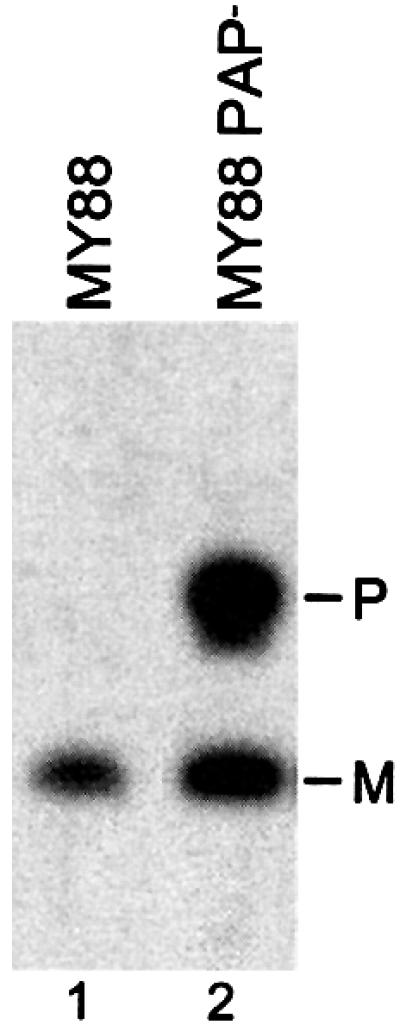
Fig. 2. Accumulation of ts-tRNATrp precursor in PAP cells. Total RNA was isolated from strains MY88 and MY88 PAP grown at 31°C, and 8 µg were added to each lane. Northern blot analysis was performed as described in Materials and methods.
None
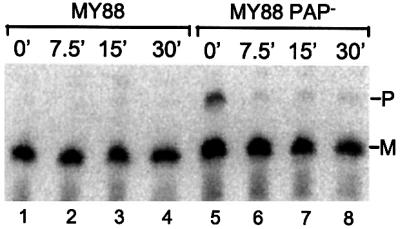
Fig. 3. Degradation of ts-tRNATrp precursor at 42°C. MY88 and MY88 PAP cells were grown at 31°C and shifted to 42°C. Total RNA was isolated at time 0 (lanes 1 and 5) and at 7.5 min (lanes 2 and 6), 15 min (lanes 3 and 7) and 30 min (lanes 4 and 8) after the temperature shift. Five micrograms of RNA were added to each lane. Northern blot analysis was performed as described in Materials and methods.
None
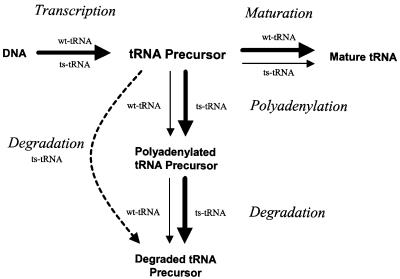
Fig. 4. Model for quality control of stable RNA synthesis. Genes encoding normal (wt-tRNA) and defective (ts-tRNA) RNAs are transcribed with equal efficiency to generate tRNA precursors. However, whereas wt-tRNA precursor is rapidly converted to its mature form by the processing RNases, maturation of the defective precursor is greatly slowed. As a consequence, the defective tRNA precursor is first subject to polyadenylation by poly(A) polymerase, and is then degraded by PNPase and other RNases. Based on this model, there is competition at the tRNA precursor level between the processing RNases and poly(A) polymerase. Altered precursor structure or removal of processing RNases (Li et al., 1998b) makes the precursor available for polyadenylation and, in the case of the defective tRNA precursor, shifts the pathway from mature tRNA production to degradation. The thickness of the arrows indicates the relative rates of individual steps in the pathway with wt-tRNA or ts-tRNA. The dashed lines indicate the degradation of tRNA precursor that occurs in the absence of polyadenylation.

References

    1. Bradford M.M. (1976) A rapid and sensitive method for the determination of microgram quantities of protein utilizing the principle of protein–dye binding. Anal. Biochem., 72, 248–254. - PubMed
    1. Carpousis A.J., Vanzo,N.F. and Raynal,L.G. (1999) mRNA degradation. Trends Genet., 15, 24–28. - PubMed
    1. Coburn G.A. and Mackie,G.A. (1999) Degradation of mRNA in Escherichia coli: an old problem with some new twists. Prog. Nucleic Acid Res. Mol. Biol., 62, 55–108. - PubMed
    1. Deutscher M.P. and Li,Z. (2000) Exoribonucleases and their multiple roles in RNA metabolism. Prog. Nucleic Acid Res. Mol. Biol., 66, 67–105. - PubMed
    1. Eisenberg S.P. and Yarus,M. (1980) The structure and aminoacylation of a temperature-sensitive tRNATrp (Escherichia coli). J. Biol. Chem., 255, 1128–1137. - PubMed

Publication types

MeSH terms

LinkOut - more resources