


Whole-gene APC deletions cause classical familial adenomatous polyposis, but not attenuated polyposis or "multiple" colorectal adenomas
- PMID: 11867715
- PMCID: PMC122454
- DOI: 10.1073/pnas.042699199
Whole-gene APC deletions cause classical familial adenomatous polyposis, but not attenuated polyposis or "multiple" colorectal adenomas
Abstract
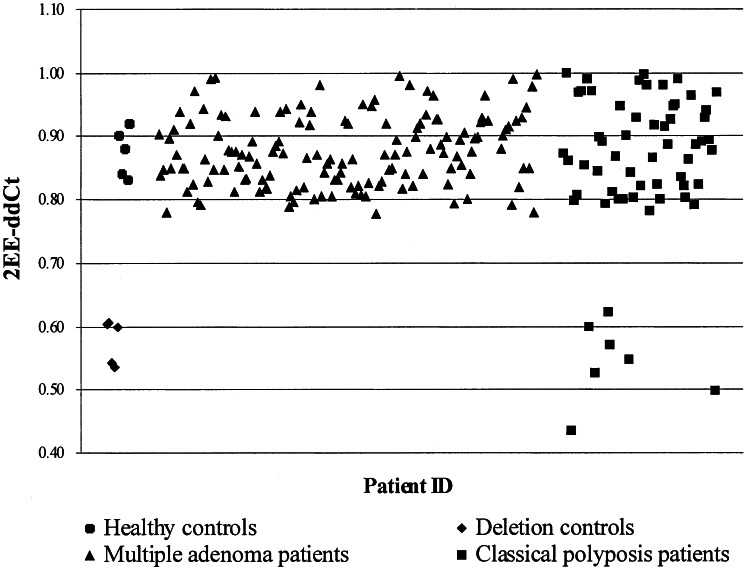
Familial adenomatous polyposis (FAP) is a dominantly inherited colorectal tumor predisposition that results from germ-line mutations in the APC gene (chromosome 5q21). FAP shows substantial phenotypic variability: classical polyposis patients develop more than 100 colorectal adenomas, whereas those with attenuated polyposis (AAPC) have fewer than 100 adenomas. A further group of individuals, so-called "multiple" adenoma patients, have a phenotype like AAPC, with 3-99 polyps throughout the colorectum, but mostly have no demonstrable germ-line APC mutation. Routine mutation detection techniques fail to detect a pathogenic APC germ-line mutation in approximately 30% of patients with classical polyposis and 90% of those with AAPC/multiple adenomas. We have developed a real-time quantitative multiplex PCR assay to detect APC exon 14 deletions. When this technique was applied to a set of 60 classical polyposis and 143 AAPC/multiple adenoma patients with no apparent APC germ-line mutation, deletions were found exclusively in individuals with classical polyposis (7 of 60, 12%). Fine-mapping of the region suggested that the majority (6 of 7) of these deletions encompassed the entire APC locus, confirming that haploinsufficiency can result in a classical polyposis phenotype. Screening for germ-line deletions in APC mutation-negative individuals with classical polyposis seems warranted.
Figures
References
-
- Sieber O M, Tomlinson I P M, Lamlum H. Mol Med Today. 2000;6:462–469. - PubMed
-
- Spirio L, Olschwang S, Groden J, Robertson M, Samowitz W, Joslyn G, Gelbert L, Thliveris A, Carlson M, Otterud B, et al. Cell. 1993;75:951–957. - PubMed
-
- Lamlum H, Al Tassan N, Jaeger E, Frayling I, Sieber O, Reza F B, Eckert M, Rowan A, Barclay E, Atkin W, et al. Hum Mol Genet. 2000;9:2215–2221. - PubMed
Publication types
MeSH terms
Substances
LinkOut - more resources
Full Text Sources
Miscellaneous
