. 2002 Mar;68(3):1180-91.
doi: 10.1128/AEM.68.3.1180-1191.2002.

Resolution of Prochlorococcus and Synechococcus ecotypes by using 16S-23S ribosomal DNA internal transcribed spacer sequences

Affiliations

Resolution of Prochlorococcus and Synechococcus ecotypes by using 16S-23S ribosomal DNA internal transcribed spacer sequences

Gabrielle Rocap et al. Appl Environ Microbiol. 2002 Mar.

Abstract

Cultured isolates of the marine cyanobacteria Prochlorococcus and Synechococcus vary widely in their pigment compositions and growth responses to light and nutrients, yet show greater than 96% identity in their 16S ribosomal DNA (rDNA) sequences. In order to better define the genetic variation that accompanies their physiological diversity, sequences for the 16S-23S rDNA internal transcribed spacer (ITS) region were determined in 32 Prochlorococcus isolates and 25 Synechococcus isolates from around the globe. Each strain examined yielded one ITS sequence that contained two tRNA genes. Dramatic variations in the length and G+C content of the spacer were observed among the strains, particularly among Prochlorococcus strains. Secondary-structure models of the ITS were predicted in order to facilitate alignment of the sequences for phylogenetic analyses. The previously observed division of Prochlorococcus into two ecotypes (called high and low-B/A after their differences in chlorophyll content) were supported, as was the subdivision of the high-B/A ecotype into four genetically distinct clades. ITS-based phylogenies partitioned marine cluster A Synechococcus into six clades, three of which can be associated with a particular phenotype (motility, chromatic adaptation, and lack of phycourobilin). The pattern of sequence divergence within and between clades is suggestive of a mode of evolution driven by adaptive sweeps and implies that each clade represents an ecologically distinct population. Furthermore, many of the clades consist of strains isolated from disparate regions of the world's oceans, implying that they are geographically widely distributed. These results provide further evidence that natural populations of Prochlorococcus and Synechococcus consist of multiple coexisting ecotypes, genetically closely related but physiologically distinct, which may vary in relative abundance with changing environmental conditions.


Figures
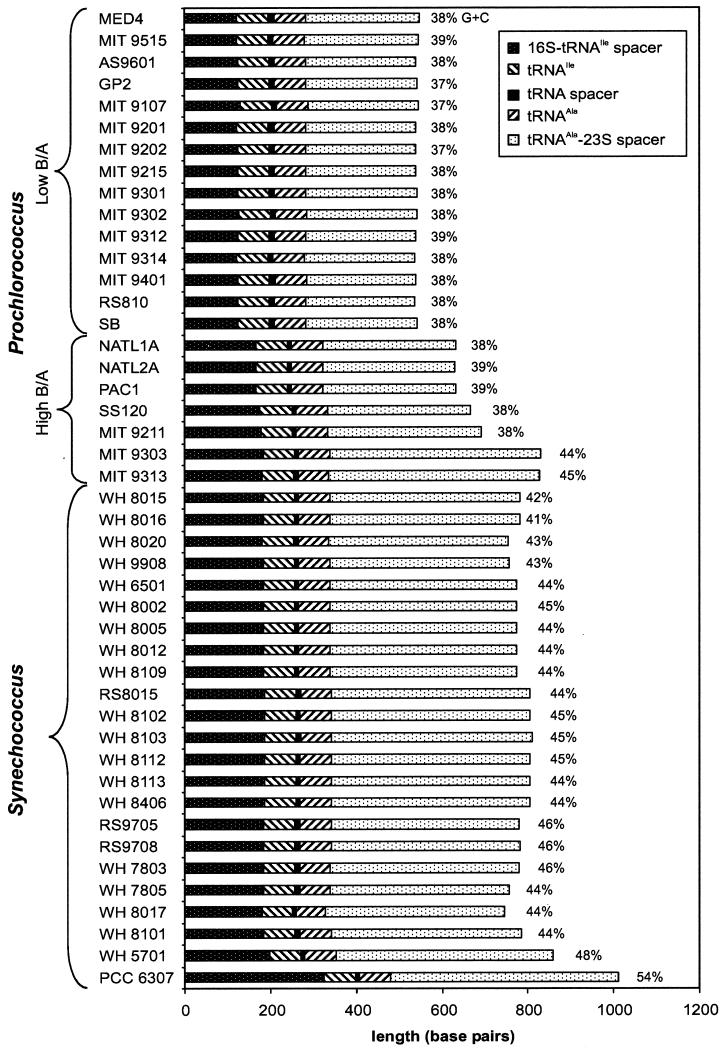
FIG. 1.
FIG. 1.
Length of the ITS region between the 16S and 23S rDNAs in Prochlorococcus and Synechococcus isolates. Low-B/A Prochlorococcus isolates all have short spacers, while high-B/A isolates have longer spacer lengths and are not as similar to one another. The freshwater strain PCC 6307 has a much longer spacer than the marine Synechococcus and Prochlorococcus isolates. The G+C content of the 16S-23S rDNA ITS is indicated to the right of each bar. Low-B/A Prochlorococcus and four high-B/A Prochlorococcus isolates have a lower G+C content than two high-B/A Prochlorococcus and Synechococcus isolates. For sets of isolates with identical ITS sequences (see text), only one isolate is represented here.
FIG. 2.
FIG. 2.
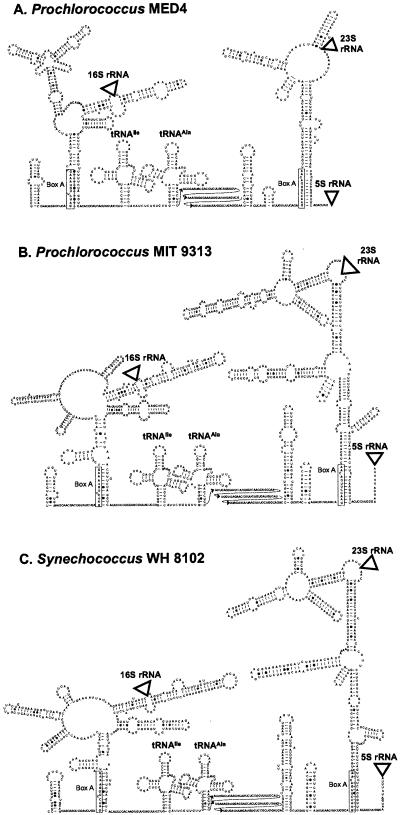
Predicted secondary structures of the ITS regions of the rRNA operon in (A) Prochlorococcus strain MED4, (B) Prochlorococcus strain MIT 9313, and (C) Synechococcus strain WH 8102. Locations of the 16S rRNA, 23S rRNA, and 5S rRNA are represented by triangles. All strains have antiterminator box B loops and box A sequences conserved in most bacterial ITS sequences, as well as genes for tRNAs isoleucine and alanine typical of cyanobacterial ITS sequences. Sequence corresponding to the box A motif is enclosed in a rectangle. The 5′ region of the tRNAAla-23S rRNA spacer (between the tRNAAla and the box B loop) for which no structure was inferred is shown in three rows of text to save space.
FIG. 3.
FIG. 3.
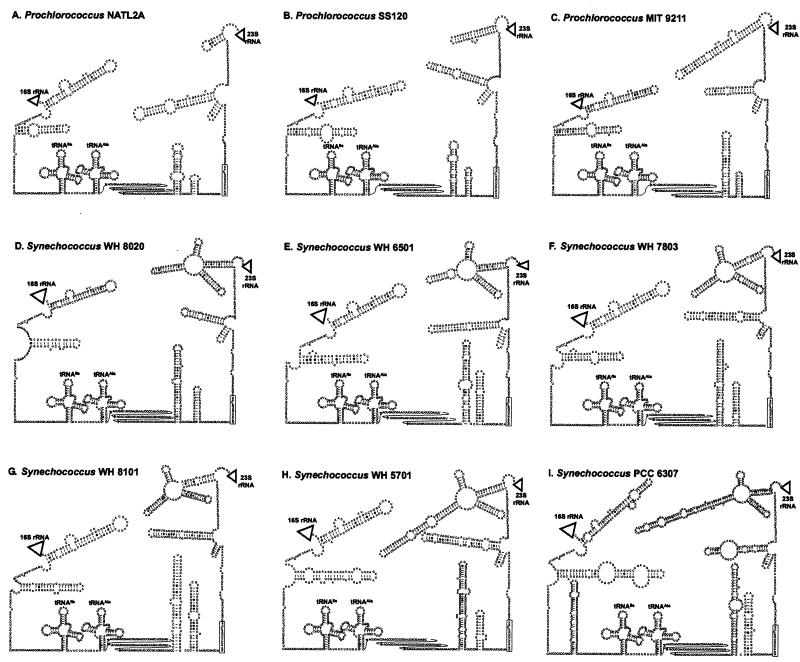
Predicted secondary structures of the 16S-23S rRNA ITS in three high-B/A Prochlorococcus strains and six Synechococcus strains identified in this study. (A) Prochlorococcus strain NATL2A, (B) Prochlorococcus strain SS120, (C) Prochlorococcus strain MIT 9211, (D) marine cluster A Synechococcus strain WH 6501, (E) marine cluster A Synechococcus strain WH 8020, (F) marine cluster A Synechococcus strain WH 7803, (G) marine cluster B Synechococcus strain WH 8101, (H) marine cluster B Synechococcus strain WH 5701, and (I) Cyanobium cluster Synechococcus sp. strain PCC 6307. Locations of the 16S rRNA, 23S rRNA, and 5S rRNA are represented by triangles. All strains have an antiterminator box B loop and box A sequence conserved in most bacterial ITS sequences as well as genes for tRNAs isoleucine and alanine typical of cyanobacterial ITS sequences. Sequence corresponding to the box A motif is enclosed in a rectangle. The 5′ region of the tRNAAla-23S rRNA spacer (between the tRNAAla and the box B loop) for which no structure was inferred is shown in three rows of text to save space.
FIG. 4.
FIG. 4.
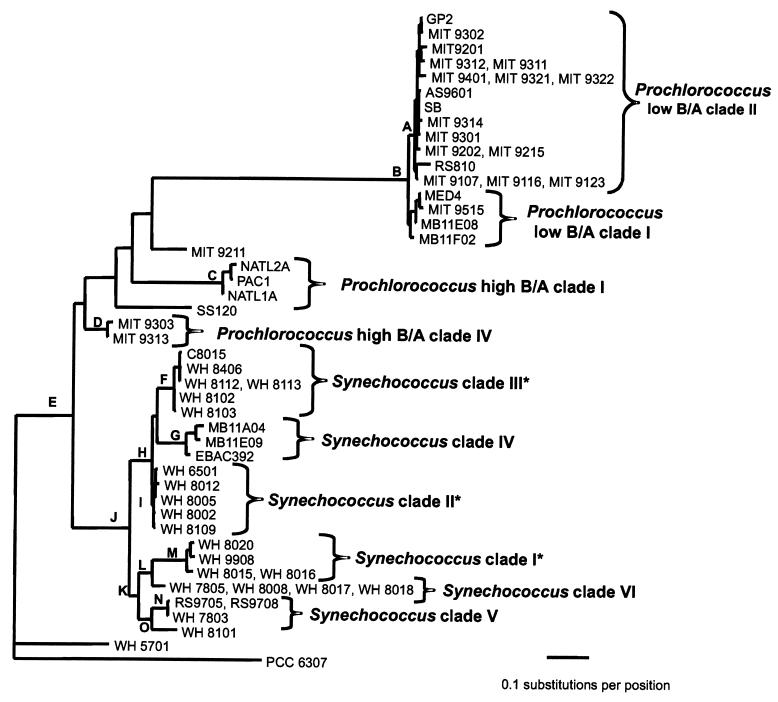
(A) Evolutionary relationships of Prochlorococcus and Synechococcus isolates and environmental sequences from Monterey Bay inferred using 233 positions of the 16S-23S rDNA spacer. The tree shown was inferred by maximum likelihood (−ln likelihood = 2,364.57) using the HKY85 model of nucleotide substitution with rate heterogeneity (gamma shape parameter = 0.383), empirical nucleotide frequencies, and a transition-transversion ratio of 1.156. The tree shown was not significantly worse (as determined by the Kishino-Hasegawa test) than the best tree found by likelihood (−ln likelihood = 2,362.09) in which the Prochlorococcus low-B/A clade I was not monophyletic. The Prochlorococcus low-B/A clade I was monophyletic in the best trees inferred using HKY85 or paralinear (logdet) distances and minimum evolution as the objective function. The tree is rooted with Cyanobium cluster Synechococcus sp. strain PCC 6307. Bootstrap values from distance/maximum-parsimony/maximum-likelihood analyses are as follows, with values less than 50 indicated by dashes: A, 79/72/81; B, 100/100/100; C, 100/100/99; D, 100/99/51; E, 64/51/—; F, 100/88/78; G, 100/98/93; H, 97/95/80; I, 100/69/—; J, 90/93/71; K, 55/—/—; L, 60/52/57; M, 100/99/99; N, 99/99/82; and O, 91/87/83. (B) Evolutionary relationships of marine Synechococcus isolates inferred using 434 positions of the 16S-23S rDNA spacer. Two strains of high-B/A Prochlorococcus and three environmental sequences from Monterey Bay were also included. Asterisks denote clades which are congruent with those identified using rpoC1. The phylogenetic framework was determined using paralinear distances (logdet) and minimum evolution as the objective function. Trees inferred using HKY85 distances resulted in identical clades with essentially similar branching orders. Bootstrap values from distance/maximum-parsimony/maximum-likelihood analyses are listed to the left of each node, with values less than 50 indicated by dashes. The tree is rooted with Cyanobium cluster Synechococcus sp. strain PCC 6307.
FIG. 4.
FIG. 4.
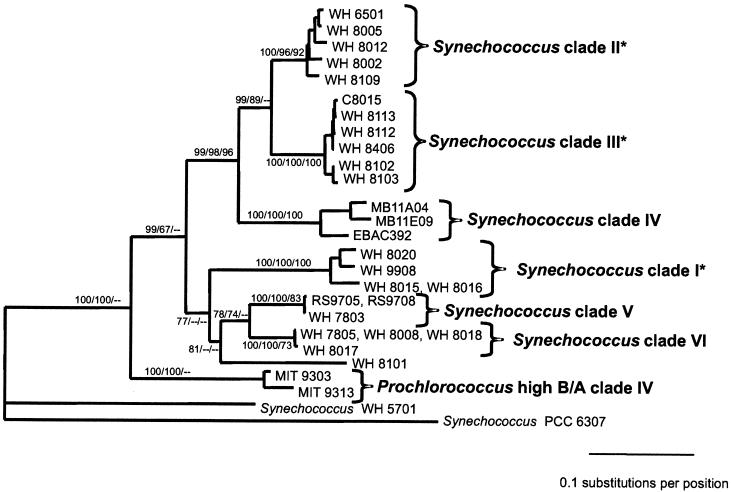
(A) Evolutionary relationships of Prochlorococcus and Synechococcus isolates and environmental sequences from Monterey Bay inferred using 233 positions of the 16S-23S rDNA spacer. The tree shown was inferred by maximum likelihood (−ln likelihood = 2,364.57) using the HKY85 model of nucleotide substitution with rate heterogeneity (gamma shape parameter = 0.383), empirical nucleotide frequencies, and a transition-transversion ratio of 1.156. The tree shown was not significantly worse (as determined by the Kishino-Hasegawa test) than the best tree found by likelihood (−ln likelihood = 2,362.09) in which the Prochlorococcus low-B/A clade I was not monophyletic. The Prochlorococcus low-B/A clade I was monophyletic in the best trees inferred using HKY85 or paralinear (logdet) distances and minimum evolution as the objective function. The tree is rooted with Cyanobium cluster Synechococcus sp. strain PCC 6307. Bootstrap values from distance/maximum-parsimony/maximum-likelihood analyses are as follows, with values less than 50 indicated by dashes: A, 79/72/81; B, 100/100/100; C, 100/100/99; D, 100/99/51; E, 64/51/—; F, 100/88/78; G, 100/98/93; H, 97/95/80; I, 100/69/—; J, 90/93/71; K, 55/—/—; L, 60/52/57; M, 100/99/99; N, 99/99/82; and O, 91/87/83. (B) Evolutionary relationships of marine Synechococcus isolates inferred using 434 positions of the 16S-23S rDNA spacer. Two strains of high-B/A Prochlorococcus and three environmental sequences from Monterey Bay were also included. Asterisks denote clades which are congruent with those identified using rpoC1. The phylogenetic framework was determined using paralinear distances (logdet) and minimum evolution as the objective function. Trees inferred using HKY85 distances resulted in identical clades with essentially similar branching orders. Bootstrap values from distance/maximum-parsimony/maximum-likelihood analyses are listed to the left of each node, with values less than 50 indicated by dashes. The tree is rooted with Cyanobium cluster Synechococcus sp. strain PCC 6307.

References

    1. Apirion, D., and A. Miczak. 1993. RNA processing in prokaryotic cells. BioEssays 15:113-120. - PubMed
    1. Ausubel, F. M., R. Brent, R. E. Kingston, D. D. Moore, J. G. Seidman, J. A. Smith, and K. Struhl. 1992. Short protocols in molecular biology. John Wiley & Sons, New York, N.Y.
    1. Barry, T., G. Colleran, M. Glennon, L. R. Dunican, and F. Gannon. 1991. The 16S/23S ribosomal spacer region as a target for DNA probes to identify eubacteria. PCR Methods Appl. 1:51-56. - PubMed
    1. Béjà, O., M. T. Suzuki, E. V. Koonin, L. Aravind, A. Hadd, L. P. Nguyen, R. Villacorta, M. Amjadi, C. Garrigues, S. B. Jovanovich, R. A. Feldman, and E. F. DeLong. 2000. Construction and analysis of bacterial artificial chromosome libraries from a marine microbial assemblage. Environ. Microbiol. 2:516-529. - PubMed
    1. Berg, K. L., C. Squires, and C. L. Squires. 1989. Ribosomal RNA operon antitermination. Function of leader and spacer region box B-box A sequences and their conservation in diverse microorganisms. J. Mol. Biol. 209:345-358. - PubMed

Publication types

LinkOut - more resources