


doi: 10.1128/AEM.68.3.1192-1195.2002.
Wax ester production from n-alkanes by Acinetobacter sp. strain M-1: ultrastructure of cellular inclusions and role of acyl coenzyme A reductase
Affiliations
- PMID: 11872467
- PMCID: PMC123770
- DOI: 10.1128/AEM.68.3.1192-1195.2002
Item in Clipboard
Wax ester production from n-alkanes by Acinetobacter sp. strain M-1: ultrastructure of cellular inclusions and role of acyl coenzyme A reductase
Appl Environ Microbiol.
2002 Mar.
Abstract
Acinetobacter sp. strain M-1 accumulated a large amount of wax esters from an n-alkane under nitrogen-limiting conditions. Under the optimized conditions with n-hexadecane as the substrate, the amount of hexadecyl hexadecanoate in the cells reached 0.17 g/g of cells (dry weight). Electron microscopic analysis revealed that multilayered disk-shaped intracellular inclusions were formed concomitant with wax ester formation. The contribution of acyl-CoA reductase to wax ester synthesis was evaluated by gene disruption analysis.
Figures
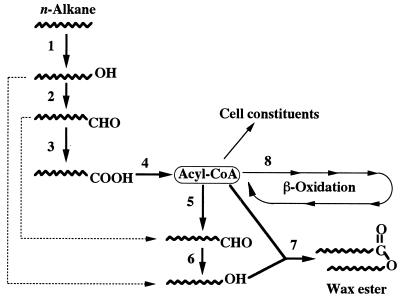
The proposed carbon flow from n-alkanes to wax esters in Acinetobacter spp. Dotted lines indicate alternative ways to wax ester synthesis. Enzymes: 1, alkane hydroxylase complex; 2, NAD(P)-dependent alcohol dehydrogenase; 3, NAD(P)-dependent aldehyde dehydrogenase; 4, acyl-CoA synthetase; 5, acyl-CoA reductase; 6, aldehyde reductase; 7, acyl-CoA: alcohol transacylase; 8, acyl-CoA dehydrogenase.
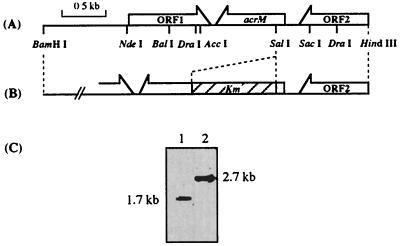
Genetic organization of the cloned region including the acrM gene and that of the disruptant. (A) ORFs and restriction map of the cloned BamHI-HindIII 4.0-kb cloned fragment. (B) Organization of the disruption vector, pDAR1, derived from pBM4. The hatched box represents the kanamycin resistance gene. (C) Genomic Southern analysis of DraI-digested total DNA (5.0 μg per each lane) from the wild-type strain (lane 1) and the acrM-KO strain (lane 2), using the 32P-labeled acrM gene fragment as a probe.
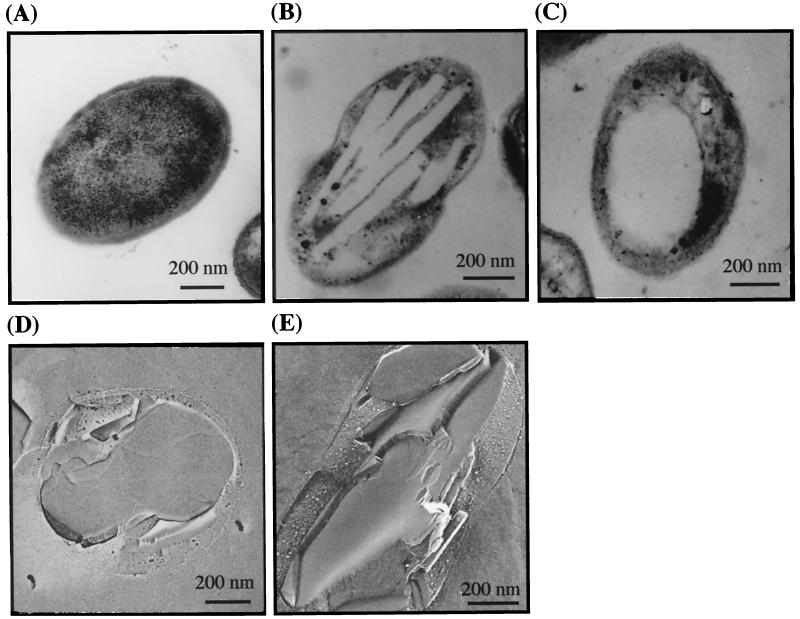
Electron microscopy of accumulated wax ester in Acinetobacter sp. strain M-1. Thin sections of cells grown on nutritious medium (A) and of cells after a shift to nitrogen-limited medium containing 0.5% n-hexadecane and incubation for 72 h at 30°C (B and C). (D and E) Images obtained by the quick-freezing replica method for cells prepared under the same conditions as in panel B.
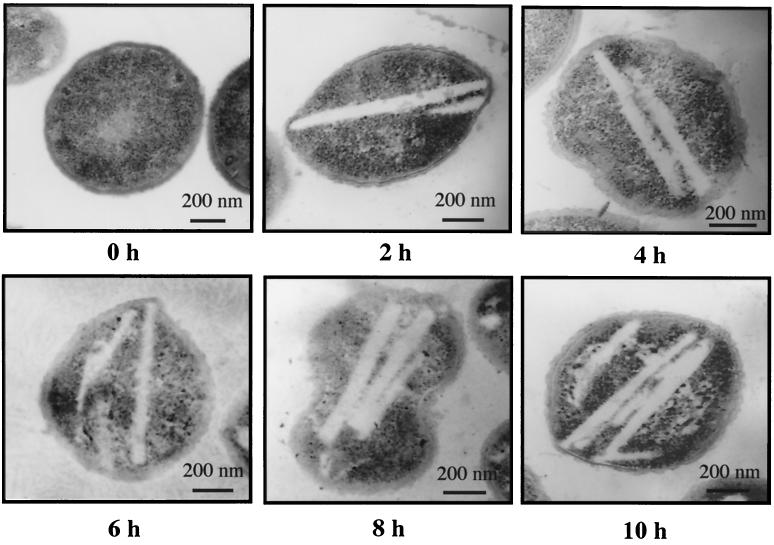
Time course of wax ester accumulation in Acinetobacter sp. strain M-1. Cells were precultured in 2× YT medium (4), shifted to nitrogen-limited medium containing 0.5% n-hexadecane for the indicated incubation periods, and then subjected to electron microscopy.
References
-
- Dewitt, S., J. L. Ervin, D. Howes-Orchison, D. Dalietos, and S. L. Neidleman. 1982. Saturated and unsaturated wax esters produced by Acinetobacter sp. HO1-N grown on C16-C20 n-alkanes. J. Am. Oil Chemists Soc. 59:69-74.
-
- Fixter, L. M., M. N. Nagi, J. G. McCormack, and C. A. Fewson. 1986. Structure, distribution and function of wax esters in Acinetobacter calcoaceticus. J. Gen. Microbiol. 132:3147-3157.
-
- Heuser, J. 1981. Preparing biological samples for stereo-microscopy by the quick-freeze, deep-etch, rotary-replication technique. Methods Cell Biol. 22:97-122. - PubMed
MeSH terms
Substances
Associated data
- Actions
LinkOut - more resources
Full Text Sources
Other Literature Sources
