


Review
doi: 10.1186/bcr416.
Epub 2001 Nov 1.
E-cadherin and loss of heterozygosity at chromosome 16 in breast carcinogenesis: different genetic pathways in ductal and lobular breast cancer?
Affiliations
- PMID: 11879552
- PMCID: PMC138715
- DOI: 10.1186/bcr416
Item in Clipboard
Review
E-cadherin and loss of heterozygosity at chromosome 16 in breast carcinogenesis: different genetic pathways in ductal and lobular breast cancer?
Breast Cancer Res.
2002.
Abstract
Loss of heterozygosity at the long arm of chromosome 16 is one of the most frequent genetic events in breast cancer. In the search for tumour suppressor genes that are the target of loss of heterozygosity at 16q, the E-cadherin gene CDH1 was unveiled by the identification of truncating mutations in the retained copy. However, only lobular tumours showed E-cadherin mutations. Whereas investigations are still devoted to finding the target genes in the more frequent ductal breast cancers, other studies suspect the E-cadherin gene to also be the target in this tumour type. The present article discusses the plausibility of those two lines of thought.
Figures
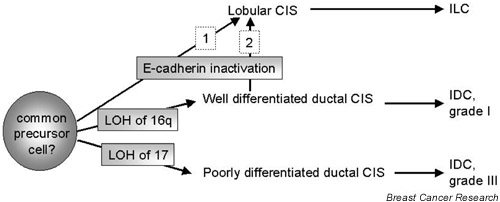
Model of breast cancer progression. Grade II tumours are omitted for simplification. Two possible pathways may result in lobular carcinoma: 1, direct; or 2, via well-differentiated ductal carcinoma in situ (CIS). IDC, infiltrating ductal carcinoma; ILC, infiltrating lobular carcinoma; LOH, loss of heterozygosity.
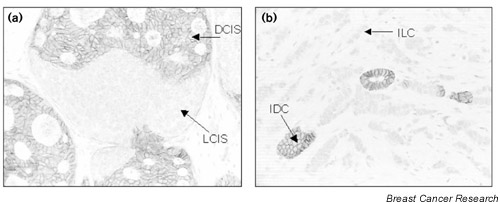
E-cadherin staining of mixed populations of (a) ductal carcinoma in situ (DCIS) and lobular carcinoma in situ (LCIS), and (b) infiltrating ductal carcinoma (IDC) and infiltrating lobular carcinoma (ILC). The E-cadherin staining was performed with antibody HECD-1 and distinguishes ductal from lobular tumour cells. Courtesy of Dr CBJ Vos.
References
-
- Graff JR, Herman JG, Lapidus RG, Chopra H, Xu R, Jarrard DF, Isaacs WB, Pitha PM, Davidson NE, Baylin SB. E-cadherin expression is silenced by DNA hypermethylation in human breast and prostate carcinomas. Cancer Res. 1995;55:5195–5199. - PubMed
-
- Comijn J, Berx G, Vermassen P, Verschueren K, van Grunsven L, Bruyneel E, Mareel M, Huylebroeck D, Van Roy F. The two-handed E box binding zinc finger protein SIP1 downregulates E-cadherin and induces invasion. Mol Cell. 2001;7:1267–1278. - PubMed
Publication types
MeSH terms
Substances
LinkOut - more resources
Full Text Sources
Medical
Miscellaneous
