. 2002 Mar 1;22(5):1858-67.
doi: 10.1523/JNEUROSCI.22-05-01858.2002.

The relationship between Abeta and memory in the Tg2576 mouse model of Alzheimer's disease

Affiliations

The relationship between Abeta and memory in the Tg2576 mouse model of Alzheimer's disease

Marcus A Westerman et al. J Neurosci. .

Abstract

Transgenic mice expressing mutant amyloid precursor proteins (APPs) have provided important new information about the pathogenesis of Alzheimer's disease (AD) histopathology. However, the molecular basis of memory loss in these mice is poorly understood. One of the major impediments has been the difficulty of distinguishing between age-dependent and age-independent behavioral changes. To address this issue we studied in parallel two lines of APP transgenic mice expressing comparable levels of mutant and wild-type human APP. This enabled us to identify age-independent behavioral deficits that were not specifically related to mutant APP expression. When mice with age-independent deficits were eliminated, we detected memory loss in transgenic mice expressing mutant APP (Tg2576 mice) starting at approximately 6 months, which coincided with the appearance of detergent-insoluble Abeta aggregates (Abeta(insol)). Genetically accelerating the formation of Abeta(insol) resulted in an earlier onset of memory decline. A facile interpretation of these results, namely that memory loss and Abeta(insol) were closely connected, was rejected when we extended our analysis to include older mice. No obvious correspondence between memory and Abeta(insol) was apparent in a combined group of old and young mice unless the mice were stratified by age, whereupon inverse correlations between memory and Abeta(insol) became evident. These results suggested that Abeta(insol) is a surrogate marker for small assemblies of Abeta that disrupt cognition and occur as intermediates during Abeta(insol) formation, and they are the first descriptive in vivo data supporting their role in impairing memory. These studies also provide a methodological framework within which to investigate these Abeta assemblies in vivo.


Figures
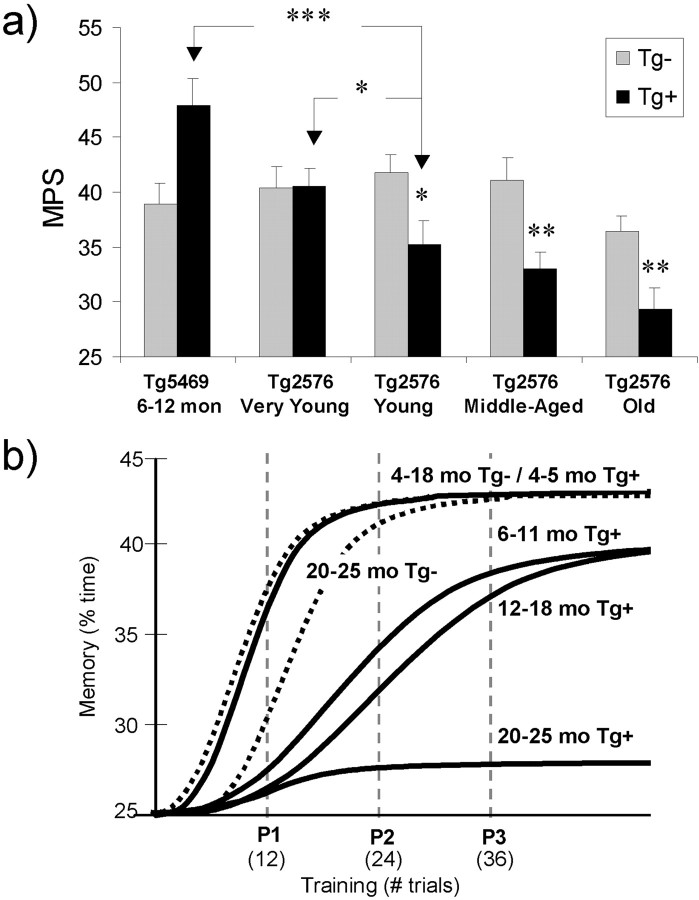
Fig. 1.
Fig. 1.
Age-dependent impairment in spatial reference memory occurs only in transgenic mice expressing mutant APP.a, The mean probe score (MPS), the mean percentage time spent in the target quadrant during all three probes, was used to assess retention of spatial information in the Morris water maze. Random swimming during all three probes would yield an MPS of 25%. There was a significant age-by-transgene interaction in Tg2576 mice (ANOVA; p < 0.05), with significantly lower scores in young (6–11 months), middle-aged (12–18 months), and old (20–25 months) Tg+ mice relative to Tg− mice (t test; *p < 0.05, **p < 0.01). MPSs of 6- to 12-month-old Tg5469 Tg+ mice were significantly higher than those of Tg− littermates (t test; **p < 0.01) and age-matched Tg+ Tg2576 mice (t test; ***p < 0.001), excluding APP overexpression as a cause of memory loss in Tg2576 mice. No significant decrease in MPS was observed in very young Tg2576 Tg+ mice devoid of Aβinsol. A significant drop in performance occurred in young Tg2576 Tg+ mice (t test; *p < 0.05), coincident with the appearance of Aβinsol. b, The learning curves of Tg+ and Tg− mice at different ages are represented, showing memory (percentage time in the target quadrant) assessed during the three probe trials,P1, P2, and P3, performed after the 12th, 24th, and 36th training trials. As expected, memory improves with training and appears to saturate. With age, there is a rightward shift of the curves. In Tg+ mice there is an apparent lowering of the saturation level of memory.
Fig. 2.
Fig. 2.
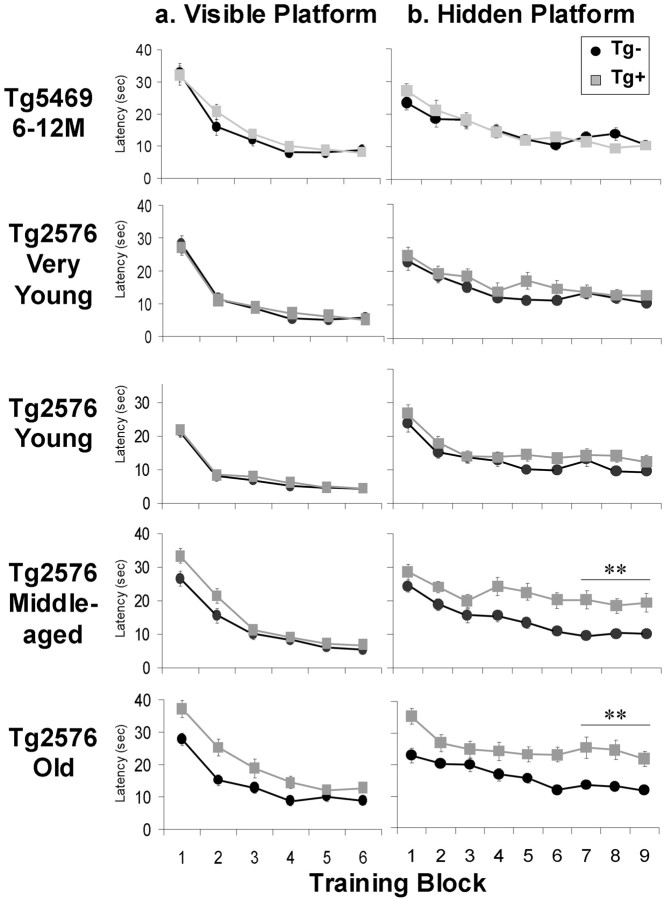
Acquisition of visible and hidden platform locations in Tg5469 and Tg2576 mice. a, Escape latencies of Tg5469 and Tg2576 mice in the visible platform version of the Morris water maze (2 blocks of 4 trials each day). No significant effect of transgene was found in the last two training blocks for either line of mouse at any age, mitigating against sensorimotor deficits as a potential explanation for impaired performance in acquisition or retention of the location of the hidden platform. Although middle-aged and old Tg2576 Tg+ mice showed an initial lag in performance, their performance was not significantly different from Tg− mice on the final day. b, Escape latencies of Tg5469 and Tg2576 mice swimming to the hidden platform in the Morris water maze. A significant age-by-transgene interaction for mean escape times during the last three training blocks was seen in Tg2576 mice (ANOVA;p < 0.005). Post hoc analysis showed significant effects of transgene in middle-aged and old Tg2576 mice (t test; **p < 0.0001).
Fig. 3.
Fig. 3.
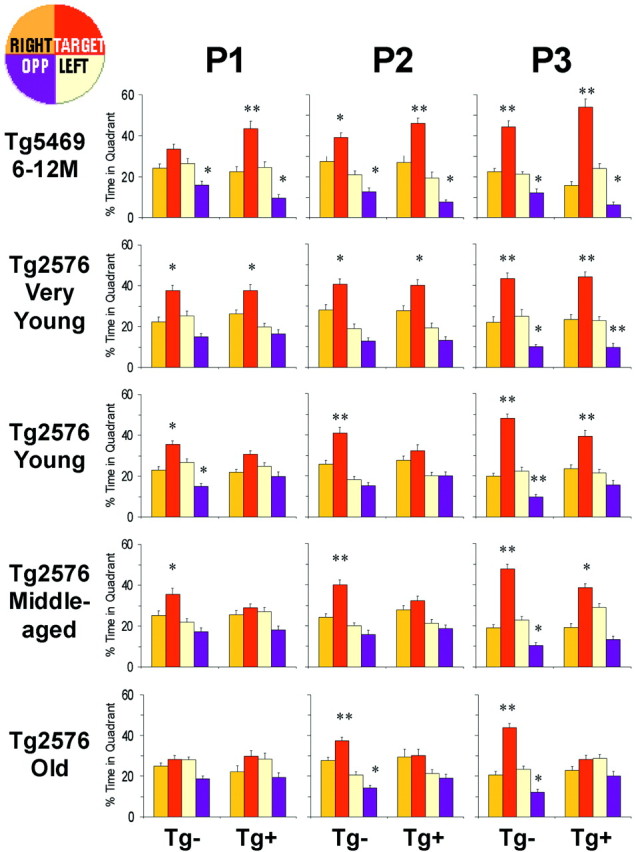
Retention of spatial reference information in Tg5469 and Tg2576 mice. Percentage time spent in each of four quadrants (inset diagram at top left) during three probe trials run at the beginning of the 4th, 7th, and 10th days of training in the Morris water maze in Tg5469 and Tg2576 mice. Tg5469 (6–12 months) and very young (4–5 months) Tg2576 mice spent a significantly greater proportion of time in the target quadrant in the first probe, regardless of transgene status. Search strategies of young (6–11 months) and middle-aged (12–18 months) Tg− mice were biased toward the target quadrant in the first probe, but those of Tg+ showed no significant bias until the third probe. Search strategies of old (20–25 months) Tg− mice were biased toward the target quadrant in the second probe, but Old Tg+ mice failed to exhibit a search bias in any probe. Differences between percentage time spent in the target and opposite quadrants compared with all other quadrants was determined using an ANOVA with Fischer's PLSD post hoc analysis (*p < 0.01; **p < 0.0001).P1, P2, and P3 are probe 1, probe 2, and probe 3, respectively.
Fig. 4.
Fig. 4.
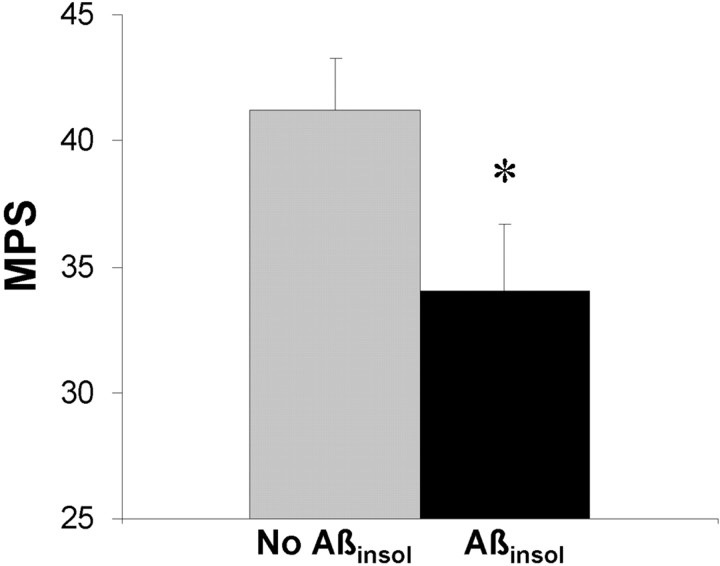
insol in Tg2576 mice is associated with impaired water maze performance. Brain Aβinsol40 and Aβinsol42 levels were determined by ELISA in a group of 4- to 6-month-old Tg2576 Tg+ mice (n = 28). When mice were segregated according to the presence (>5 pmol/gm of either Aβinsol40 or Aβinsol42) (n = 12) or absence of Aβinsol(n = 16), MPSs were significantly lower in mice with Aβinsol (t test; *p < 0.05). When mice were segregated by age (≤5 months, n = 13; or 6 months, n= 15), no significant differences were observed (data not shown).
Fig. 5.
Fig. 5.
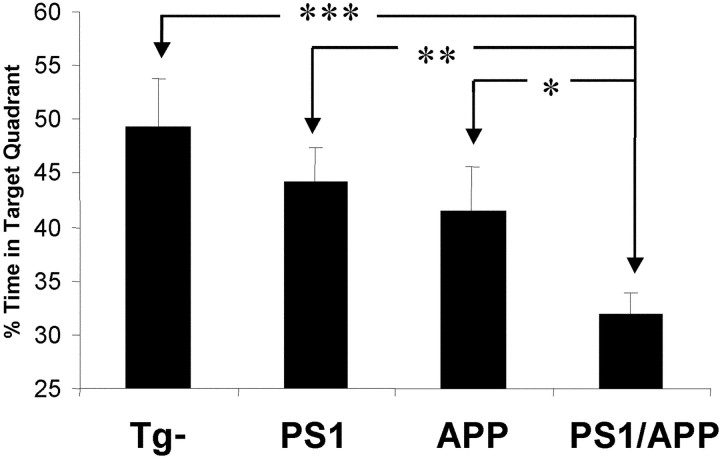
Mutant presenilin-1 accelerates memory loss in Tg2576 mice. At 4–5 months, Aβinsol was present in all PS1/APP mice but in only ∼20% of APP mice. PS1/APP mice (n = 21) showed significantly worse performance in probe 1 than APP (n = 11), PS1 (n = 14), or nontransgenic (n = 13) mice (*p < 0.05; **p < 0.01; ***p < 0.001).
Fig. 6.
Fig. 6.
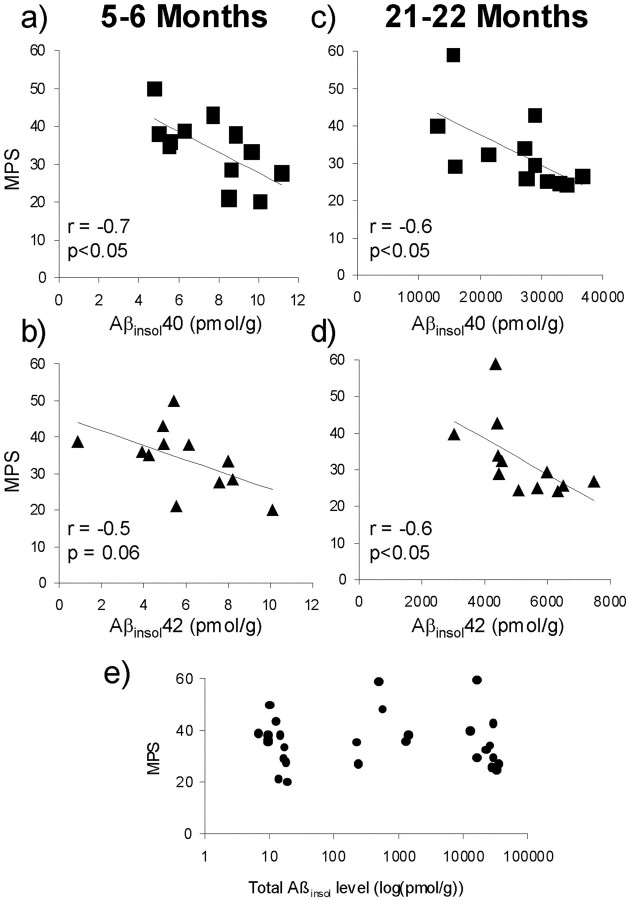
Water maze performance correlates inversely with Aβinsol in young and old Tg2576 mice stratified by age. Brain Aβinsol40 and Aβinsol42 were determined by ELISA in 12 Tg2576 Tg+ mice at 5–6 months (a, b) and 12 Tg2576 Tg+ mice at 21–22 months (c, d). Significant correlations between MPSs and Aβinsol40 or Aβinsol42 were found in Tg2576 mice stratified by age, but not when the old and young mice were pooled together (e). Total Aβinsol ine is the sum of Aβinsol40 and Aβinsol42.
Fig. 7.
Fig. 7.
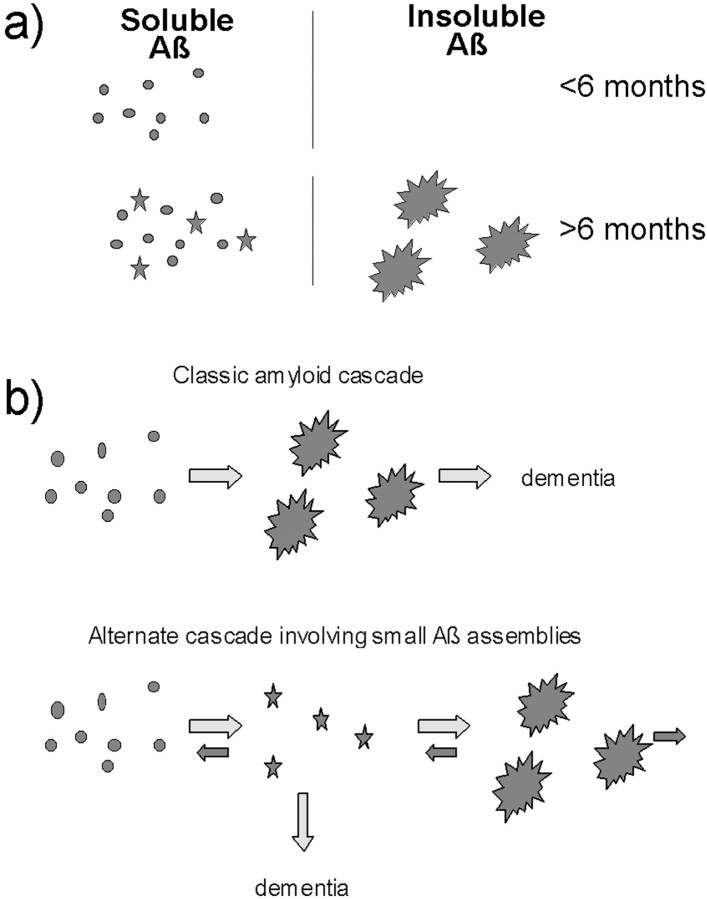
Proposed model of small Aβ assemblies disrupting learning and memory. a, Tg2576 mice <6 months have soluble Aβ (circles) but no memory loss. This indicates that the soluble Aβ species present in mice <6 months do not disrupt cognitive function. Mice >6 months show memory loss coinciding with the appearance of detergent-insoluble Aβ aggregates (large starbursts), also referred to as Aβinsol. However, when memory and Aβinsolwere studied in mice across a broad age range, no correlation was found, arguing against Aβinsol being the major cause of memory loss in Tg2576 mice. Yet inverse correlations between memory and Aβinsol became apparent when mice were stratified by age. To explain these findings, we propose that amyloid load and Aβinsol are both surrogate measures for one or more small Aβ assemblies (stars) that disrupt learning and memory. An extension of this hypothesis is that these Aβ assemblies may also be involved in the conversion of soluble to insoluble Aβ. Although it is possible that these Aβ assemblies comprise a subset of the insoluble Aβ species, the difficulty of reconciling in some old mice very high levels of Aβinsol with relatively normal cognitive function mitigates against this possibility. It is more likely that the Aβ assemblies reside among the soluble Aβ species.b, The hypothetical cascade involving small Aβ assemblies contrasts with the classic amyloid cascade hypothesis, in which cognitive dysfunction and dementia are caused by the accumulation of insoluble Aβ aggregates resulting in neuronal destruction. In the alternate cascade involving Aβ assemblies, memory loss and dementia are caused by a subset of soluble Aβ species that are present in the subpopulation of mice that possess Aβinsol, the presence of which reflects the Aβ assemblies.

References

    1. Arriagada PV, Growdon JH, Hedley-White ET, Hyman BT. Neurofibrillary tangles but not senile plaques parallel duration and severity of Alzheimer's disease. Neurology. 1992;42:631–639. - PubMed
    1. Bach ME, Barad M, Son H, Zhuo M, Lu YF, Shih R, Mansuy I, Hawkins RD, Kandel ER. Age-related defects in spatial memory are correlated with defects in the late phase of hippocampal long-term potentiation in vitro and are attenuated by drugs that enhance the cAMP signaling pathway. Proc Natl Acad Sci USA. 1999;96:5280–5285. - PMC - PubMed
    1. Bartoo GT, Nochlin D, Chang D, Kim Y, Sumi SM. The mean Aβ load in the hippocampus correlates with duration and severity of dementia in subgroups of Alzheimer disease. J Neuropathol Exp Neurol. 1997;56:531–540. - PubMed
    1. Bellush LL, Wright AM, Walker JP, Kopchick J, Colvin RA. Caloric restriction and spatial learning in old mice. Physiol Behav. 1996;60:541–547. - PubMed
    1. Berg L, McKeel DW, Jr, Miller JP, Baty J, Morris JC. Neuropathological indexes of Alzheimer's disease in demented and nondemented persons aged 80 years and older. Arch Neurol. 1993;50:349–358. - PubMed

Publication types

MeSH terms