. 2002 Mar 5;99(5):2806-11.
doi: 10.1073/pnas.052675499.

Crystal structure of an antiparallel DNA fragment with Hoogsteen base pairing

Affiliations

Crystal structure of an antiparallel DNA fragment with Hoogsteen base pairing

Nicola G A Abrescia et al. Proc Natl Acad Sci U S A. .

Abstract

We report here an alternative double-helical structure of the DNA molecule. It has been found in the d(ATA(Br)UAT) and d(ATATAT) sequences by single-crystal x-ray crystallography. This sequence is found not only in TATA boxes, but also in other regulatory regions of DNA. Bases of the two antiparallel strands form Hoogsteen pairs, with adenines in the syn conformation. The structure is related neither to those found in triple helices nor to parallel DNA duplexes. Its conformational parameters are very similar to those of duplex DNA in the B form. Both forms may coexist under physiological conditions, although the Hoogsteen pairing greatly influences the recognition sites on DNA. Our results demonstrate that an alternative to the classical B-DNA double helix is possible.


Figures
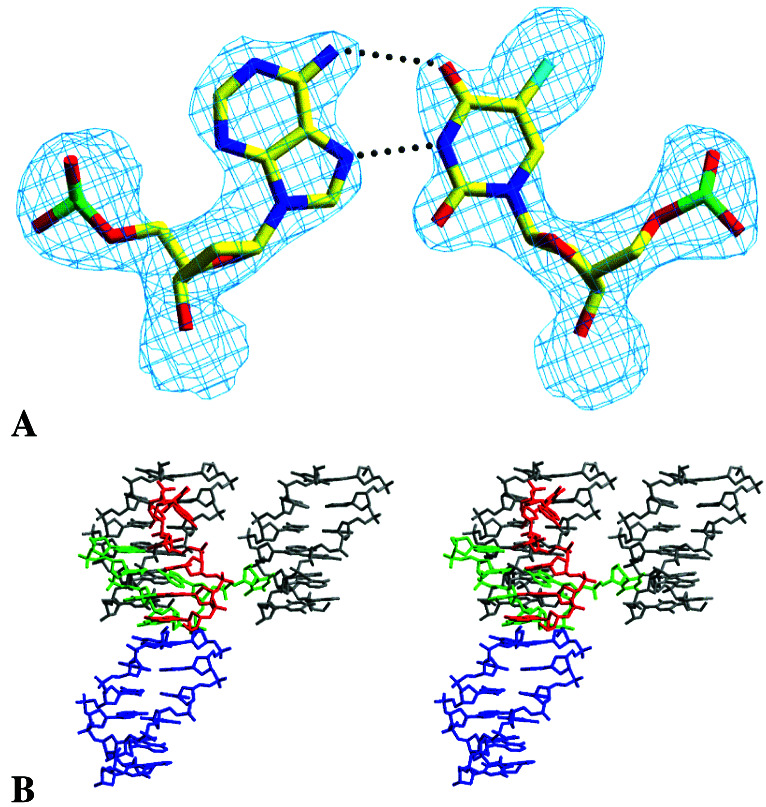
Figure 1
Figure 1
Views of Hoogsteen DNA. (A) (2FoFc) electron density map (base pair A3⋅BrU10) of the refined structure (1.1 σ). The Hoogsteen base pairs fit the electron density map throughout the structure. Note that the adenine base has now two hydrogen-bond acceptor atoms (N1 and N3) in the major groove side and none in the minor groove, whereas in the B form there is one in each groove (N7 and N3 respectively). (B) Stereo pair of the crystal structure of d(ApTpApBrUpApT). The asymmetric unit consists of a fully helical hexamer duplex (in blue) plus another hexamer duplex (red and green) with four base pairs in a duplex configuration, whereas the two terminal bases of each strand are extrahelical. The terminal thymines are located in the minor grooves of neighbor duplexes (in gray), whereas one terminal adenine (green) fits into the minor groove of the tetramer duplex. The two duplexes are stabilized by Hoogsteen base pairs, as shown in A. All figures have been prepared with setor (24).
Figure 2
Figure 2
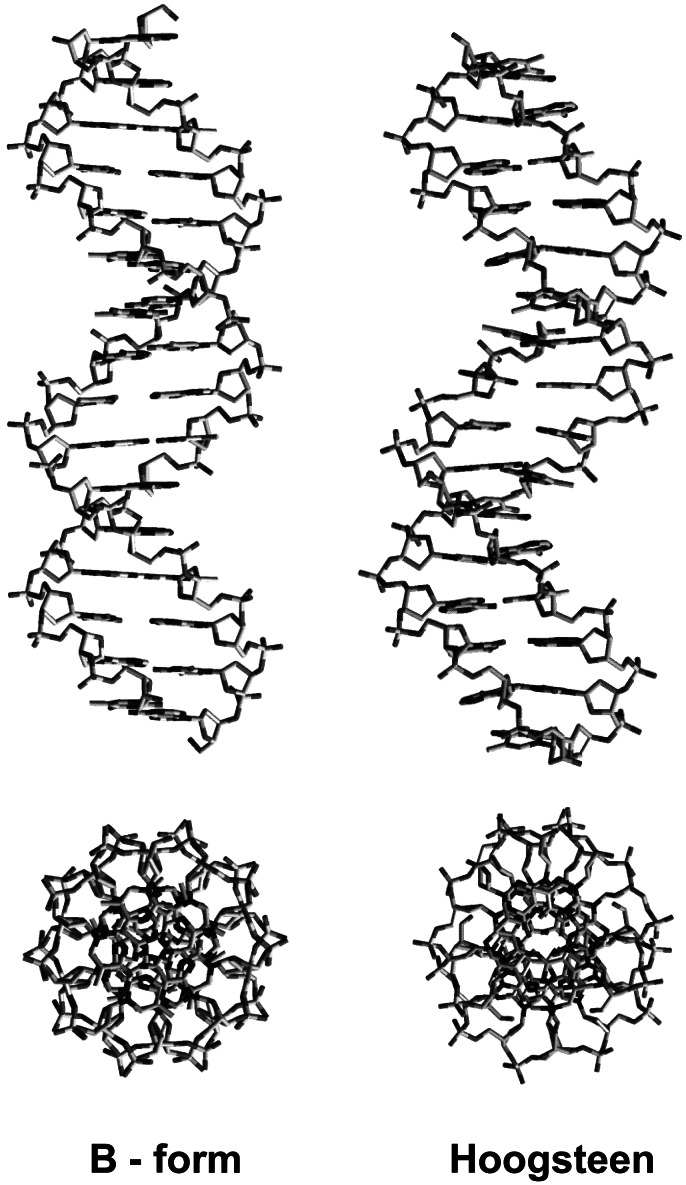
Comparison of ideal B form (Left) with Hoogsteen DNA (Right). Hoogsteen DNA has been obtained from a hexamer/tetramer/hexamer stack as found in the crystal structure.
Figure 3
Figure 3
Groove structure of Hoogsteen DNA. (A) Comparison of minor groove structure (stereo pairs). The central AT-rich region of d(CGTATATACG) (26) in the B form (Lower) is compared with the Hoogsteen hexamer (Upper). Both have a narrow minor groove. The presence of the N3 hydrogen bond acceptor group of adenine (blue) is clearly apparent in B-form DNA. (B) A detail of major groove hydration. Some water molecules (red spheres) are hydrogen bonded both to the N3 atom of adenine and to a phosphate oxygen.
Figure 4
Figure 4
Stereo pair of Hoogsteen DNA as found in the crystal. Two thymines from neighbor molecules enter the minor groove of the hexamer duplex (lower part). An adenine is found in the minor groove of the tetramer duplex (upper part), whereas the other extra helical adenine lies on the major groove of the hexamer. The three bases in the minor groove form tight van der Waals contacts plus a single hydrogen bond with a base in the groove.

References

    1. Patikoglou G A, Kim J L, Sun L, Yang S-H, Kodadek T, Burley S K. Genes Dev. 1999;13:3217–3230. - PMC - PubMed
    1. Juo Z S, Chiu T K, Leiberman P M, Baikalov I, Berk A J, Dickerson R E. J Mol Biol. 1996;261:239–254. - PubMed
    1. Moreau J, Maschat M F, Kejzlarova-Lepesant J, Lepesant J-A, Scherrer K. Nature (London) 1982;295:260–262. - PubMed
    1. Oosumi T, Garlick B, Belknap W R. Proc Natl Acad Sci USA. 1995;92:8886–8890. - PMC - PubMed
    1. Kim J L, Nikolov D B, Burley S K. Nature (London) 1993;365:520–527. - PubMed

Publication types

Associated data