. 2002 Mar 15;21(6):1414-26.
doi: 10.1093/emboj/21.6.1414.

CCR4, a 3'-5' poly(A) RNA and ssDNA exonuclease, is the catalytic component of the cytoplasmic deadenylase

Affiliations

CCR4, a 3'-5' poly(A) RNA and ssDNA exonuclease, is the catalytic component of the cytoplasmic deadenylase

Junji Chen et al. EMBO J. .

Abstract

The CCR4-NOT complex from Saccharomyces cerevisiae is a general transcriptional regulatory complex. The proteins of this complex are involved in several aspects of mRNA metabolism, including transcription initiation and elongation and mRNA degradation. The evolutionarily conserved CCR4 protein, which is part of the cytoplasmic deadenylase, contains a C-terminal domain that displays homology to an Mg2+-dependent DNase/phosphatase family of proteins. We have analyzed the putative enzymatic properties of CCR4 and have found that it contains both RNA and single-stranded DNA 3'-5' exonuclease activities. CCR4 displays a preference for RNA and for 3' poly(A) substrates, implicating it as the catalytic component of the cytoplasmic deadenylase. Mutations in the key, conserved catalytic residues in the CCR4 exonuclease domain abolished both its in vitro activities and its in vivo functions. Importantly, CCR4 was active as a monomer and remained active in the absence of CAF1, which links CCR4 to the remainder of the CCR4-NOT complex components. These results establish that CCR4 and most probably other members of a widely distributed CCR4-like family of proteins constitute a novel class of RNA-DNA exonucleases. The various regulatory effects of the CCR4-NOT complex on gene expression may be executed in part through these CCR4 exonuclease activities.


Figures
None
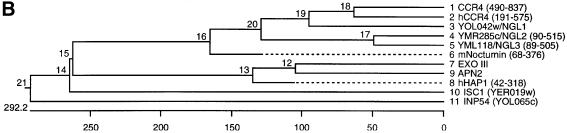
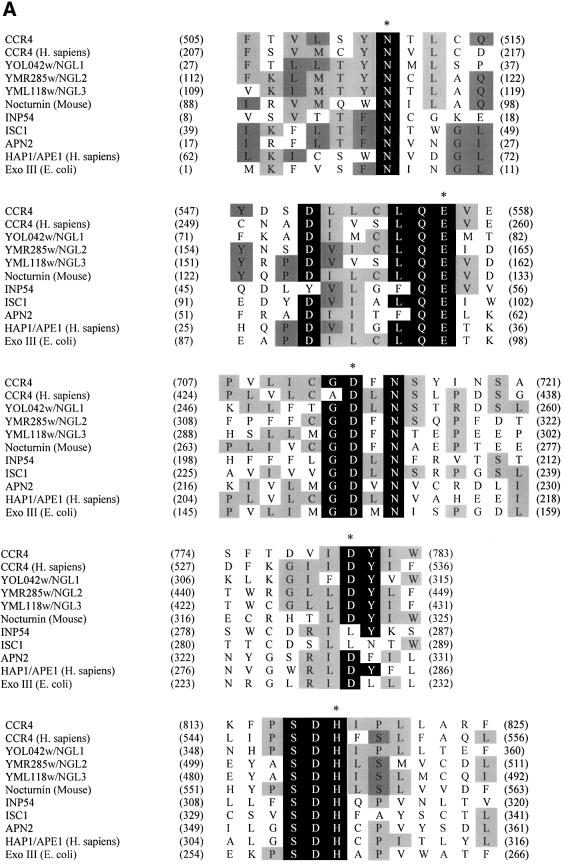
Fig. 1. Sequence alignment of CCR4 protein within the Mg2+-dependent ExoIII/APE1 (HAP1) nuclease family. (A) By performing Clustal W 1.8and PIMA multiple sequence alignment together with Block Maker search, we aligned the C-terminal domain of CCR4 protein, its yeast homologs (YOL042w, YMR285w and YML118w) and human ortholog (KIAA1194) with ExoIII, HAP1 (APE1), APN2 (yeast ortholog of AP endonuclease), ISC1 (yeast sphingomyelinase) and INP52 (one of the representative yeast inositol 5′-phosphatases). The most conserved catalytic amino acid residues are highlighted with a black background. The critical catalytic amino acids for enzymatic reactions are also marked with an asterisk at the top of each motif. The residues with at least four amino acids conserved in the same position are highlighted with a gray background. (The amino acids leucine and isoleucine were considered to be identical for this analysis.) (B) Phylogenetic tree for the C-terminal domain of CCR4 protein and enzymatic domains from this nuclease family aligned by Clustal methods from DNA Star. In this phylogenetic tree, the numbers in the branch length represent approximately the divergence from an ancestral node (DNA Star Program Manual).
None
Fig. 1. Sequence alignment of CCR4 protein within the Mg2+-dependent ExoIII/APE1 (HAP1) nuclease family. (A) By performing Clustal W 1.8and PIMA multiple sequence alignment together with Block Maker search, we aligned the C-terminal domain of CCR4 protein, its yeast homologs (YOL042w, YMR285w and YML118w) and human ortholog (KIAA1194) with ExoIII, HAP1 (APE1), APN2 (yeast ortholog of AP endonuclease), ISC1 (yeast sphingomyelinase) and INP52 (one of the representative yeast inositol 5′-phosphatases). The most conserved catalytic amino acid residues are highlighted with a black background. The critical catalytic amino acids for enzymatic reactions are also marked with an asterisk at the top of each motif. The residues with at least four amino acids conserved in the same position are highlighted with a gray background. (The amino acids leucine and isoleucine were considered to be identical for this analysis.) (B) Phylogenetic tree for the C-terminal domain of CCR4 protein and enzymatic domains from this nuclease family aligned by Clustal methods from DNA Star. In this phylogenetic tree, the numbers in the branch length represent approximately the divergence from an ancestral node (DNA Star Program Manual).
None
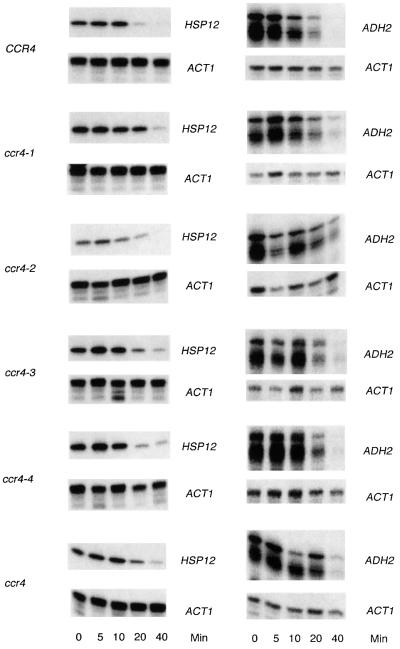
Fig. 2. mRNA decay of HSP12 and ADH2. RNA was isolated at the time point indicated following shifting of yeast from medium containing ethanol/glycerol to repressive medium containing glucose. HSP12 and ADH2 transcription are shut off upon growth on glucose-containing medium. Quantitative S1 nuclease protection assays were conducted to measure mRNA levels. ACT1 mRNA is used to standardize loading as its synthesis is unaffected by growth on glucose-containing medium. Decay rates for HSP12 were calculated without including the zero time point since HSP12 synthesis does not cease immediately.
None
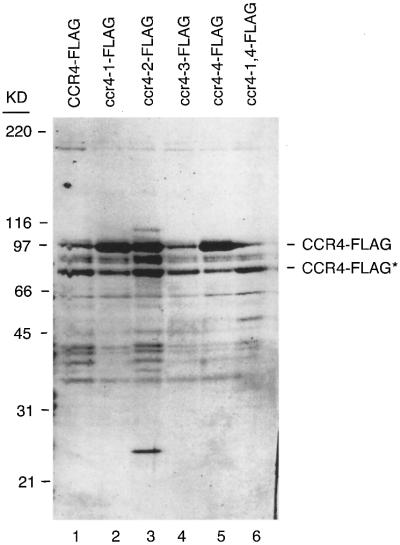
Fig. 3. Coomassie Blue-stained SDS–polyacrylamide gel of CCR4-FLAG preparations. The band marked with the asterisks (CCR4-FLAG*) lacks ∼100 amino acids of the extreme N-terminus of CCR4 as determined by western analysis. Loss of this region of CCR4 had no effect on CCR4 in vivo activity (Draper et al., 1994). Molecular weight standards are indicated on the left and the respective CCR4-FLAG mutants are indicated.
None
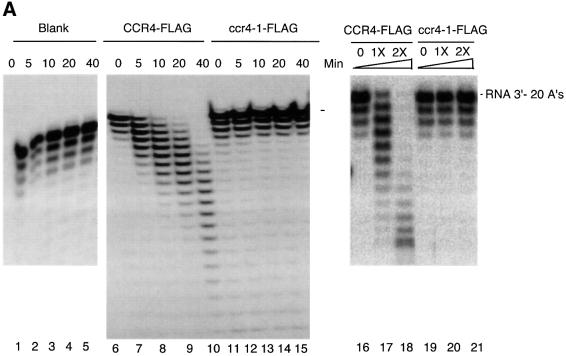
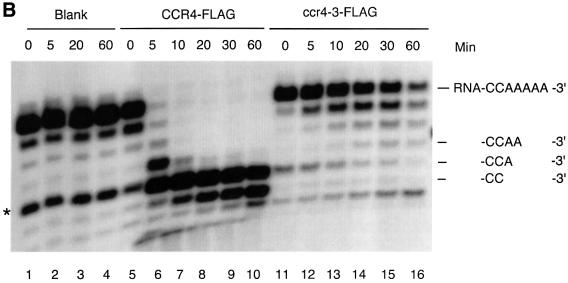
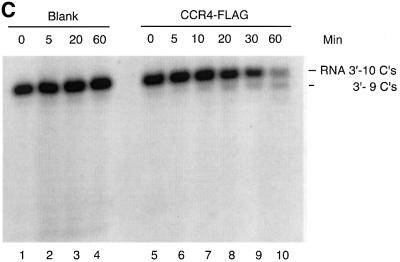
Fig. 4. The CCR4 protein is a poly(A) exoribonuclease. (A) Time course of CCR4-FLAG fusion protein degradation of 5′-labeled RNA with 20 As at its 3′ end as substrate. Radioactively labeled RNA substrate was analyzed on a denaturing sequencing gel. The three minor RNA species migrating below the full-length RNA oligonucleotides (see lane 1) most probably represent oligonucleotides lacking one, two and three As, respectively, as each of these substrates was degraded completely by CCR4-FLAG (lanes 8–10). CCR4-FLAG and ccr4-1-FLAG protein abundance was 32 ng in each reaction for lanes 6–15. CCR4-FLAG and the variant proteins were extracted from KY803-1a (ccr4) strains. The indicated times refer to minutes of incubation prior to stoppage of the enzyme reaction. The dosage effect of CCR4-FLAG enzymatic activities was determined following 20 min of incubation. Lanes 1–5, no protein extract was added to RNA substrate; lanes 6–10, CCR4-FLAG extracts; lanes 11–15, ccr4-1-FLAG extracts; lanes 16–18, CCR4-FLAG extracts containing no CCR4-FLAG, or 16 or 32 ng of CCR4-FLAG; lanes 19 and 21, ccr4-1-FLAG extracts at the same respective concentrations as indicated for lanes 16–18. (B) Time course of CCR4-FLAG and ccr4-3-FLAG fusion protein degradation of 5′-labeled RNA with five As at its 3′ end. Reactions were conducted as described in (A). An additional RNA species that migrated four nucleotides smaller than the full-length substrate (see lane 1) is discussed in the text. (C) Time course of CCR4-FLAG fusion protein enzyme activity with 5′-labeled RNA with 10 Cs at its 3′ end.
None
Fig. 4. The CCR4 protein is a poly(A) exoribonuclease. (A) Time course of CCR4-FLAG fusion protein degradation of 5′-labeled RNA with 20 As at its 3′ end as substrate. Radioactively labeled RNA substrate was analyzed on a denaturing sequencing gel. The three minor RNA species migrating below the full-length RNA oligonucleotides (see lane 1) most probably represent oligonucleotides lacking one, two and three As, respectively, as each of these substrates was degraded completely by CCR4-FLAG (lanes 8–10). CCR4-FLAG and ccr4-1-FLAG protein abundance was 32 ng in each reaction for lanes 6–15. CCR4-FLAG and the variant proteins were extracted from KY803-1a (ccr4) strains. The indicated times refer to minutes of incubation prior to stoppage of the enzyme reaction. The dosage effect of CCR4-FLAG enzymatic activities was determined following 20 min of incubation. Lanes 1–5, no protein extract was added to RNA substrate; lanes 6–10, CCR4-FLAG extracts; lanes 11–15, ccr4-1-FLAG extracts; lanes 16–18, CCR4-FLAG extracts containing no CCR4-FLAG, or 16 or 32 ng of CCR4-FLAG; lanes 19 and 21, ccr4-1-FLAG extracts at the same respective concentrations as indicated for lanes 16–18. (B) Time course of CCR4-FLAG and ccr4-3-FLAG fusion protein degradation of 5′-labeled RNA with five As at its 3′ end. Reactions were conducted as described in (A). An additional RNA species that migrated four nucleotides smaller than the full-length substrate (see lane 1) is discussed in the text. (C) Time course of CCR4-FLAG fusion protein enzyme activity with 5′-labeled RNA with 10 Cs at its 3′ end.
None
Fig. 4. The CCR4 protein is a poly(A) exoribonuclease. (A) Time course of CCR4-FLAG fusion protein degradation of 5′-labeled RNA with 20 As at its 3′ end as substrate. Radioactively labeled RNA substrate was analyzed on a denaturing sequencing gel. The three minor RNA species migrating below the full-length RNA oligonucleotides (see lane 1) most probably represent oligonucleotides lacking one, two and three As, respectively, as each of these substrates was degraded completely by CCR4-FLAG (lanes 8–10). CCR4-FLAG and ccr4-1-FLAG protein abundance was 32 ng in each reaction for lanes 6–15. CCR4-FLAG and the variant proteins were extracted from KY803-1a (ccr4) strains. The indicated times refer to minutes of incubation prior to stoppage of the enzyme reaction. The dosage effect of CCR4-FLAG enzymatic activities was determined following 20 min of incubation. Lanes 1–5, no protein extract was added to RNA substrate; lanes 6–10, CCR4-FLAG extracts; lanes 11–15, ccr4-1-FLAG extracts; lanes 16–18, CCR4-FLAG extracts containing no CCR4-FLAG, or 16 or 32 ng of CCR4-FLAG; lanes 19 and 21, ccr4-1-FLAG extracts at the same respective concentrations as indicated for lanes 16–18. (B) Time course of CCR4-FLAG and ccr4-3-FLAG fusion protein degradation of 5′-labeled RNA with five As at its 3′ end. Reactions were conducted as described in (A). An additional RNA species that migrated four nucleotides smaller than the full-length substrate (see lane 1) is discussed in the text. (C) Time course of CCR4-FLAG fusion protein enzyme activity with 5′-labeled RNA with 10 Cs at its 3′ end.
None
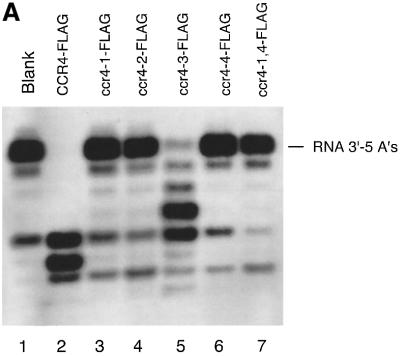
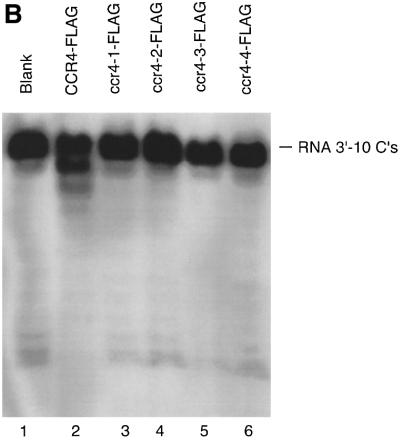
Fig. 5. The effect of CCR4 mutations on its enzymatic activity. (Accr4 mutations block CCR4 poly(A) RNA exonuclease activity. Reaction conditions were as described in Figure 4, except that the incubation time was 60 min. The CCR4 protein variants are described in the text, and ccr4-1,4-FLAG contains both D556A and H818A alterations. The RNA substrate was the 27mer oligonucleotide with five As at its 3′ end. (B) CCR4-FLAG mutants block CCR4 exonuclease activity. The substrate was the RNA containing 10 Cs at its 3′ end. The reaction conditions were the same as in Figure 3A.
None
Fig. 5. The effect of CCR4 mutations on its enzymatic activity. (Accr4 mutations block CCR4 poly(A) RNA exonuclease activity. Reaction conditions were as described in Figure 4, except that the incubation time was 60 min. The CCR4 protein variants are described in the text, and ccr4-1,4-FLAG contains both D556A and H818A alterations. The RNA substrate was the 27mer oligonucleotide with five As at its 3′ end. (B) CCR4-FLAG mutants block CCR4 exonuclease activity. The substrate was the RNA containing 10 Cs at its 3′ end. The reaction conditions were the same as in Figure 3A.
None
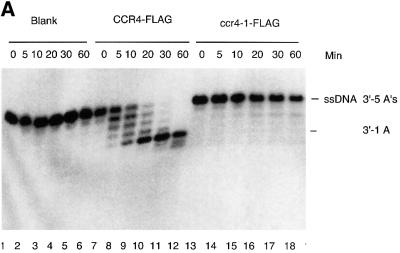
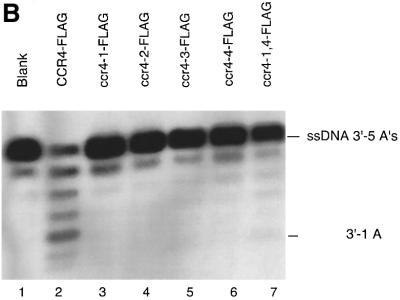
Fig. 6. CCR4 is an ssDNA exonuclease. (A) Time course of CCR4-FLAG enzyme activity with the ssDNA substrate containing five As at its 3′ end. A 160 ng aliquot of CCR4-FLAG and of ccr4-1-FLAG was used in the incubations. (Bccr4 mutations block CCR4 ssDNA exonuclease activity. A 32 ng aliquot of each CCR4-FLAG variant was used and the reactions were for 60 min.
None
Fig. 6. CCR4 is an ssDNA exonuclease. (A) Time course of CCR4-FLAG enzyme activity with the ssDNA substrate containing five As at its 3′ end. A 160 ng aliquot of CCR4-FLAG and of ccr4-1-FLAG was used in the incubations. (Bccr4 mutations block CCR4 ssDNA exonuclease activity. A 32 ng aliquot of each CCR4-FLAG variant was used and the reactions were for 60 min.
None
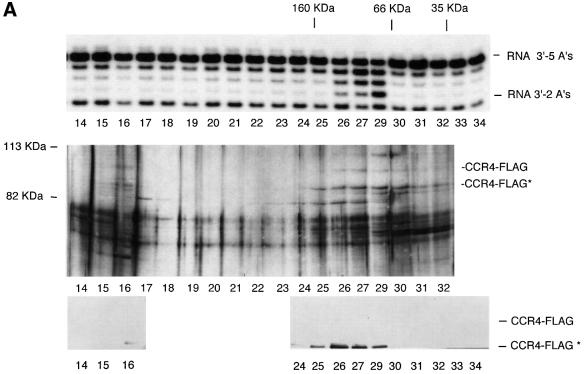
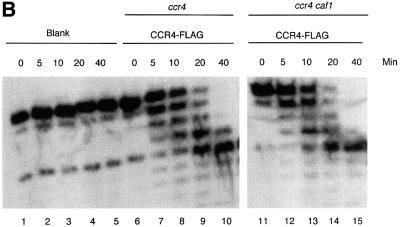
Fig. 7. CAF1 protein is not required for CCR4 nuclease activity. (A) Deadenylase activity co-migrates with CCR4-FLAG. Purified CCR4-FLAG was subjected to Superdex 200 gel filtration chromatography. Top panel: determination of deadenylation activity using the 27mer RNA substrate with five As at its 3′ end. Middle panel: silver staining profile of proteins. CCR4-FLAG and CCR4-FLAG* are indicated. Bottom panel: western analysis using FLAG antibody. In the original western blot, CCR4-FLAG could be detected in fractions 26 and 27. Molecular weight standards at the top of the figure refer to IgG (160 kDa), BSA (66 kDa) and lactoglobulin (35 kDa). (B) CCR4-FLAG enzymatic activity in ccr4 and ccr4 caf1 strains. CCR4-FLAG plasmid was expressed in strains EGY188-1a (ccr4) (lanes 6–10) and EGY188-1a-1-c1 (ccr4 caf1) (lanes 11–15). Reaction conditions were as described in Figure 4.
None
Fig. 7. CAF1 protein is not required for CCR4 nuclease activity. (A) Deadenylase activity co-migrates with CCR4-FLAG. Purified CCR4-FLAG was subjected to Superdex 200 gel filtration chromatography. Top panel: determination of deadenylation activity using the 27mer RNA substrate with five As at its 3′ end. Middle panel: silver staining profile of proteins. CCR4-FLAG and CCR4-FLAG* are indicated. Bottom panel: western analysis using FLAG antibody. In the original western blot, CCR4-FLAG could be detected in fractions 26 and 27. Molecular weight standards at the top of the figure refer to IgG (160 kDa), BSA (66 kDa) and lactoglobulin (35 kDa). (B) CCR4-FLAG enzymatic activity in ccr4 and ccr4 caf1 strains. CCR4-FLAG plasmid was expressed in strains EGY188-1a (ccr4) (lanes 6–10) and EGY188-1a-1-c1 (ccr4 caf1) (lanes 11–15). Reaction conditions were as described in Figure 4.
None
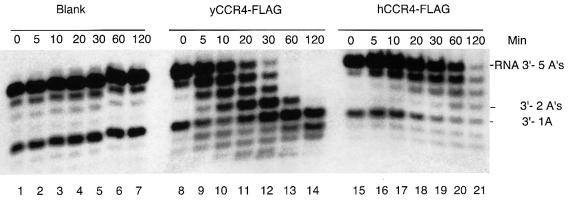
Fig. 8. Human CCR4-FLAG is an RNA exonuclease. Reaction conditions are as described in Figure 2. The indicated times refer to minutes of incubation prior to stoppage of the enzyme reaction. Lanes 1–7, no protein added; lanes 8–14, yeast CCR4-FLAG at 10 ng in each reaction; lanes 15–21, human CCR4-FLAG at 10 ng in each reaction. The RNA substrate contained five As at its 3′ end.

References

    1. Albert T.K., Lemaire,M., van Berkum,N.L., Gentz,R., Collart,M.A. and Timmers,H.T. (2000) Isolation and characterization of human orthologs of yeast CCR4–NOT complex subunits. Nucleic Acids Res., 28, 809–817. - PMC - PubMed
    1. Badarinarayana V., Chiang,Y.C. and Denis,C.L. (2000) Functional interaction of CCR4–NOT proteins with TATAA-binding protein (TBP) and its associated factors in yeast. Genetics, 155, 1045–1054. - PMC - PubMed
    1. Bai Y., Salvadore,C., Chiang,Y.-C., Collart,M.A., Liu,H.-Y. and Denis,C.L. (1999) The CCR4 and CAF1 proteins of the CCR4–NOT complex are physically and functionally separate from NOT2, NOT4 and NOT5. Mol. Cell. Biol., 19, 6642–6651. - PMC - PubMed
    1. Barilla D., Lee,B.A. and Proudfoot,N.J. (2001) Cleavage/polyadenylation factor IA associates with the carboxyl-terminal domain of RNA polymerase II in Saccharomyces cerevisiae. Proc. Natl Acad. Sci. USA, 98, 445–450. - PMC - PubMed
    1. Barzilay G., Mol,C.D., Robson,C.N., Walker,L.J., Cunningham,R.P., Tainer,J.A. and Hickson,I.D. (1995) Identification of critical active-site residues in the multifunctional human DNA repair enzyme HAP1. Nature Struct. Biol., 2, 561–568. - PubMed

Publication types

MeSH terms

Substances