


Identification of the cAD1 sex pheromone precursor in Enterococcus faecalis
- PMID: 11889094
- PMCID: PMC134937
- DOI: 10.1128/JB.184.7.1880-1887.2002
Identification of the cAD1 sex pheromone precursor in Enterococcus faecalis
Abstract
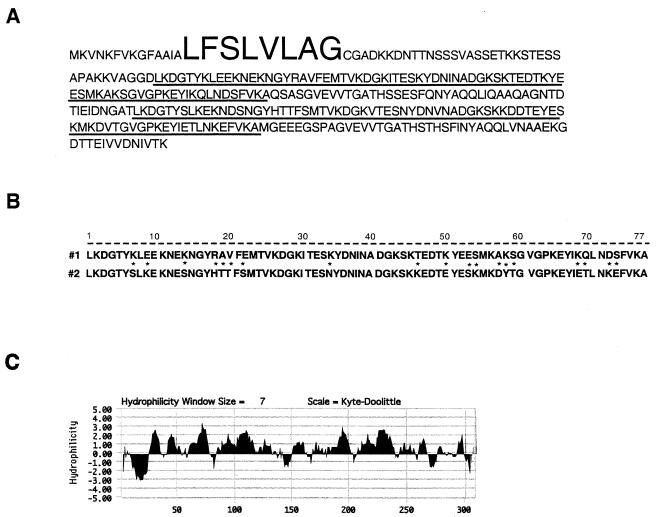
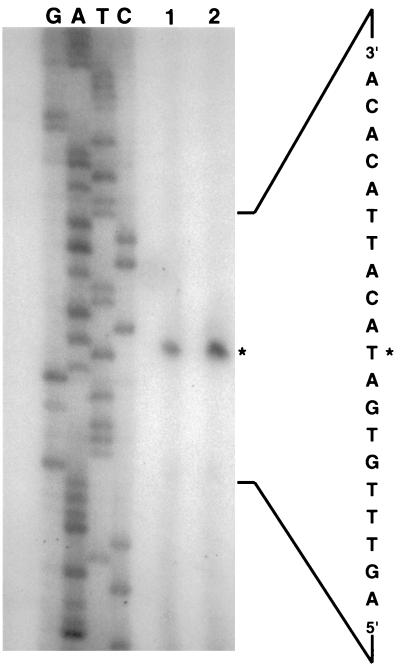
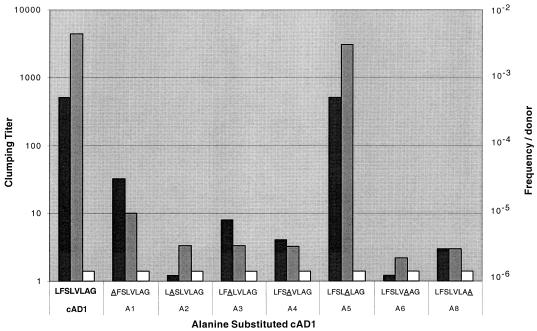
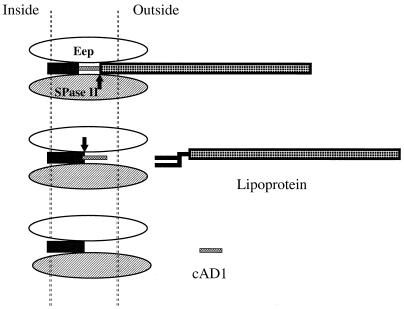
The Enterococcus faecalis virulence plasmid pAD1 encodes a mating response induced by exposure to an octapeptide sex pheromone, cAD1, secreted by plasmid-free enterococci. The determinant for the pheromone in E. faecalis FA2-2, designated cad, was found to encode a 309-amino-acid lipoprotein precursor with the last 8 residues of its 22-amino acid signal sequence representing the cAD1 moiety. The lipoprotein moiety contained two 77-amino-acid repeats (70% identity) separated by 45 residues. The nonisogenic E. faecalis strain V583 determinant encodes a homologous precursor protein, but it differs at two amino acid positions, both of which are located within the pheromone peptide moiety (positions 2 and 8). Construction of a variant of strain FA2-2 containing the differences present in V583 resulted in cells that did not produce detectable cAD1. The mutant appeared normal under laboratory growth conditions, and while significantly reduced in recipient potential, when carrying pAD1 it exhibited a normal mating response. A mutant of FA2-2 with a truncated lipoprotein moiety appeared normal with respect to recipient potential and, when carrying plasmid DNA, donor potential. A gene encoding a protein designated Eep, believed to be a zinc metalloprotease, had been previously identified as required for pheromone biosynthesis and was believed to be involved in the processing of a pheromone precursor. Our new observation that the pAD1-encoded inhibitor peptide, iAD1, whose precursor is itself a signal sequence, is also dependent on Eep is consistent with the likelihood that such processing occurs at the amino terminus of the cAD1 moiety.
Figures

References
-
- An, F. Y., and D. B. Clewell. 1994. Characterization of the determinant (traB) encoding sex pheromone shutdown by the hemolysin/bacteriocin plasmid pAD1 in Enterococcus faecalis. Plasmid 31:215-221. - PubMed
-
- An, F. Y., and D. B. Clewell. 1997. The origin of transfer (oriT) of the Enterococcal, pheromone-responding, cytolysin plasmid pAD1 is located within the repA determinant. Plasmid 37:87-94. - PubMed
-
- Ausubel, F. M., R. Brent, R. E. Kingston, D. D. Moor, J. G. Seidman, J. A. Smith, and K. Struhl. 1987. Current protocols in molecular biology. John Wiley & Sons, Inc., New York, N.Y.
-
- Bartolome, B., Y. Jubete, E. Martinez, and F. de la Cruz. 1991. Construction and properties of a family of pACYC184-derived cloning vectors compatible with pBR322 and its derivatives. Gene 102:75-78. - PubMed
Publication types
MeSH terms
Substances
Grants and funding
LinkOut - more resources
Full Text Sources
Other Literature Sources
Molecular Biology Databases
Miscellaneous
