Comparative Study
. 2002 Mar;128(3):844-53.
doi: 10.1104/pp.010698.

Simultaneous suppression of multiple genes by single transgenes. Down-regulation of three unrelated lignin biosynthetic genes in tobacco

Affiliations
Comparative Study

Simultaneous suppression of multiple genes by single transgenes. Down-regulation of three unrelated lignin biosynthetic genes in tobacco

James C Abbott et al. Plant Physiol. 2002 Mar.

Abstract

Many reports now describe the manipulation of plant metabolism by suppressing the expression of single genes. The potential of such work could be greatly expanded if multiple genes could be coordinately suppressed. In the work presented here, we test a novel method for achieving this by using single chimeric constructs incorporating partial sense sequences for multiple genes to target suppression of two or three lignin biosynthetic enzymes. We compare this method with a more conventional approach to achieving the same end by crossing plants harboring different antisense transgenes. Our results indicate that crossing antisense plants is less straightforward and predictable in outcome than anticipated. Most progeny had higher levels of target enzyme activity than predicted and had lost the expected modifications to lignin structure. In comparison, plants transformed with the chimeric partial sense constructs had more consistent high level suppression of target enzymes and had significant changes to lignin content, structure, and composition. It was possible to suppress three target genes coordinately using a single chimeric construct. Our results indicate that chimeric silencing constructs offer great potential for the rapid and coordinate suppression of multiple genes on diverse biochemical pathways and that the technique therefore deserves to be adopted by other researchers.


Figures
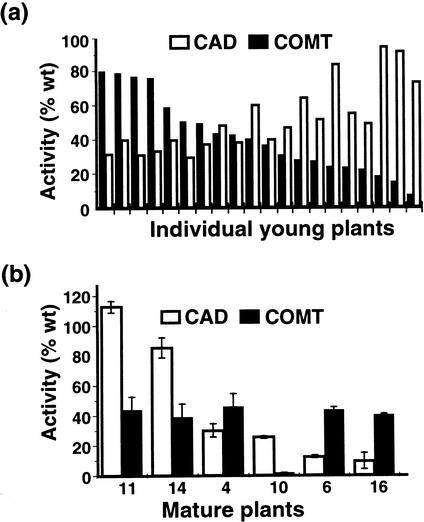
Figure 1
Figure 1
Target enzyme activity in progeny of the cross between COMT B10 and CAD J40. The activities of CAD and COMT were measured in wild-type plants to determine the normal mean activity (100%) for each enzyme (n = 20, young plants; n = 3, mature plants). CAD and COMT activities assayed in individual young (a) and mature (b) progeny of the cross were expressed as a percentage of this mean wild-type value. Results in a are shown with individual plants ranked from highest (left) to lowest (right) CAD activity. Assays on mature plants were performed on three clonal plants per line and error bars indicate the se between assays.
Figure 2
Figure 2
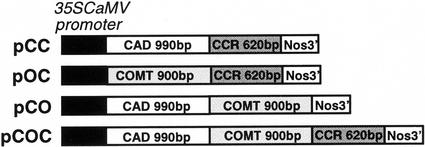
Chimeric constructs for suppressing multiple lignin biosynthetic genes. Constructs were prepared by fusing together partial sense sequences for CAD, COMT and CCR, expressing these from the 35S CaMV promoter. Nos 3′ indicates the nos terminator.
Figure 3
Figure 3
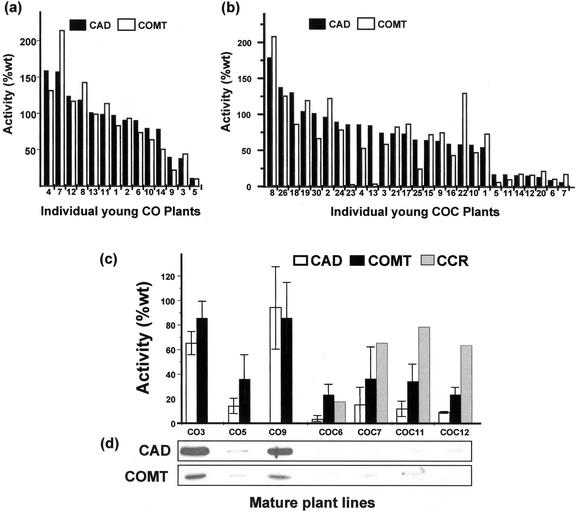
Target enzyme activity in plants transformed with CO or COC partial sense chimeric constructs. The activities of CAD and COMT were measured in wild-type plants to determine the normal mean activity (100%) for each enzyme (n = 10, young plants; n = 3, mature plants). CAD and COMT activities were assayed in individual young CO (a) or COC (b) plants. Selected plants were clonally propagated to yield small populations (“lines”) of genetically identical individuals. c, Clonal plant lines were grown to maturity and assayed for CAD, COMT, and CCR (as appropriate). Error bars in c indicate the se between assays on different clonal individuals of the same plant line. d, Enzyme assay data for CAD and COMT activity in mature plants were confirmed by western blotting.
Figure 4
Figure 4
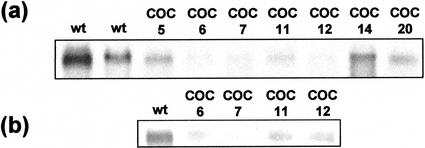
Northern blots of COC lines to monitor CCR expression. Total RNA from young (a) and mature (b) plants transformed with the CAD-COMT-CCR construct was subjected to northern blotting and hybridized to a CCR riboprobe. wt, Wild-type plant.
Figure 5
Figure 5
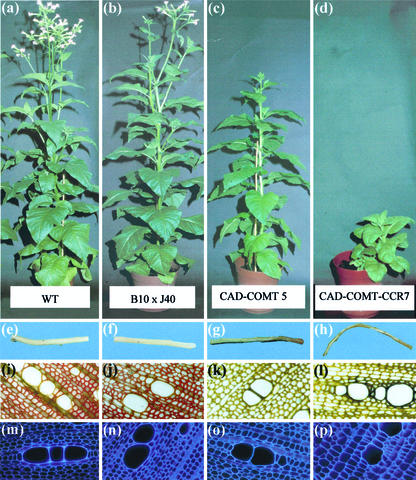
Phenotypes and histochemistry of transgenics. Relative heights of plants at maturity are shown in a through d. The color of woody stem sections (with bark and cortex removed) are shown in e through h. Results of Maüle staining (i–l) and UV autofluorescence (m–p) of thin-stem sections is shown. Wild-type plants are shown in column a through m, B10 × CAD J40 are shown in column b through n, CO5 plants are shown in column c through o, and COC7 plants are shown in column d through p.

References

    1. Atanassova R, Favet N, Martz F, Chabbert B, Tollier MT, Monties B, Fritig B, Legrand M. Altered lignin composition in transgenic tobacco expressing O-methyltransferase sequences in sense and antisense orientation. Plant J. 1995;8:465–477.
    1. Baucher M, Vailhe MAB, Chabbert B, Besle J-M, Opsomer C, Van Montagu M, Botterman J. Down-regulation of cinnamyl alcohol dehydrogenase in transgenic alfalfa (Medicago sativa L.) and the effect on lignin composition and digestibility. Plant Mol Biol. 1999;39:437–447. - PubMed
    1. Baucher M, Chabbert B, Pilate G, VanDoorsselaere J, Tollier MT, PetitConil M, Cornu D, Monties B, VanMontagu M, Inzé D et al. Red xylem and higher lignin extractability by down-regulating a cinnamyl alcohol dehydrogenase in poplar. Plant Physiol. 1996;112:1479–1490. - PMC - PubMed
    1. Chabannes M, Barakate A, Lapierre C, Marita JM, Ralph J, Pean M, Danoun S, Halpin C, Grima-Pettenati J, Boudet AM. Strong decrease in lignin content without significant alteration of plant development is induced by simultaneous down-regulation of cinnamoyl CoA reductase (CCR) and cinnamyl alcohol dehydrogenase (CAD) in tobacco plants. Plant J. 2001;28:257–270. - PubMed
    1. Chuang CF, Meyerowitz EM. Specific and heritable genetic interference by double-stranded RNA in Arabidopsis thaliana. Proc Natl Acad Sci USA. 2000;97:4985–4990. - PMC - PubMed

Publication types

MeSH terms