. 2002 Mar;128(3):1149-62.
doi: 10.1104/pp.010612.

Changes in the expression and the enzymic properties of the 20S proteasome in sugar-starved maize roots. evidence for an in vivo oxidation of the proteasome

Affiliations

Changes in the expression and the enzymic properties of the 20S proteasome in sugar-starved maize roots. evidence for an in vivo oxidation of the proteasome

Gilles Basset et al. Plant Physiol. 2002 Mar.

Abstract

The 20S proteasome (multicatalytic proteinase) was purified from maize (Zea mays L. cv DEA 1992) roots through a five-step procedure. After biochemical characterization, it was shown to be similar to most eukaryotic proteasomes. We investigated the involvement of the 20S proteasome in the response to carbon starvation in excised maize root tips. Using polyclonal antibodies, we showed that the amount of proteasome increased in 24-h-carbon-starved root tips compared with freshly excised tips, whereas the mRNA levels of alpha 3 and beta 6 subunits of 20S proteasome decreased. Moreover, in carbon-starved tissues, chymotrypsin-like and caseinolytic activities of the 20S proteasome were found to increase, whereas trypsin-like activities decreased. The measurement of specific activities and kinetic parameters of 20S proteasome purified from 24-h-starved root tips suggested that it was subjected to posttranslational modifications. Using dinitrophenylhydrazine, a carbonyl-specific reagent, we observed an increase in carbonyl residues in 20S proteasome purified from starved root tips. This means that 20S proteasome was oxidized during starvation treatment. Moreover, an in vitro mild oxidative treatment of 20S proteasome from non-starved material resulted in the activation of chymotrypsin-like, peptidyl-glutamyl-peptide hydrolase and caseinolytic-specific activities and in the inhibition of trypsin-like specific activities, similar to that observed for proteasome from starved root tips. Our results provide the first evidence, to our knowledge, for an in vivo carbonylation of the 20S proteasome. They suggest that sugar deprivation induces an oxidative stress, and that oxidized 20S proteasome could be associated to the degradation of oxidatively damaged proteins in carbon starvation situations.


Figures
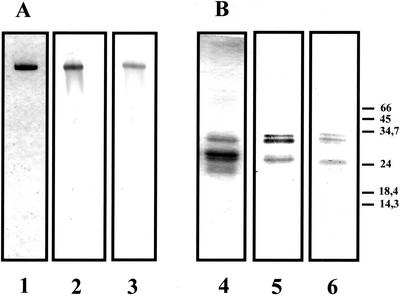
Figure 1
Figure 1
Native-PAGE (A) and SDS-PAGE (B) analysis of purified 20S proteasome preparation obtained from maize roots. The purified 20S proteasome was revealed by Coomassie Brillant Blue coloration after PAGE (6% [w/v] gel; lane 1) or SDS-PAGE (12.5% [w/v] gel; lane 4). Purified antibodies were used to immunodetect 20S proteasome in purified preparation (lanes 2 and 5) or in crude extracts of maize roots (lanes 3 and 6). Pure 20S proteasome (3 μg) was loaded in tracks 1, 2, 4, and 5 and 50 μg of total protein in tracks 3 and 6. The molecular masses of markers are indicated in kilodaltons.
Figure 2
Figure 2
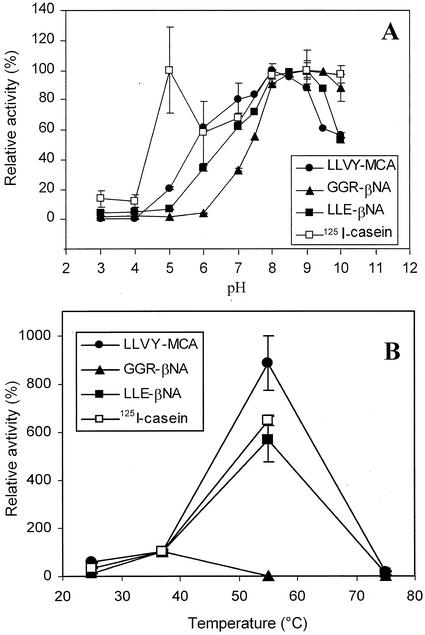
Determination of 20S proteasome optimal pH (A) and temperature effects (B). Chymotrypsin-like, trypsin-like, PGPH, and caseinolytic activities of purified 20S proteasome (1 μg) were measured in 70 μL of pH 3 to 10 tri-buffer mixture (50 mm acetic acid, 50 mm MES, and 100 mm Tris) for the determination of the pH effects (A) or in Tris-HCl buffer, pH 7.5, and 20 mm NaCl at 25°C, 37°C, 55°C, and 75°C for the determination of the temperature effects (caseinolytic activities were not measured at 75°C because of casein precipitation; B). Activities measured at 37°C were normalized to 100%. Values are means of three independent experiments.
Figure 3
Figure 3
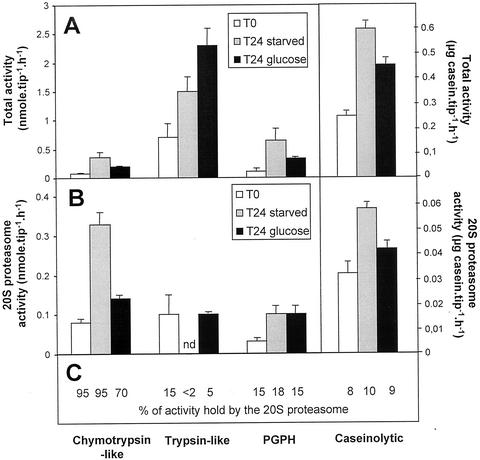
Total and 20S proteasome activities in starved and non-starved maize root tips. A, Chymotrypsin-like, trypsin-like, PGPH, and caseinolytic total activities were measured in desalted crude extracts of non starved (T0), 24-h Glc-starved (T24 starved), and 24-h Glc-fed (T24 + Glc) root tips. B, The 20S proteasome activities were determined after immunoprecipitation of desalted crude extracts with anti-20S proteasome antibodies. For each activity, the percentage of total activity because of the 20S proteasome is reported in C. n.d., Non-detected, because of the detection limit of the immunoprecipitation method. Values are means of six independent experiments.
Figure 4
Figure 4
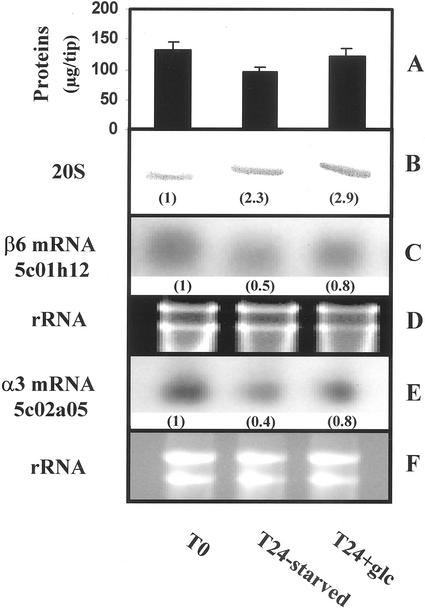
Western- and northern-blot analysis of the 20S proteasome in starved and non-starved maize root tips. A, Total protein content in T0, T24-starved, and T24 + Glc root tips. Values are means of three independent experiments. B, Protein extracts (1 root tip/track) were separated by PAGE, and the proteasome was immunodetected with anti-20S proteasome antibodies. Relative immunosignal intensities are indicated in brackets. C and E, Northern-blot analysis of two transcripts encoding for β6- and α3-subunits of the maize 20S proteasome (10 μg total RNA/track). D and F, rRNA were used as a loading control. Values are representative of four independent experiments.
Figure 5
Figure 5
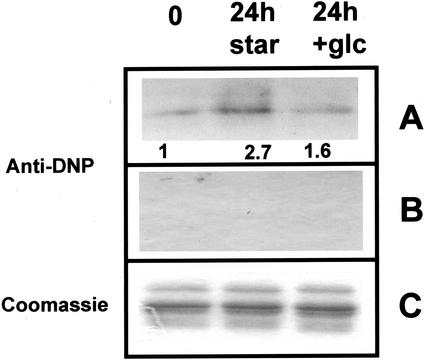
Immunodetection of carbonyl residues in 20S proteasomes from starved and non-starved maize root tips. Purified 20S (10 μg) proteasomes from T0, T24-starved, and T24 + Glc-fed root tips were incubated with (A) or without (B) DNPH and separated by 12.5% (w/v) SDS-PAGE. Carbonyl residues were then immunodected with anti-DNP antibodies as described in “Materials and Methods.” A, Relative immunosignal intensities are indicated. C, Coomassie Brillant Blue coloration of aliquot fractions of DNPH-treated proteasomes after SDS-PAGE (2 μg/track) was used as loading controls.
Figure 6
Figure 6
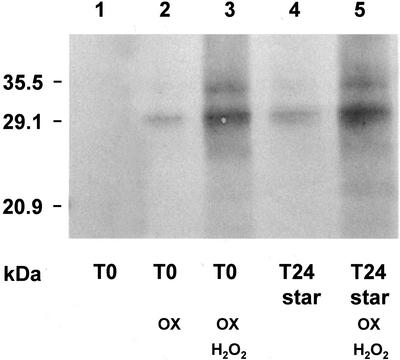
Immunodetection of carbonyl residues in 20S proteasomes from starved and non-starved maize root tips after oxidative treatment. Purified 20S proteasomes (2 μg) from T0 and T24-starved root tips were submitted to various oxidative treatments, incubated with DNPH, and separated by 12.5% (w/v) SDS-PAGE. Carbonyl residues were then immunodected with anti-DNP antibodies as described in “Materials and Methods.” Lanes 1 and 4, Nonoxidized 20S proteasomes from T0 and T24 starved root tips. Lane 2, 20S proteasome from T0 root tips treated for 2 h at 37°C with 50 mm ascorbate/200 μm FeSO4. Lanes 3 and 5, 20S proteasome from T0 and T24 starved root tips treated for 2 h at 37°C with 50 mm ascorbate/200 μm FeSO4/5 mm H2O2.

References

    1. Aubert S, Gout E, Bligny R, Marty-Mazars D, Barrieu F, Alabouvette J, Marty F, Douce R. Ultrastructural and biochemical characterization of autophagy in higher plant cells subjected to carbon deprivation: control by the supply of mitochondria with respiratory substrates. J Cell Biol. 1996;133:1251–1263. - PMC - PubMed
    1. Blackburn RV, Spitz DR, Liu X, Galoforo SS, Sim JE, Ridnour LA, Chen JC, Davis BH, Corry PM, Lee YJ. Metabolic oxidative stress activates signal transduction and gene expression during glucose deprivation in human tumor cells. Free Radic Biol Med. 1999;26:419–430. - PubMed
    1. Bose S, Mason GGF, Rivett AJ. Phosphorylation of proteasomes in mammalian cells. Mol Biol Rep. 1999;26:11–14. - PubMed
    1. Bradford MM. A rapid and sensitive method for the quantification of microgram quantities of proteins utilizing the principle of protein-dye binding. Anal Biochem. 1976;72:248–254. - PubMed
    1. Brouquisse R, Gaudillère JP, Raymond P. Induction of a carbon-starvation-related proteolysis in whole maize plants submitted to light/dark cycles and to extended darkness. Plant Physiol. 1998;117:1281–1291. - PMC - PubMed

Publication types

MeSH terms

LinkOut - more resources