


doi: 10.1073/pnas.042700599.
Epub 2002 Mar 12.
Covalent modification of proteins by cocaine
Affiliations
- PMID: 11891282
- PMCID: PMC122537
- DOI: 10.1073/pnas.042700599
Item in Clipboard
Covalent modification of proteins by cocaine
Proc Natl Acad Sci U S A.
.
Abstract
Cocaine covalently modifies proteins through a reaction in which the methyl ester of cocaine acylates the epsilon-amino group of lysine residues. This reaction is highly specific in vitro, because no other amino acid reacts with cocaine, and only cocaine's methyl ester reacts with the lysine side chain. Covalently modified proteins were present in the plasma of rats and human subjects chronically exposed to cocaine. Modified endogenous proteins are immunogenic, and specific antibodies were elicited in mouse and detected in the plasma of human subjects. Covalent modification of proteins could explain cocaine's autoimmune effects and provide a new biochemical approach to cocaine's long-term actions.
Figures
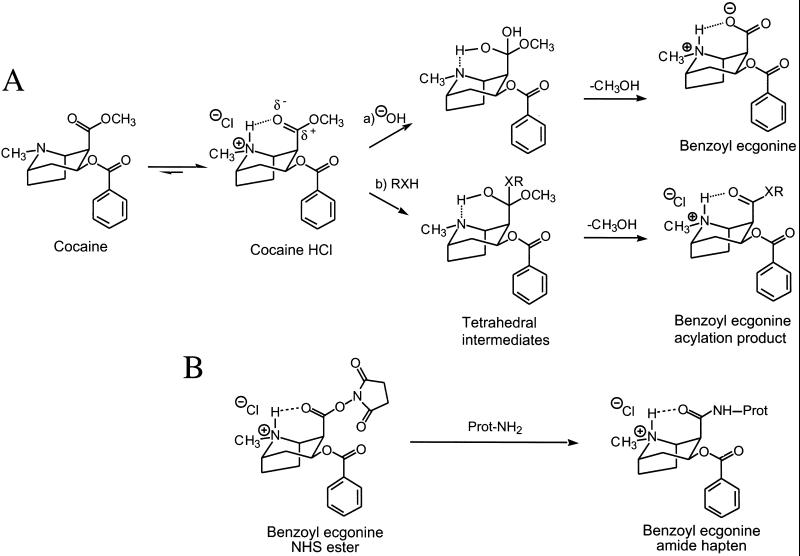
Intramolecular acid-catalyzed reactions of cocaine at pH 7.4. (A) alkaline hydrolysis to yield benzoyl ecgonine and nucleophile (RXH) transfer to yield benzoyl ecgonine acylation product. (B) Controlled synthesis of benzoyl ecgonine amide hapten:benzoyl ecgonine N-hydroxy succinimide (NHS) ester reacts with lysine ɛ-amino groups of protein to yield a benzoyl ecgonine amide hapten.
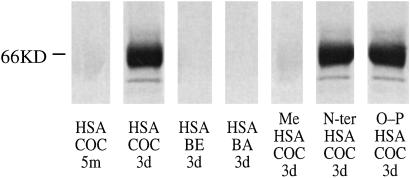
Incorporation of radiolabeled cocaine into HSA. SDS/PAGE and autoradiogram of (i) HSA exposed to 4′-[125I]iodococaine for 15 min (lane 1, COC 15m) or 3 days (lane 2, COC 3d), 4′-[125I]iodobenzoyl ecgonine for 3 days (lane 3, BE 3d), or 4-[125I]iodobenzoic acid for 3 days (lane 4, BA 3d) or (ii) 4′-[125I]iodococaine incubated for 3 days with HSA methylated with CH2O/NaBH4 (lane 5, Me HSA+COC3d) or N-terminally blocked with glyoxalic acid (lane 6, N-ter HSA COC 3d) or blocked at serine and tyrosine hydroxyl groups with diisopropyl fluorophosphate (lane 7, O-P HSA COC 3d). n = 3; illustrative results are shown.
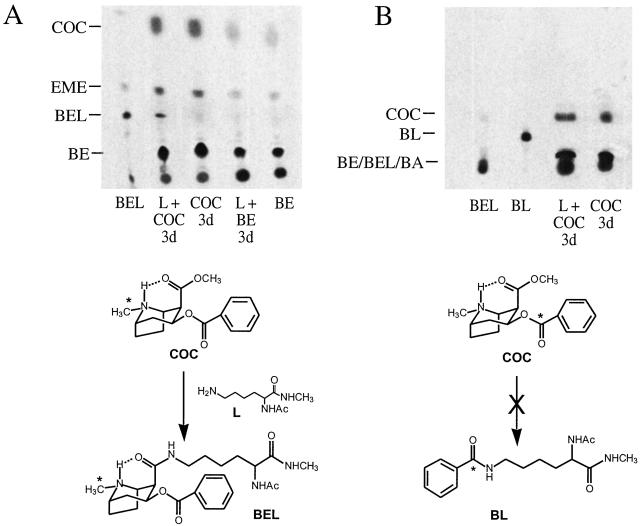
Acylation of lysine by the methyl ester of 14C-cocaine (COC). n = 4; illustrative results are shown. (A) Analytical TLC (silica gel) (CHCl3/CH3OH/NH4OH 15:1:0.05) and autoradiogram of lysine L and [N-methyl-14C]cocaine after 3 days (lane 2, COC+L 3d); authentic acylation product BEL (lane 1, BEL); [N-methyl-14C]cocaine alone after 3 days (lane 3, COC 3d); [N-methyl-14C]benzoyl ecgonine and lysine L after 3 days (lane 4, BE+L 3d); and hydrolysis product [N-methyl-14C]benzoyl ecgonine (lane 5, BE). (B) TLC (CHCl3/MeOH 50:1) and autoradiogram of lysine L and [benzoylcarbonyl-14C]cocaine incubated for 3 days (lane 3, COC+L 3d); authentic acylation product BL (lane 2, BL); authentic BEL (lane 1, BEL); and [benzoylcarbonyl-14C]cocaine after 3 days (lane 4, COC 3d). Authentic benzoyl ecgonine (not shown) and benzoic acid (BA, not shown) remain near the origin.
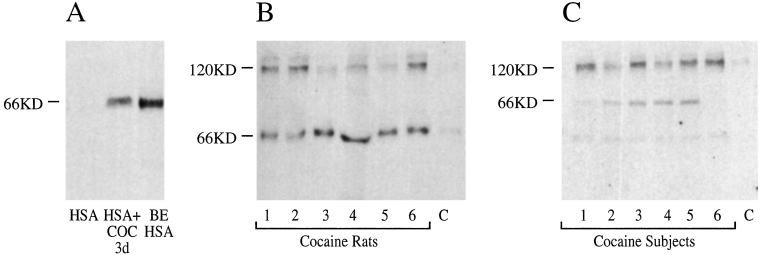
Incorporation of anti-benzoyl ecgonine immunoreactivity into proteins. SDS/PAGE chromatography and Western blot with mAb 46H1 of samples are shown. n = 3; illustrative results are shown. (A) HSA (lane 1); HSA incubated with cocaine and immunoprecipitated with mAb 46H1 (lane 2, HSA+COC); and HSA acylated as per Fig. 1C with N-hydroxyphthalimide-activated benzoyl ecgonine (lane 3, BE HSA). (B) Plasma from rats exposed to cocaine twice daily for 7 days (lanes 1–6) and plasma from an unexposed control (lane 7) immunoprecipitated with mAb 46H1. (C) Plasma from human cocaine users (lanes 1–6) and an unexposed control subject (lane 7) immunoprecipitated with mAb 46H1. Each lane represents material from an individual.
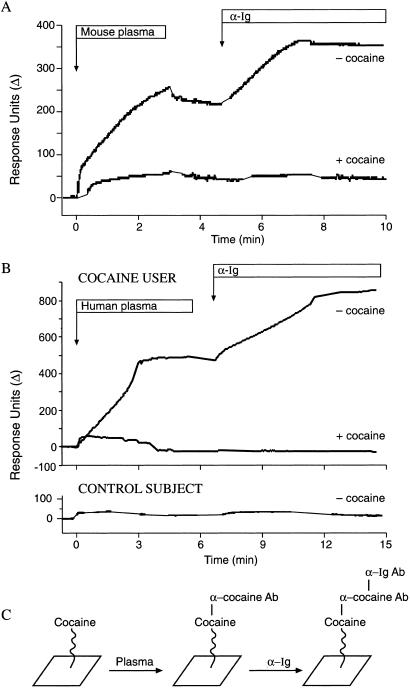
Detection of anti-cocaine antibodies by Biacore. Continuous flow of plasma assayed against cocaine immobilized on a tether followed by a continuous flow of species-specific goat anti-Ig antibody (α-Ig) is shown. (A) Plasma from a mouse subjected to in situ haptenization with benzoyl ecgonine N-hydroxysuccinimide ester. n = 3; illustrative results are shown. A binding signal with plasma is observed, and enhancement of the signal after the addition of goat α-Ig confirms the presence of murine anti-cocaine antibodies. (B) Plasma from a human cocaine user (Upper) and a control subject (Lower). The signal is observed only from the cocaine user, and enhancement after the addition of goat α-Ig confirms the presence of human anti-cocaine antibodies. Pretreatment of plasma with 100 μM free cocaine (+cocaine) inhibits binding to the tethered cocaine, confirming the anti-cocaine specificity of the antibodies detected in plasma. (C) Schematic of putative binding events. Cocaine tethered to the gold surface is bound by anti-cocaine antibodies (α cocaine Ab) from experimental plasma, which in turn are bound by anti-Ig antibodies (α-Ig Ab).
References
-
- Chow M J, Ambre J J, Ruo T I, Atkinson A J, Bowsher D J, Fisherman M W. Clin Pharmacol Ther. 1985;38:318–324. - PubMed
-
- Isenschmid D S, Fischman M W, Foltin R W, Caplan Y H. J Anal Toxicol. 1992;16:311–314. - PubMed
-
- Volkow N D, Hitzemann R, Wang G J, Fowler J S, Wolf A P, Dewey S L, Handlesman L. Synapse. 1992;11:184–190. - PubMed
-
- Volkow N D, Wang G J, Fowler J S, Logan J, Gatley S J, Hitzemann R, Chen A D, Dewey S L, Pappas N. Nature (London) 1997;386:830–833. - PubMed
-
- Karoum F, Suddath R I, Wyatt R J. Eur J Pharmacol. 1990;186:1–8. - PubMed
Publication types
MeSH terms
Substances
LinkOut - more resources
Full Text Sources
Other Literature Sources
