. 2002 Apr;70(4):1924-35.
doi: 10.1128/IAI.70.4.1924-1935.2002.

Role of various enterotoxins in Aeromonas hydrophila-induced gastroenteritis: generation of enterotoxin gene-deficient mutants and evaluation of their enterotoxic activity

Affiliations

Role of various enterotoxins in Aeromonas hydrophila-induced gastroenteritis: generation of enterotoxin gene-deficient mutants and evaluation of their enterotoxic activity

Jian Sha et al. Infect Immun. 2002 Apr.

Abstract

Three enterotoxins from the Aeromonas hydrophila diarrheal isolate SSU have been molecularly characterized in our laboratory. One of these enterotoxins is cytotoxic in nature, whereas the other two are cytotonic enterotoxins, one of them heat labile and the other heat stable. Earlier, by developing an isogenic mutant, we demonstrated the role of a cytotoxic enterotoxin in causing systemic infection in mice. In the present study, we evaluated the role of these three enterotoxins in evoking diarrhea in a murine model by developing various combinations of enterotoxin gene-deficient mutants by marker-exchange mutagenesis. A total of six isogenic mutants were prepared in a cytotoxic enterotoxin gene (act)-positive or -negative background strain of A. hydrophila. We developed two single knockouts with truncation in either the heat-labile (alt) or the heat-stable (ast) cytotonic enterotoxin gene; three double knockouts with truncations of genes encoding (i) alt and ast, (ii) act and alt, and (iii) act and ast genes; and a triple-knockout mutant with truncation in all three genes, act, alt, and ast. The identity of these isogenic mutants developed by double-crossover homologous recombination was confirmed by Southern blot analysis. Northern and Western blot analyses revealed that the expression of different enterotoxin genes in the mutants was correspondingly abrogated. We tested the biological activity of these mutants in a diet-restricted and antibiotic-treated mouse model with a ligated ileal loop assay. Our data indicated that all of these mutants had significantly reduced capacity to evoke fluid secretion compared to that of wild-type A. hydrophila; the triple-knockout mutant failed to induce any detectable level of fluid secretion. The biological activity of selected A. hydrophila mutants was restored after complementation. Taken together, we have established a role for three enterotoxins in A. hydrophila-induced gastroenteritis in a mouse model with the greatest contribution from the cytotoxic enterotoxin Act, followed by the Alt and Ast cytotonic enterotoxins.


Figures
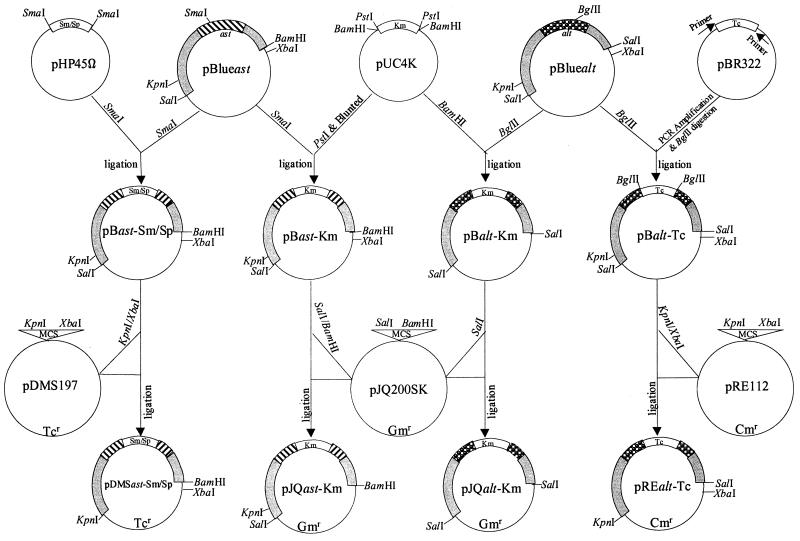
FIG. 1.
FIG. 1.
Flow diagram showing the construction of various recombinant plasmids for the preparation of enterotoxin gene-deficient mutants of A. hydrophila SSU. The recombinant plasmid pBlue ast contained a 4.6-kb SalI/BamHI DNA fragment from the chromosome of A. hydrophila which harbored the ast gene. The ast gene was truncated at the SmaI restriction site by introducing either a Km gene cassette from plasmid pUC4K or a Sm-Sp gene cassette from plasmid pHP45Ω to generate recombinant plasmid pB ast-Km or pB ast-Sm/Sp, respectively. The truncated ast gene with its flanking sequences was cloned into suicide vector pJQ200SK or pDMS197, forming recombinant plasmid pJQ ast-Km or pDMS ast-Sm/Sp, respectively, for the generation of ast gene-deficient mutants of A. hydrophila. The recombinant plasmid pBlue alt contained a 4.0-kb DNA fragment from the chromosome of A. hydrophila which harbored the alt gene. The alt locus was truncated at the BglII restriction site by introducing either a Km gene cassette from plasmid pUC4K or a Tc gene cassette from plasmid pBR322 to generate recombinant plasmid pB alt-Km or pB alt-Tc, respectively. The truncated alt locus with its flanking sequences was cloned into suicide vector pJQ200SK or pRE112, forming recombinant plasmid pJQ alt-Km or pRE alt-Tc, respectively, for the generation of alt gene-deficient mutants of A. hydrophila. The striped bar represents the ast gene, while the dotted bar represents the alt gene. The gray bar represents sequences flanking the ast or alt gene. The open bar indicates the Km, Sm-Sp, or Tc gene cassette. These plasmids are not drawn to scale. MCS, multiple cloning sites. The primers used to amplify the Tc gene cassette had a BglII restriction site (Table 2).
FIG. 2.
FIG. 2.
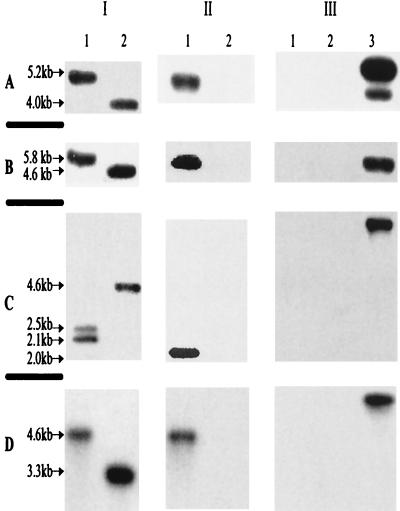
Confirmation of the identity of the enterotoxin gene-deficient mutants of A. hydrophila SSU based on Southern blot analysis. (A) Chromosomal DNA from SSUΔalt mutant (lanes 1) and wild-type A. hydrophila (lanes 2) was digested with SalI restriction enzyme. Suicide vector pJQ200SK digested with restriction enzyme XbaI was used in lane 3. (B) Chromosomal DNA from the SSUΔast mutant (lanes 1) and wild-type A. hydrophila (lanes 2) was digested with SalI/BamHI restriction enzyme. Suicide vector pJQ200SK digested with restriction enzyme XbaI was used in lane 3. (C) Chromosomal DNA from the SSUΔalt,ast or SSUΔact,ast mutant (lanes 1) and wild-type A. hydrophila (lanes 2) was digested with SalI/BamHI restriction enzyme. Suicide vector pDMS197 digested with restriction enzyme XbaI was used in lane 3. (D) Chromosomal DNA from the SSUΔact,alt or SSUΔact,alt,ast mutant (lanes 1) and wild-type A. hydrophila (lanes 2) was digested with KpnI/XbaI restriction enzyme. Suicide vector pRE112 digested with restriction enzyme XbaI was used in lane 3. Different enterotoxin genes (alt [A-I and D-I] and ast [B-I and C-I]), different antibiotic gene cassettes (Km cassette [A-II and B-II], Sm-Sp cassette [C-II], and Tc cassette [D-II]), and different suicide vectors (pJQ200SK [A-III and B-III], pDMS197 [C-III], and pRE112 [D-III]) were used as probes. In panel A, lane 3, the two bands were due to incomplete digestion of the vector pJQ200SK.
FIG. 3.
FIG. 3.
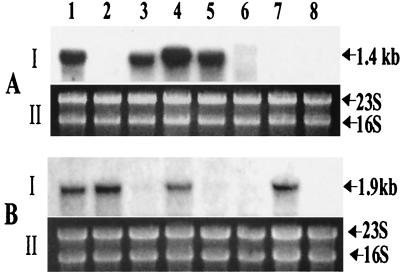
The transcripts for the enterotoxin genes act and alt were eliminated in the indicated mutants, based on Northern blot analysis. Total RNA from wild-type A. hydrophila and its enterotoxin gene-deficient mutants was isolated and hybridized with the act gene probe (A-I) and the alt gene probe (B-I), as described in Materials and Methods. Lane 1, wild-type A. hydrophila; lane 2, mutant SSUΔact; lane 3, mutant SSUΔalt; lane 4, mutant SSUΔast; lane 5, mutant SSUΔalt,ast; lane 6, mutant SSUΔact,alt; lane 7, mutant SSUΔact,ast; lane 8, mutant SSUΔact,alt,ast. The RNA loaded in each lane was quantitated by scanning 16S and 23S rRNA bands after ethidium bromide staining of the gel (A-II and B-II).
FIG. 4.
FIG. 4.
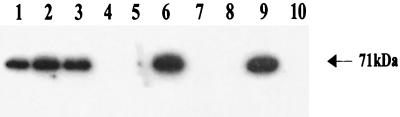
Western blot analysis showing that the ast gene expression was eliminated in its corresponding gene-deficient mutant of A. hydrophila. The cell lysates from different enterotoxin-deficient mutants of A. hydrophila were subjected to SDS-12% PAGE, and subsequently the proteins were transferred to a nitrocellulose membrane for Western blot analysis as described in Materials and Methods. Lane 1, wild-type A. hydrophila; lane 2, SSUΔact; lane 3, SSUΔalt; lane 4, SSUΔast; lane 5, SSUΔalt,ast; lane 6, SSUΔact,alt; lane 7, SSUΔact,ast; lane 8, SSUΔact,alt,ast; lane 9, purified Ast (0.1 μg) as a positive control; lane 10, cell lysate from E. coli as a negative control.

References

    1. Abbott, S. L., S. Seli, M. Catino, Jr., M. A. Hartley, and J. M. Janda. 1998. Misidentification of unusual Aeromonas species as members of the genus Vibrio: a continuing problem. J. Clin. Microbiol. 36:1103-1104. - PMC - PubMed
    1. Alavandi, S. V., M. S. Subashini, and S. Ananthan. 1999. Occurrence of haemolytic and cytotoxic Aeromonas species in domestic water supplies in Chennai. Indian J. Med. Res. 110:50-55. - PubMed
    1. Albert, M. J., M. Ansaruzzaman, K. Talukdar, A. K. Chopra, I. Kuhn, M. Rahman, A. S. G. Faruque, M. S. Islam, R. B. Sack, and R. Mollby. 2000. Prevalence of enterotoxin genes in Aeromonas spp. isolated from children with diarrhea, healthy controls, and the environment. J. Clin. Microbiol. 38:3785-3790. - PMC - PubMed
    1. Altwegg, M., L. G. Martinetti, J. Luthy-Hottenstein, and M. Rohrbach. 1991. Aeromonas-associated gastroenteritis after consumption of contaminated shrimp. Eur. J. Clin. Microbiol. Infect. Dis. 10:44-45. - PubMed
    1. Annapurna, E., and S. C. Sanyal. 1977. Enterotoxicity of Aeromonas hydrophila. J. Med. Microbiol. 10:317-323. - PubMed

Publication types